
IBM Files Patent to Help AI Turn Vague Requests Into Working Regulatory Instructions
Ask an AI to write code for your company's systems and it has to guess at tools it has never seen. IBM's filing adds a step that hands the AI a menu of your real tools before it writes a line.
What IBM's two-prompt code writer actually does
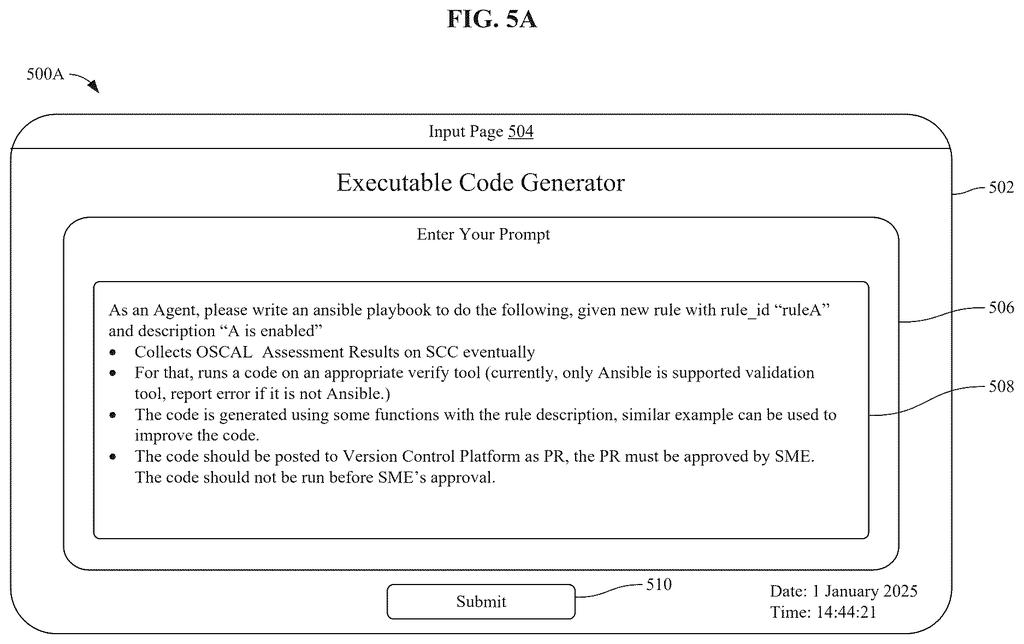
Imagine you work in compliance at a big company and you type a long, messy request into an AI tool: write a script that checks a new security rule, send it to a reviewer, and do not run it until a human signs off. The AI has never seen your company's internal tools, so it may guess at how to do each step.
IBM's patent application adds a step before the AI writes anything. The system splits your request into its separate jobs, such as checking which tool to use, posting the code for review, and confirming approval. It then looks up matching entries in your company's own library, each with a short plain-text description, and builds a fuller second prompt.
Only then does the code-writing AI get to work, and the system can run some or all of what it produces. In the filing's example, the richer prompt scored 0.95 on accuracy versus 0.91 for the original request.
… generating, by the computer, a second prompt comprising the first prompt, the set of method signatures, and the set of method descriptions, wherein an accuracy score of the second prompt is greater than an accuracy score of the first prompt …
Translation: The system builds an improved prompt that performs better than the original user request.
How IBM turns a request into function lists
The input is a first prompt: a request in everyday language about a work problem in one field, such as compliance. Inside it are what the claims call action specifications, meaning the high-level steps the user wants done.
The system then does four things:
- Fetches method data from a knowledge base (a stored library of code plus background material like past audit results and regulations).
- Converts each step into a method signature (a function's name plus what it takes in and hands back).
- Pulls a plain-text method description for each signature.
- Builds a second prompt that holds the original request, the signatures and the descriptions.
Claim 1 requires the second prompt to have a higher accuracy score than the first. The description measures this by generating many sample outputs and comparing them with ideal ones using precision, recall and a combined F1 score (measures of how many results are right and how many are missed). A code language model (a large AI model that writes code) then runs on the second prompt, and the system controls execution of at least some of the instructions it produces.
Later claims add a loop: results and feedback from running the code are used to rewrite the second prompt and generate a revised set. The worked example is an Ansible playbook (a script format for automating IT tasks) with five steps.
A set of action specifications is converted into a set of method signatures. A set of method descriptions associated with the set of method signatures is retrieved.
Translation: Vague operational goals are translated into precise technical instructions using a knowledge base.
Why IBM's compliance-code idea matters at work
If you have ever asked a chatbot for code and received something that looks right but calls tools that do not exist, this is the problem IBM is aiming at. By handing the model a menu of your organization's real functions, with descriptions, before it writes, the system tries to produce code that fits your environment. The filing says the payoff is fewer errors and less manual review.
The main example is compliance work, where a script must follow rules such as waiting for a human expert's approval before it runs. The same approach could apply to other business workflows, like the order-processing example in the filing, though the patent ties the idea to no named IBM product.
This is the 16th IBM filing we've tracked since July on our AI agents acting for you, following earlier applications like a virtual shopping bank advisor and building a model by typing.
Claim 1 covers a specific sequence: receive a request, pull relevant function descriptions from a stored library, bundle them into a richer prompt, run a code-writing AI on that prompt, and produce runnable instructions. The claim names no particular industry, programming language, or subject matter, so it reaches any software system that follows those steps, whether the task involves payroll, security alerts, or logistics.
That breadth has real consequences. Any company building an AI tool that enriches a user's request with pre-labeled function descriptions before generating executable code would fall inside this boundary.
The claim does carry one vulnerable point. It requires the enriched prompt to score higher on accuracy than the original, but never defines how accuracy is measured, and the filing treats one measurement approach as optional rather than required. That gap is the most likely place a challenger would push.
Get our take in your Top Stories
Liked this breakdown? Add Patentlyze as a preferred source on Google, and our plain-English take shows up more often in your Top Stories the next time IBM patent news breaks.
There are more where this came from
We read every patent application Big Tech publishes and send you the ones worth knowing. Plain English, free, every week.
The drawings
9 drawing sheets from US 2026/0339624 A1 · click any drawing to enlarge


Show the other 1 sheets

Want this weekly breakdown for a company we don't cover? Patentlyze Pro →
Be the first to weigh in