
Qualcomm Files Patent for Glasses That Remember What You Saw Today
Qualcomm has filed a patent for an AI assistant on smart glasses that keeps a short, selective memory of your day, so you can ask about things you saw hours ago. The twist is that the memory stays on your own gear instead of going to the cloud.
What Qualcomm's glasses memory idea actually does
Imagine you're standing in a grocery store and can't remember whether you're out of milk. With the glasses in this patent, you could just ask, and the assistant would answer based on the last time your glasses looked inside your fridge at home.
The trouble is that glasses have very little storage, so they can't record everything. Qualcomm's filing describes a way to keep only the moments that matter to you, such as places you visit often, people you know, or things you keep looking at, and let the rest fade.
Those saved moments are held on the glasses or on your phone, not on a remote server. When you ask a question, the assistant searches only those saved moments and answers in your ear or on the lens.
… encode, with a multimodal language model, the sensor data into a plurality of language representation embeddings; cache a selected set of language representation embeddings of the plurality of language representation embeddings for an interval of time based on one or more context parameters associated with a profile of a user …
Translation: The glasses use AI to turn what you see into stored digital memories customized for you.
How the glasses turn sights and sounds into notes
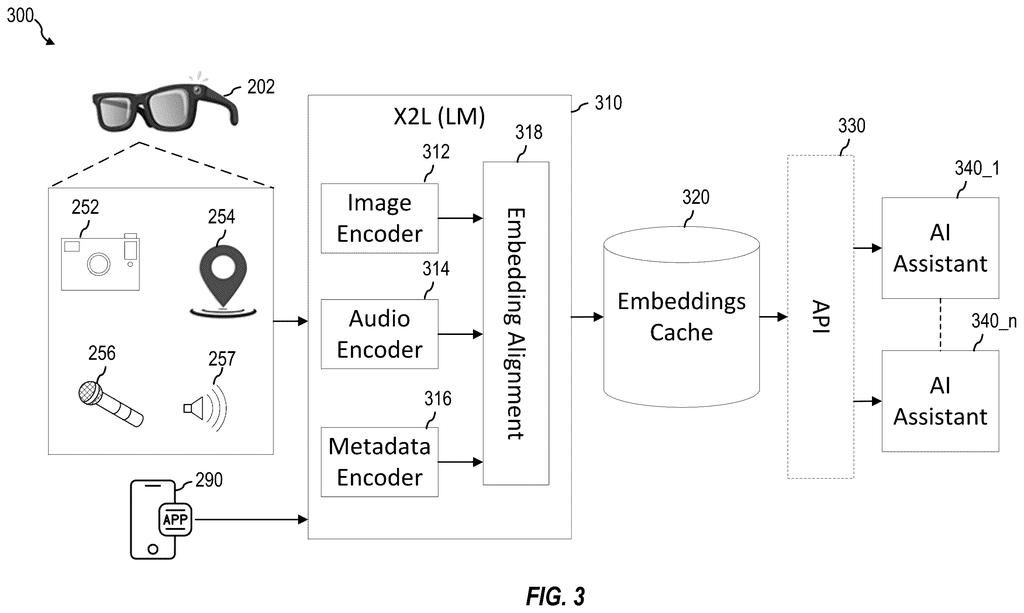
The system starts by collecting sensor data from the glasses: camera images, microphone audio, GPS location and time. A multimodal language model (an AI that can handle more than one kind of input, like pictures and sound) turns each piece into language representation embeddings, which are lists of numbers that capture what something means so a computer can search it.
The embeddings from the different sensors are lined up in one shared space and tagged with details like a timestamp and location. That is what lets the assistant filter by time when you ask something like "what did I have for lunch yesterday?"
The memory-saving step is what claim 1 is built around. A language model is prompted to pick out which embeddings match context parameters tied to your profile, such as:
- Places you go and objects you care about
- People's faces or voices
- Your app and past question history
Only those embeddings are cached for a period of time, and newer ones can replace older ones, such as today's milk level replacing last week's. When you ask a question, the assistant pulls the matching embeddings from the cache and builds its answer from them. The filing also says this can include things from a different place than where you're standing now.
Why a private memory on your glasses matters
If your glasses could answer "where did I park?" or "what was that car brand I saw earlier?", they would feel much more useful than today's assistants, which mostly handle news and weather. The privacy angle matters too: keeping the memory on your glasses or phone avoids sending a record of your home and conversations to a company server.
The application is early. The examiner's first review rejected the claims as filed, which is routine and usually followed by amendments. Even so, Qualcomm's interest in on-device AI for wearables fits what this document describes: a design made for small devices with little memory and power.
This is the 24th Qualcomm filing we've tracked since July in our on-device AI privacy watchlist, building on two earlier face-hiding applications: one where you hold the key and one where you have the key.
Claim 1 is broad. It covers any device that gathers sensor data, turns it into embeddings with a multimodal model, saves a chosen subset based on a user's profile for a set time, and answers questions from that subset. It says nothing specific about glasses. Only a later claim narrows it to a wearable, and another to a camera and microphone.
That breadth is the point. If granted as written, it could reach any assistant that keeps a filtered, short-term memory of what its sensors picked up, whether it sits on glasses, a phone or something else.
The idea itself is sensible, since nobody wants a device that records everything forever. But how much of the claim survives the examiner's rejection will decide whether this stays a good concept or becomes a real hurdle for others.
Get our take in your Top Stories
Liked this breakdown? Add Patentlyze as a preferred source on Google, and our plain-English take shows up more often in your Top Stories the next time Qualcomm patent news breaks.
There are more where this came from
We read every patent application Big Tech publishes and send you the ones worth knowing. Plain English, free, every week.
The drawings
5 drawing sheets from US 2026/0340277 A1 · click any drawing to enlarge


Want this weekly breakdown for a company we don't cover? Patentlyze Pro →
Be the first to weigh in