
Samsung Files Patent for Smart Glasses That Tuck Their Camera Away When Folded
Samsung's smart glasses camera would slide out of the frame as you unfold the arms and slip back inside as you fold them. The hinge does the pushing, with no motor involved.
What Samsung's hinge-driven glasses camera does
Ever tossed your glasses in a bag and found a scratch on the lens later? Now consider the same bag ride for a camera that sticks out of the front of your smart glasses. Samsung's new patent filing goes after exactly that worry.
The camera would live inside the frame while the glasses are folded. When you open the arms to put them on, the hinge nudges the camera forward so the lens pokes out with a wide view. Fold the arms and it slides back in. The movement comes straight from the hinge, with no motor.
A small magnet and sensor tell the glasses whether the arms are open or closed, so the camera powers on when you wear them and shuts off when they're folded. The filing also describes a little cover that slides over the lens while it's tucked away.
… a camera module disposed to be at least partially movable within the rim or the hinge structure, wherein the camera module comprises a camera, and a camera bracket including a space for accommodating the camera and a pole connected to the hinge structure …
Translation: The glasses hide a moving camera bracket and pole inside the frame or hinge.
How the peg and curved groove move the lens
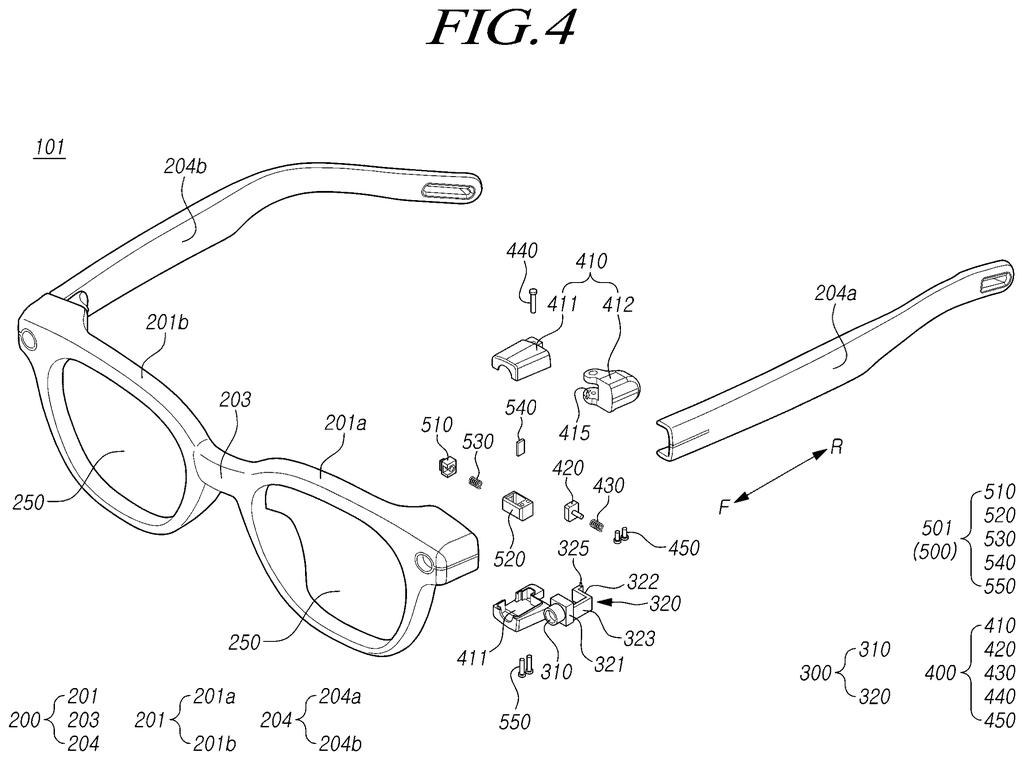
The filing describes smart glasses with the camera sitting in a movable holder (a "camera bracket") near the hinge, the joint that connects each arm (the temple) to the front frame (the rim). The holder has a small peg, called a pole, that rides in a curved groove, called a guide slot, cut into the hinge.
When you swing an arm open, the peg travels along the groove, and the groove pulls the holder forward so the lens pokes through an opening in the front of the frame. The groove's center sits off the hinge pivot, and its curve changes along its length, so the peg ends up farther from the pivot when the arm is open than when it is folded. That changing distance is what makes the camera slide forward or back.
- Folded (about 0 degrees): the camera is inside the rim and powered off.
- Unfolded (about 90 degrees): the lens is exposed and the camera is powered and ready to shoot.
- In between: the camera keeps whatever state it was already in.
Power control uses a magnet and a Hall sensor (a tiny part that measures magnetic strength). As the camera moves, the gap between them changes. A reading under 20 percent of full strength counts as weak (camera off), and 80 percent or more counts as strong (camera on).
The filing also covers a hook that lets you swap the arms, plus a sliding cover on a linkage that uncovers the lens as it moves out.
When the temple rotates with respect to the rim, the pole of the camera bracket may move along the guide slot, and the camera received in the camera bracket may be configured to move toward the front side or a rear side.
Translation: Folding the glasses arm slides the camera back and forth automatically.
Why a tuck-away lens matters for smart glasses
If you wear a camera on your face, you probably want two things: a lens that survives your pockets and bags, and some proof the camera is off when you say it is. This design offers both through one simple motion, folding the glasses. A lens hidden inside the frame is harder to scratch, and a camera that cuts its own power when folded is easier to trust.
For Samsung, it shows how the company is thinking about the physical side of camera glasses, which usually gets less attention than the software. The filing calls out a wide viewing angle as a reason to let the lens stick out while you wear the glasses. Whether this ever reaches a shipping pair is unknown, but it points to a camera built into the hinge rather than bolted on.
That makes this Samsung's 80th filing we've tracked in our AR glasses race watchlist since May, adding to work like fixing drifting passthrough video and matching camera view to gaze.
Every moving part in a pair of glasses is a part that can wear out, jam, or collect lint. Glasses get folded and unfolded thousands of times, and this design asks the hinge to double as a camera mechanism, with a sliding holder, a curved groove, a magnet, and a cover all packed into a space barely wider than your thumb. That is a lot to ask of a joint.
The protection also has a gap. The lens is shielded only while the glasses are folded, which is when they are usually in a case or pocket anyway. While you wear them, the lens sticks out into the world, which is when bumps and dust are most likely.
Still, the trade looks reasonable. Tying power to the arm position is cheap, easy to understand, and gives wearers a clear off switch. If the hinge holds up, this is a sensible way to protect a camera that has to face the world.
Get our take in your Top Stories
Liked this breakdown? Add Patentlyze as a preferred source on Google, and our plain-English take shows up more often in your Top Stories the next time Samsung patent news breaks.
There are more where this came from
We read every patent application Big Tech publishes and send you the ones worth knowing. Plain English, free, every week.
The drawings
27 drawing sheets from US 2026/0339108 A1 · click any drawing to enlarge


Show the other 19 sheets


Want this weekly breakdown for a company we don't cover? Patentlyze Pro →
Be the first to weigh in