
Samsung Files Patent to Make Your PIN Pad Look Like a Cat to Snoopers
Samsung has filed a patent application for a phone screen that shows you your PIN pad but shows anyone farther away a blurry cat. You choose how far away "farther" starts.
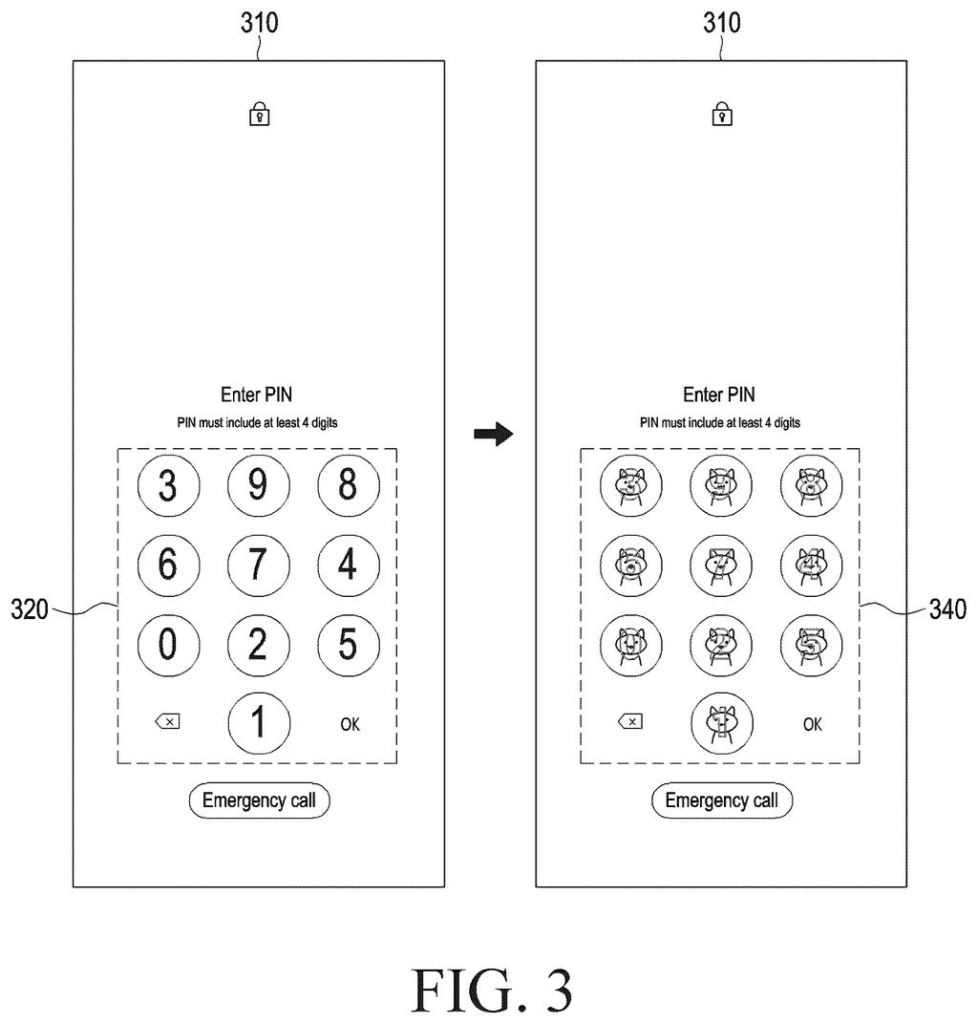
What Samsung's cat-camouflage PIN screen does
You're standing in a crowded spot, tapping in your banking PIN, and the stranger next to you is clearly reading over your shoulder. Normally your only defense is to hunch over your phone and hope.
Samsung's patent application takes a different route. The phone swaps the number keys for a hybrid picture: the digits blended with an unrelated image, such as a cat. Up close, your eyes pick out the sharp digits. From farther away, those fine details fade, and the viewer sees only a blurry cat.
You pick the "security distance," for example 70 or 80 centimeters (about 28 to 31 inches), and the phone adjusts the blend to match. The filing also describes a settings app with a preview window and a distance control. It can switch the effect on automatically for apps you choose, like banking or messaging.
… identify a first security distance at which the first information is not discernible by person's eyes when the person views the display; …
Translation: The device figures out how far away a nosy person has to be to stop them from seeing your private information.
How the screen blends a number with a cat
The phone starts with the screen it was going to show, say a PIN pad, and a security distance that you set or the phone picks. It then makes two ingredients. The digits go through a high-pass filter (a setting that keeps only fine detail, like sharp edges), which reshapes the thickness of each digit's outline. A stored, unrelated picture, such as a cat, goes through a low-pass filter (the opposite, which blurs everything).
The two layers are added or subtracted to make a hybrid image. Fine detail dominates up close, so you read the digits. From a distance only the blurry picture survives.
To choose how strong each filter should be, the phone computes a score:
- It measures how close the final image is to each layer, weighted by a contrast sensitivity function (a curve for how well eyes pick up detail at each distance).
- The ratio of those two measurements is the "first value." The filing's examples: about 0.53 for 70 cm, 0.58 for 80, 0.65 for 90 and 0.72 for 100.
- The phone searches for filter strengths that hit that value.
A second step corrects for how alike the digit layer and the picture layer look. In one example, a similarity of 0.35 trims a 90 cm estimate by 10 cm. The curve can also be tuned for age, eyesight, eye health and colors.
… obtain a fourth image in which the first information is not discernible by the eyes at a distance greater than or equal to the first security distance from the display, using the second image and the third image; …
Translation: It blends two different pictures together so snoopers from afar see a decoy instead of your actual PIN code.
Why Samsung's peek-proof PIN screen matters
Looking over someone's shoulder is a low-tech way to steal a PIN or read a private message, and it can happen anywhere you use your phone in public. This patent aims to fix it in software. You would not need a special film on the screen, and the protection would be tied to a distance you pick rather than a viewing angle.
The patent office has approved this application, and once Samsung pays the final fee it should be issued as a granted patent. The filing does not tie the idea to a named product. It does describe a settings app and an automatic mode for apps like banking and messaging, so it reads as a possible phone feature.
Samsung's 1577th filing in our Samsung coverage since May follows work like the robot gripping modes patent and the lensless health sensor.
Shoulder surfing is a small crime with an enormous victim pool. Nearly everyone types a password or reads a private message in public, and the only common defense is hunching over a screen and hoping for the best.
The approach matches that modest, everyday scale. It targets the casual glance from someone a few feet away, not a determined spy with a camera, and it lets users set how far away a stranger needs to be before the screen becomes readable again. Accounting for age and eyesight shows real care for how differently people actually see.
The honest caveat is that the distances come from a mathematical model of human vision, not from watching real strangers try to snoop. That gap between theory and a crowded subway car is worth closing before anyone leans on this too heavily.
Get our take in your Top Stories
Liked this breakdown? Add Patentlyze as a preferred source on Google, and our plain-English take shows up more often in your Top Stories the next time Samsung patent news breaks.
There are more where this came from
We read every patent application Big Tech publishes and send you the ones worth knowing. Plain English, free, every week.
The drawings
14 drawing sheets from US 2026/0340206 A1 · click any drawing to enlarge


Show the other 6 sheets


Want this weekly breakdown for a company we don't cover? Patentlyze Pro →
Be the first to weigh in