
A New Tesla Patent Gives Robot Fingers Cables That Work Like Tendons
Tesla's latest robot-hand filing skips the usual trick of wrapping cables around finger joints. Instead, one cable runs along the finger, and its thickened end floats loose inside the fingertip until a pull catches it.
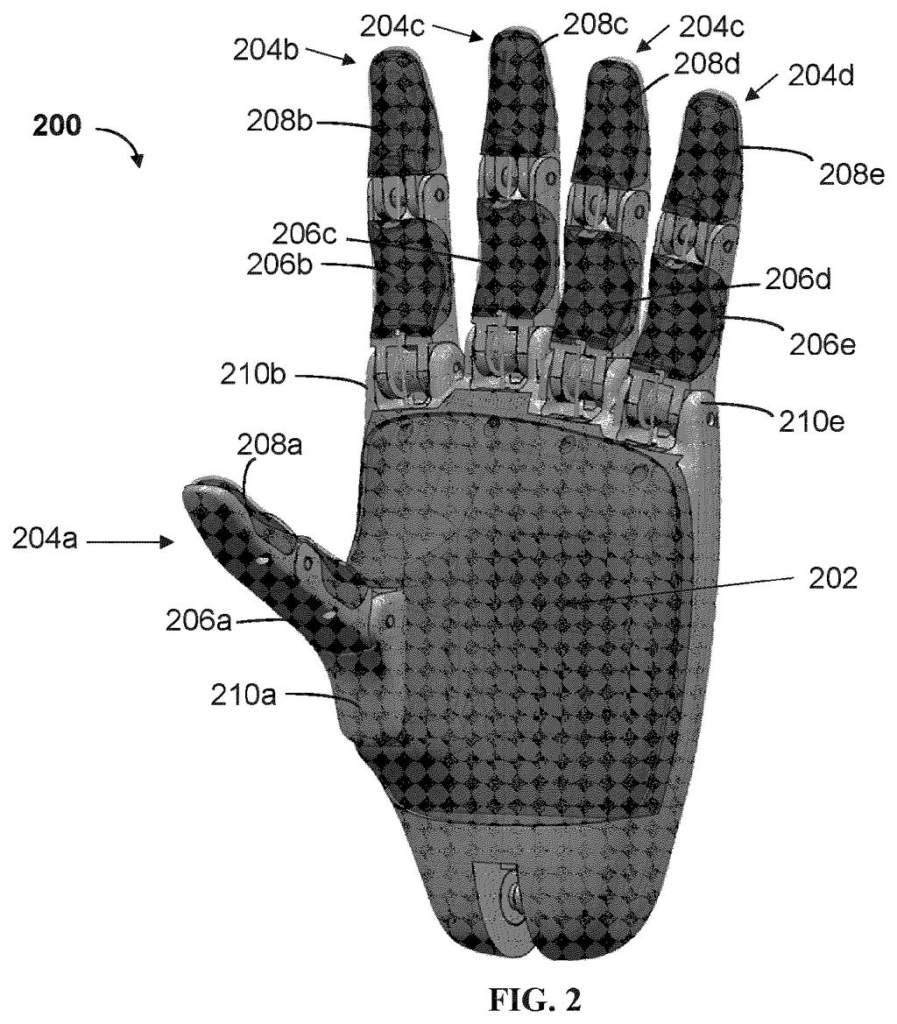
What Tesla's tendon-style robot finger does
Ever noticed how your fingers close around a mug without you thinking about which knuckle should bend first? Your hand just adapts: whichever part touches the mug first stops, and the rest keeps curling around it.
Tesla's patent application describes a robot finger built to behave that way. Each finger has two hinged sections, much like the bones of your own finger, and just one motor pulls a cable to move both. The cable works like a tendon. Instead of winding around each joint, it runs along the finger, and its end floats loose inside the fingertip, catching on a small ledge when pulled.
The filing says this lets the finger curl around whatever it touches, helps it hold on without slipping, and cuts down on parts. It also describes small springs at each joint to keep the finger steady, plus tiny magnet sensors that tell the robot how far each section has bent.
… a respective cable having a first portion coupled to the actuator and a second portion extending along the proximal member and the distal member, the second portion separated away from the first pivot and the second pivot and having an end with a higher dimension than a diameter of the cable …
Translation: The fingers use a cable system that acts like a tendon to control movement.
How the cable skips the joints and floats
The claims cover a robotic hand with a palm and one or more fingers, plus a stand-alone finger device. Each finger has a proximal member (the section nearest the palm) that rotates around a first pivot, and a distal member (the fingertip section) that rotates around a second pivot. The finger is underactuated, meaning a single actuator (a motor with a gearbox) drives both joints.
The key detail is the cable. One end connects to the actuator, and the other runs along both sections, kept away from both pivots instead of wrapped around them. That end is thicker than the cable itself, so it catches on the fingertip section when pulled. The filing says it can float in a pocket or channel and can be a potted end (set in hardened filler) or a potted insert.
The description also adds:
- A torsion spring (a coiled spring that resists twisting) at each pivot for stiffness and stability.
- A magnet at a pivot paired with a Hall effect sensor (a chip that reads magnetic fields), so the processor can work out the joint angle.
- A curved surface between sections so the metal cable bends gently and does not break.
The filing also describes a computer simulation that solves for finger lengths, spring stiffness, joint locations and cable distance from the joints, aiming to reduce slipping.
What this means for Tesla's humanoid robot
Picking things up is the whole job of a robot hand, and the filing itself calls hands one of the hardest parts of a robot to design. Moving the cable away from the joints, letting its end float, and tuning force through finger geometry instead of an elaborate gearbox could mean a hand with fewer parts and less cable wear. For you, that could someday mean a humanoid robot that holds a mug or a tool without dropping it.
The patent shows its fingers on a humanoid robot, though it names no product. The examiner's first review rejected the claims as filed, which is routine at this stage and usually followed by amendments, so the final wording may differ.
Tesla's second filing we've tracked on our watchlist for teaching robots to grasp and move since October builds on their touch-sensitive robot hand skin.
Picking things up is the entire point of giving a robot hands, so a finger that drops objects or wears out its cables is a costly problem. A weak hand limits a humanoid robot more than almost any software upgrade can fix.
The filing answers with a mechanical change: move the cable away from the joints, let its end float, and add springs. That matches the size of the problem well, because a physical weakness in a finger needs a physical fix.
The text we have gives no measured grip strength or cable lifespan, so how much better this finger is stays unknown. Still, the cable-snapping and limited-motion problems it targets are real ones, and it goes after them directly.
Get our take in your Top Stories
Liked this breakdown? Add Patentlyze as a preferred source on Google, and our plain-English take shows up more often in your Top Stories the next time Tesla patent news breaks.
There are more where this came from
We read every patent application Big Tech publishes and send you the ones worth knowing. Plain English, free, every week.
The drawings
23 drawing sheets from US 2026/0346473 A1 · click any drawing to enlarge


Show the other 15 sheets


Want this weekly breakdown for a company we don't cover? Patentlyze Pro →
Be the first to weigh in