
Google Files Patent for a Toy Wand That Flashes a Color to Pair With Your Phone
Google's patent application has a toy wand flash a color or play a sound so your phone can tell which wand is yours in a room full of look-alikes.
What Google's flashing-wand pairing does
When a room full of people all try to connect a gadget to a phone at the same time, things can go wrong. Your phone might link up with a stranger's toy instead of your own. Google describes that exact mix-up in this patent application, and its fix is surprisingly physical.
The gadget in the filing is a handheld toy wand. When you squeeze it, the wand sends your phone a short wireless message with its serial number and a hint: I'm about to flash a certain color (or play a certain sound). Your phone then turns on its camera or microphone, watches or listens for that signal, and only connects once it sees a match.
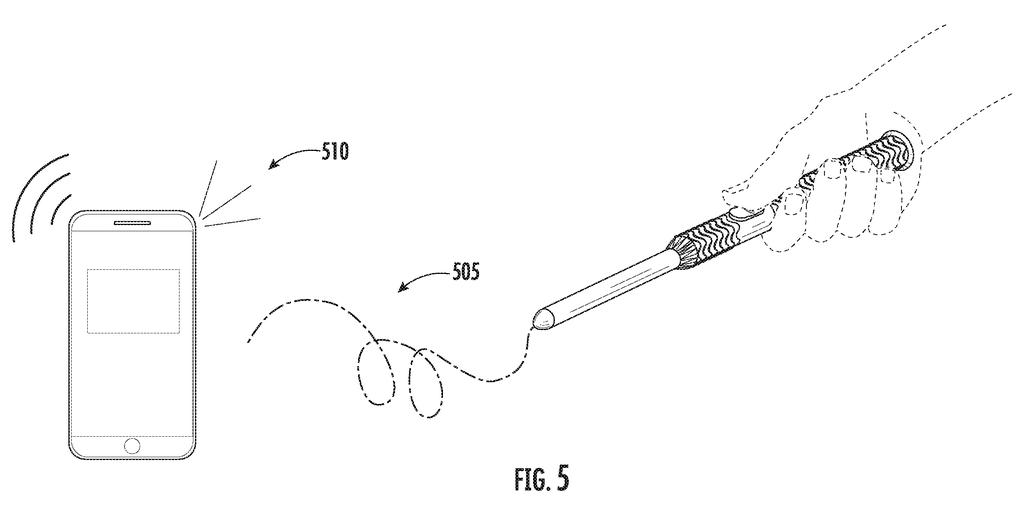
Once linked, you can wave the wand like you're casting a spell and the phone does the work. The filing lists things like turning up the volume, snapping a photo, or buying something.
obtaining a pairing communication from an interactive object; determining a pairing output signal that is emittable by the interactive object based at least in part on the pairing communication from the interactive object …
Translation: The phone receives a signal from the toy to figure out how they should connect.
How the phone confirms which wand is yours
The claims center on the phone's side of the handshake. A phone receives a pairing message from a nearby object, works out what signal that object will give off, switches on the right sensor, confirms it saw or heard that signal, and only then pairs.
The message is a Bluetooth Low Energy advertising packet (a tiny broadcast over short-range radio). It carries the object's unique ID, such as a serial number, plus details of its signal: a color, flash rate and duration for light, or a pitch, melody and volume for sound. The filing also mentions ultrasound and infrared as options.
On the phone, the steps run like this:
- The phone keeps a list matching each nearby object's ID to its signal.
- It turns on a camera for light signals or a microphone for sound signals.
- It looks up the detected signal in the list to find the matching ID, then pairs with that object.
- Entries that sit past a time limit get dropped.
After pairing, the wand sends motion data, a series of coordinates and times. A recognizer model on the phone (software that matches movement patterns to stored gestures) identifies the gesture and triggers an action. The wand can also buzz in your hand to confirm that pairing worked.
The pairing output signal includes at least one of a visual signal or an audio signal of the interactive object.
Translation: The toy connects to your phone by flashing a light or making a sound.
Why crowded rooms are the real test for wands
If you've ever fought with Bluetooth in a crowded place, you know the annoyance. The filing is built around a store or room where many people hold toys that look alike and each one needs to link to its own owner's phone. A color flash or a tone lets the phone work out which wand is calling, without extra steps from you.
The filing also pitches this as a safety and efficiency gain. If a phone sees a signal from an object that never sent a matching message, it knows not to pair, and it avoids the wasted effort of unpairing and retrying. Because the phone does the heavy lifting for gestures, the toy itself can stay simple.
Google's 34th filing we've tracked in our cell phone coverage since May follows a proximity-sensing button and auto-connecting earbuds.
Wrong-device pairing is a small problem, and the fix is sized to match it. Anyone who has watched a Bluetooth list fill up with strangers' gadgets knows the annoyance. A room of kids holding near-identical toys makes it worse, because each phone has to find its own wand among dozens.
The remedy asks very little of the hardware. A wand that already has a light and a speaker flashes a color, and a phone that already has a camera and a microphone checks for it. There are no new chips and no extra steps for the person holding the toy.
Expect a tidy, sensible piece of engineering for toy-and-phone setups. It earns a nod because a wrong pairing can mean your phone obeying a stranger's wand, and a color check is a cheap way to stop that.
Get our take in your Top Stories
Liked this breakdown? Add Patentlyze as a preferred source on Google, and our plain-English take shows up more often in your Top Stories the next time Google patent news breaks.
There are more where this came from
We read every patent application Big Tech publishes and send you the ones worth knowing. Plain English, free, every week.
The drawings
9 drawing sheets from US 2026/0353486 A1 · click any drawing to enlarge


Show the other 1 sheets

Want this weekly breakdown for a company we don't cover? Patentlyze Pro →
Be the first to weigh in