
Google
Google · Cell phone · Filed Oct 6, 2025 · USPTO published Oct 8, 2026 · Oct 8 release
Google Patents a Phone Camera Focus System That Knows When It Is Guessing
Google's new patent application gives a camera something most autofocus systems lack: a way to tell how sure it is about where to focus. When it's unsure, the lens holds back instead of lurching around.
- Publication number
- US 2026/0313231 A1(US20260313231A1)
- Applicant
- Google LLC
- Filed · Published
- Oct 6, 2025 · Oct 8, 2026
- Inventors
- Stanley Wei Xian Chen, Zihan Xu, Edward Chang, Andrey Yatsunenko, Katrina Hannover Passarella, Kumar Ayush, Jwalant Bhatt, David Cong Tian, Joachim Jacques Lerman, Desmond Akira Hollub Kamas, Hemang Mehta, Maria Lyubimtseva, Gerardo Carranza, Vitalii Dziuba
- Status when we published
- Waiting for an examiner
- Document
- 20 claims
- US classification
- 348/345
- Examiner
- GARCES-RIVERA, ANGEL L (Art Unit 2637)
- Parent application
- National Stage Entry of PCT/US2023/017752 (filed Jun 23, 2023)(PCTUS2023017752)
What Google's self-doubting autofocus does
Imagine you're filming your kid blowing out birthday candles. The flames flicker, your hand wobbles, and your phone's camera keeps pulsing in and out of focus as it second-guesses itself.
Google's patent application goes after that problem. Instead of crunching a huge amount of data to decide where to focus, the camera reads a small, low-detail set of signals from special focus sensors. A trained AI model then guesses how far off the focus is and, just as important, how sure it is about that guess.
When the AI is confident, the lens moves right away. When it isn't, perhaps because the light changed or your hand shook, the camera leans on its earlier readings and holds the lens steadier instead of lurching. You get quick focus when the scene is clear and calm focus when it isn't.
… determining a disparity prediction and an associated confidence value; using the associated confidence value to determine an autofocus lens position for an image sensor based on the disparity prediction …
Translation: The camera calculates how to focus and measures how sure it is about that guess.
How the two-step model scores its own focus guess
The system starts with sparse phase detection sensors: scattered focus-sensing points on the camera sensor, each capturing a left view and a right view of the scene. The shift between the two views (called disparity) shows how far the lens is from sharp focus. The data is low resolution, so there is far less to process.
A trained model then produces two outputs, using two sub-models:
- The first, which can be based on MobileNet (a compact network built for phones), predicts the disparity.
- The second takes the same data plus that prediction and outputs a confidence value.
If confidence clears a threshold, the new prediction sets the lens position. If it doesn't, or the lighting shifts sharply, the system blends the new reading with earlier ones (filtering) so the lens doesn't jitter. Per-region conversion coefficients and an offset then translate the result into a lens position.
For training, the filing describes photographing images on a high-resolution display and cropping them to mimic hand jitter. A tensor processing unit (a chip built for AI math) can run the model.
… causing the image sensor to autofocus based on the determined autofocus lens position.
Translation: The phone physically moves the camera lens to match the calculated focus point.
Why steadier phone focus is easy to notice
The payoff shows up in moments you already know: a video where focus keeps pulsing, or a shot of a moving kid where the lens hunts before settling. Telling the lens when to commit and when to hold back could make focus feel calmer without making it slower, since the filter only kicks in when the camera is unsure.
There is also a cost angle. The filing says low resolution sensors can be cheaper while delivering roughly the same value as high resolution ones, and less data means faster math. Phone cameras are the main example in the description, but it also lists laptops, tablets and wearables. As with any patent application, it shows what Google is exploring, not what will ship.
Google's 28th filing in our cell phone patents we've tracked since May follows earlier applications like one on tap-to-reframe cameras and one on AI battery management.
Source: US 2026/0313231 A1 at the USPTO (PDF). Full patent text and figures are in the official publication.
Get our take in your Top Stories
Liked this breakdown? Add Patentlyze as a preferred source on Google, and our plain-English take shows up more often in your Top Stories the next time Google patent news breaks.
Add Patentlyze on Google
One click.
There are more where this came from
We read the new patents from Big Tech, carmakers and more and send you the ones worth knowing. Plain English, free, every week.
The drawings · 8 sheets
8 drawing sheets from US 2026/0313231 A1 · click any drawing to enlarge


More from Google
All 1,127 Google patents →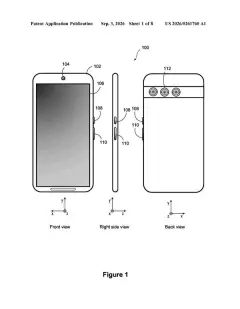
More in Camera
All 278 Camera patents →
Samsung
Samsung Patents a Camera That Pre-Focuses Before You See the Viewfinder
Samsung
Samsung Patents a Modular Camera Stack That Chains Units Together on One Board
Samsung
Samsung Patents a Fix for Misaligned Frames in Multi-Shot Camera Captures
Samsung
No comments yet