
Google Files Patent for a Phone Button That Senses When You Walk Up
The same metal contact that reads your heartbeat could also tell your phone you're walking toward it, without sending out a single signal.
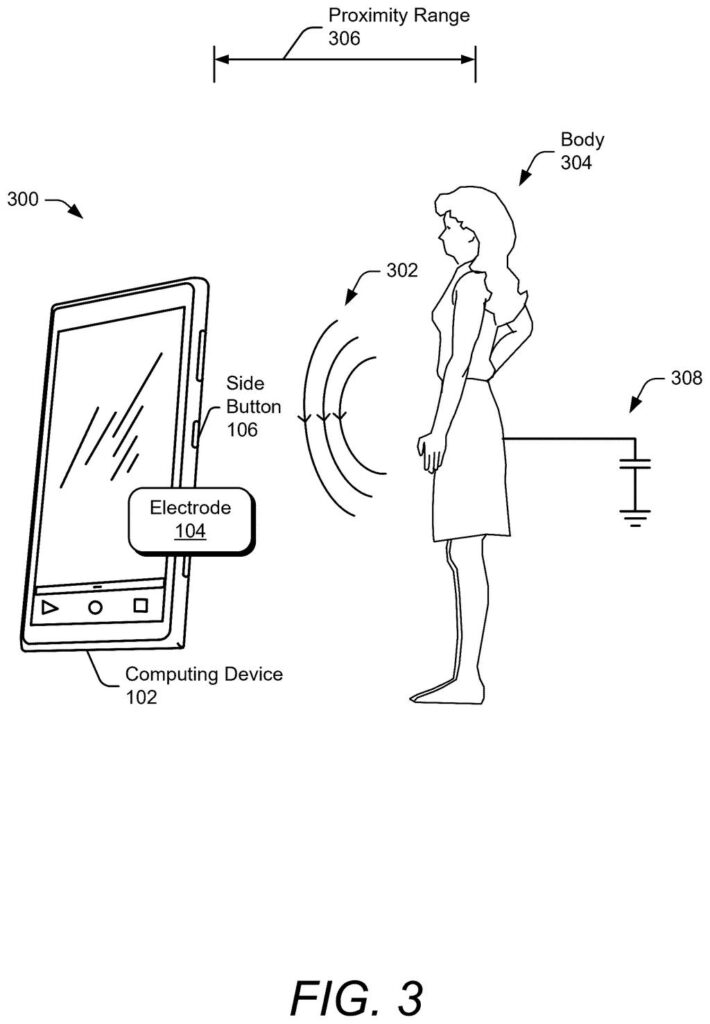
What Google's listening electrode actually does
Right now, a phone usually learns you're nearby in one of two ways: you touch it, or a camera or radar chip keeps watch for you. Waiting for a touch means a delay, and a phone propped up while you watch a video can go dark on you. Cameras drain the battery, need light, and raise privacy worries. Google's filing goes after all of that with a much simpler part.
The patent describes an electrode, the same kind of metal contact used in heart-rhythm sensors, that just listens to the faint electric field in the room. It sends nothing out. When a person walks up, the field shifts and the device notices. Your phone could turn its screen on as you step up to the sink, then turn it off once you leave.
The same electrode can also read your pulse when you rest a finger on it, so one part does two jobs.
… detecting from the change in the electric field that a body is present within a proximity range from the computing device; and measuring, during a second time and using the at least one electrode, a heart rate from a human appendage placed over a portion of the computing device that includes the at least one electrode.
Translation: The device notices when you get close and can also read your pulse if you touch the right spot.
How the electrode reads changes in the room
The core is an electrode, a small metal contact wired to an impedance circuit (a part that resists current, which lets the chip read tiny voltage changes) tied to the device's ground. It passively senses the electric field in the room, meaning it never transmits anything. When a person or another charged body comes near, the field's strength shifts, and the electrode records that as a charge value.
Software compares charge values from different moments. The description says a swing of about 20% or more from the recent average counts as significant. Bigger swings suggest something closer. With two electrodes in different spots, the device can estimate the angle too. Detection ranges run from a few centimeters to several meters.
The claims layer on several steps:
- Detect a body, then move from a low-power state to a high-power state, and back again when the body leaves.
- Check a motion sensor so readings only count when the device is mostly still.
- At a later time, measure a heart rate when a finger rests over the electrode, as an ECG (electrocardiogram) sensor does.
The filing also describes using the same signal to track movement during sleep, spot live electrical wires inside walls, and tell walking from running by watching movement patterns of 2 to 3 hertz (cycles per second) versus 5 to 8 hertz.
Other advantages of the electrode include it being orientation agnostic, able to operate in all lighting conditions, and capable of penetrating obstructions.
Translation: This sensor works in any light, through covers, and no matter which way the phone is facing.
Why Google's electrode matters for your battery
The practical payoff is a screen that behaves the way you expect. It could light up as you approach a phone on a counter and go dark when you leave, with no tap needed. The filing also describes waking parts like face or fingerprint unlock early, so they are ready by the time you reach for the device. Because the electrode works in the dark and from any side of the phone, it avoids the lighting and viewing-angle limits of a camera.
The extras are where the bigger stakes could sit: rough sleep tracking from a phone on your nightstand, and a warning when you hold it near a wire in a wall. The examiner's first review rejected the claims as filed, which is routine at this stage, so the final wording may change. The filing also says users should control whether this data is collected.
Google's 33rd filing we've tracked in our cell phone patents since May follows ideas like connecting earbuds early and detecting a finger over the speaker.
Every design choice here costs something, and the main cost is certainty. An electric field is a faint, messy signal, and the filing says the electrode reacts to a person, an animal, or any charged object. Your phone may not know whether it just sensed you or the cat.
The second cost is that the device has to sit still. The design pauses detection and throws out readings while the phone is moving, so a phone in your pocket or bag gets almost nothing from it. That suits a phone on a desk or counter, and it keeps false alarms down.
In return, you give up very little: no camera, no extra chip, and power use around a milliwatt. The claims also tie the idea to a heart-rate sensor, which keeps the added hardware cost low. The trade is worth it for a wake-up signal that costs almost nothing, as long as Google is honest about the cases where it will guess wrong.
Get our take in your Top Stories
Liked this breakdown? Add Patentlyze as a preferred source on Google, and our plain-English take shows up more often in your Top Stories the next time Google patent news breaks.
There are more where this came from
We read every patent application Big Tech publishes and send you the ones worth knowing. Plain English, free, every week.
The drawings
9 drawing sheets from US 2026/0324988 A1 · click any drawing to enlarge


Show the other 1 sheets

Want this weekly breakdown for a company we don't cover? Patentlyze Pro →
Be the first to weigh in