
Google Patents a Phone Camera That Adjusts Blur and Grain to Fit Your Connection
Google's patent application teaches a camera to shoot a slightly worse picture on purpose, accepting a little blur or grain so the squeezed video that reaches the other end looks cleaner.
What Google's bitrate-aware camera actually does
You're on a video call from a train platform, and your signal is down to one bar. Faces turn into blocky mosaics and the background shimmers. Some of the blame lands on your camera, which shot the scene as if your connection were perfect.
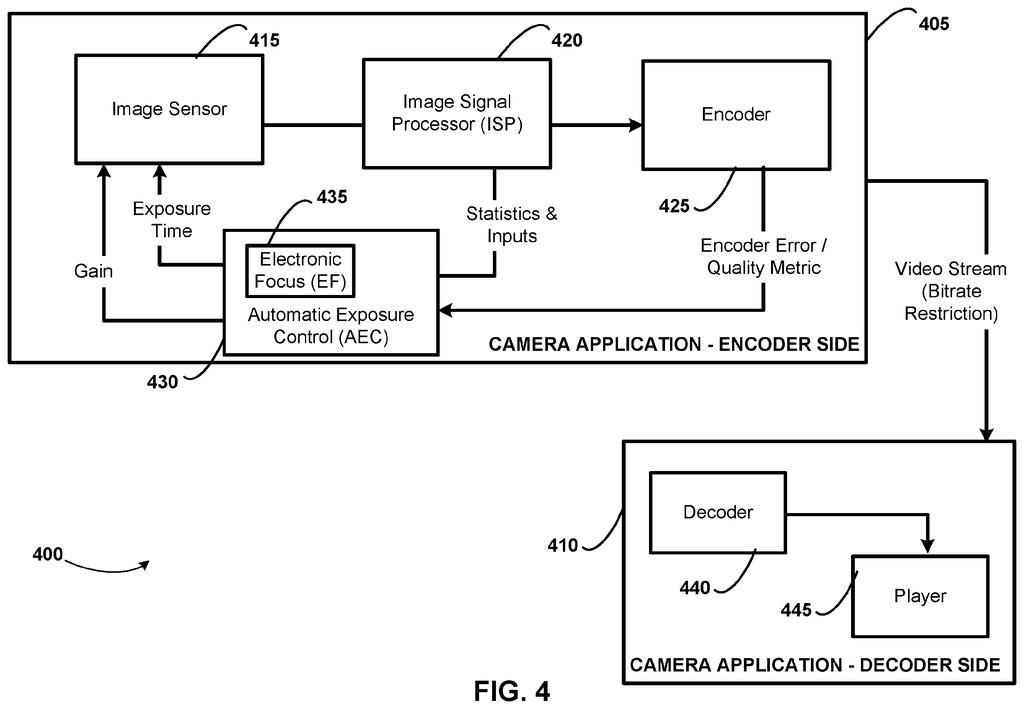
Google's patent application describes a camera that checks how much video data it can actually send each second (called the bitrate) and changes its settings to match. Those settings are how long the shutter stays open, which controls blur from movement, and how much the signal gets boosted, which controls speckled noise. A tight data budget changes which of those flaws looks worst after compression.
The main claim covers one version: when the bitrate is low, shorten the exposure to cut blur and accept more noise. The description also covers the reverse for weak networks, allowing extra blur so there is less noise to turn into blocks.
… adjusting, based on the bitrate, an amount of motion blur, a level of image noise, or both, by updating one or more of the exposure time or the digital gain, wherein the adjusting, when applied to the media content, reduces one or more image degradations associated with the media content …
Translation: The camera changes blur and grain based on your network speed to keep the video looking clean.
How the camera trades blur against grain
The method starts by reading three numbers inside the camera pipeline: the exposure time (how long the sensor collects light, also called shutter speed), the digital gain (an amplification step that brightens the image but adds speckles) and the bitrate (how much data is recorded or sent per second).
It then updates the exposure time, the digital gain, or both, depending on the bitrate. A longer exposure gives cleaner pictures but more blur from motion. A higher gain lets the shutter close faster, which cuts blur but adds noise. The first independent claim covers the case where the bitrate is below a threshold: exposure time goes down, blur goes down, and noise is allowed to sit above a threshold level.
The description also covers the opposite call for tight connections. There, the video encoder (the software that shrinks footage so it can be sent) struggles with noisy frames and leaves blocky patches, so the filing raises exposure time and lowers gain instead. Other claims and examples include:
- Detecting that a social media app encodes video at a low bitrate.
- Judging network bandwidth, including how far the phone is from a cellular tower.
- Measuring blur from motion across video frames (optical flow) or from room brightness.
- Comparing noise before and after encoding to correct the settings.
- Nudging the bitrate itself up when blur is high, or down when noise is high.
A computer-implemented method for dynamically adjusting automatic exposure settings for a media content capturing device is described.
Translation: The system automatically changes how the camera captures light while you record.
Why weak signals could stop ruining your video calls
If this ended up in a phone camera, you would notice it in video calls, livestreams and clips you post to a social app: fewer blocky patches and better detail when your connection is weak. Your camera app would be making a choice you never see, picking the type of imperfection that survives compression best.
Automatic exposure is something every phone camera already does. This filing adds the connection quality to the list of things it pays attention to. The description mentions phones, home security cameras and cars as places cameras show up. It is a patent application, so nothing here says any product will use it.
Google's 35th filing in our cell phone patents we've tracked since May follows ideas like a color-flashing toy wand and a proximity-sensing button.
The design gives up some picture quality at the camera to protect picture quality at the other end. On a good connection that sacrifice would be wasted, which is why the patent sets a threshold and leaves the camera's normal behavior alone above it.
The risk is a wrong guess. Bitrate can change second to second, and a camera that keeps flipping between blurry and grainy could look jumpy. The filing also describes two opposite recipes for a weak connection, one that adds blur and one that keeps detail with more noise, so the right choice depends on the scene.
Still, the trade reads as worth it. Your eye forgives a little blur in a video call far more easily than it forgives blocky faces. The filing says existing automatic exposure ignores bitrate, so tying the two together is a sensible fix.
Get our take in your Top Stories
Liked this breakdown? Add Patentlyze as a preferred source on Google, and our plain-English take shows up more often in your Top Stories the next time Google patent news breaks.
There are more where this came from
We read every patent application Big Tech publishes and send you the ones worth knowing. Plain English, free, every week.
The drawings
6 drawing sheets from US 2026/0352959 A1 · click any drawing to enlarge


Want this weekly breakdown for a company we don't cover? Patentlyze Pro →
Be the first to weigh in