
Samsung Files Patent to Make Phone AI Chips Waste Less Time Shuffling Data
Every time an AI chip sends a half-finished result out to slow memory and fetches it back, it burns time and battery. Samsung's patent application describes a way to let a computer search for the fewest wasted trips.
What Samsung's AI-chip shortcut search does
Ever cooked a big meal while running down to a basement pantry for every single ingredient? It eats up time, and dinner gets cold. An AI chip has a version of that problem. It has a tiny, fast workspace on the chip itself, plus a bigger but slower memory farther away.
AI programs work in steps, and each step hands its result to the next. Every time a result takes the trip to the slow memory and back, you lose speed and battery. Keeping some results on the fast workspace avoids the trip, but the workspace is small, so you can't do it everywhere.
Samsung's patent application describes a way to decide which handoffs get the shortcut. A computer tries many combinations, measures how each one performs, and keeps the best. The chip then runs your AI task that way.
… performing a black box optimization on the NN model based on the DAG to optimize the plurality of hyperparameters …
Translation: The system automatically tweaks the data pathways to make the artificial intelligence run faster.
How the trial-and-error search picks its shortcuts
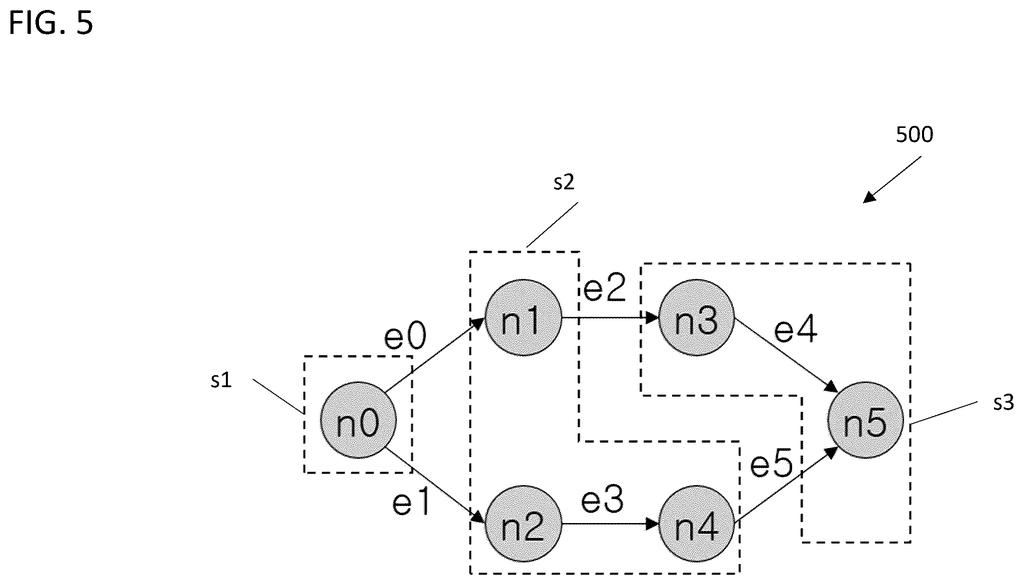
Samsung's filing starts by turning an AI model into a map. Each step of the model (a layer, such as a convolution, which scans an image for patterns) becomes a dot, and each handoff of results between steps becomes an arrow. Engineers call this a directed acyclic graph, meaning the arrows only point forward and never loop back.
Each arrow gets one yes-or-no setting, called a hyperparameter (a tuning knob set before the program runs). Yes means the result is sent out to the slower external memory before the next step. No means the result stays in the chip's fast internal memory and passes straight on. Steps linked by no-arrows form a group the filing calls a subgraph, and they run in a fused way.
To pick the settings, the method uses black box optimization: it treats the chip as a sealed box, tries a set of settings, measures the outcome, and uses that result to choose the next try. The filing names random search, Bayesian optimization and evolutionary algorithms as ways to do this. The score can target delay, memory traffic, power or resource use, for example holding power under 10 millijoules while cutting delay.
With n layers, the number of possible groupings is about 2 to the power of n, far too many to check one by one. Because the search is iterative, you can stop early and settle for a good answer when time or computing budget is tight. The filing says the tuning may run offline, such as on a server.
… a directed acyclic graph (DAG) that represents a NN model including a plurality of layers, wherein the DAG includes a plurality of nodes representing the plurality of layers, and a plurality of edges representing data paths between the plurality of layers …
Translation: The AI model is mapped out as a web of connected layers and data routes.
What this means for AI on your phone and car
The practical payoff is AI that answers faster and drains less battery on the same chip. Moving data in and out of memory is a big cost in AI work, and the filing's whole aim is to cut those trips without adding more expensive on-chip memory. It says this avoids growing the chip's size.
The filing lists smartphones, wearables, cameras, drones and driver-assistance systems as places the approach could apply, all devices that need quick answers on limited power. It also notes the idea works for any task that can be drawn as this kind of map, and for chips such as graphics processors. This is a behind-the-scenes tuning method, so you would feel it as snappier features, not as a new button.
This is the 63rd Samsung filing we've tracked since June in our AI chip wars watchlist, adding to work on memory chips doing AI math and handling many chatbot users at once.
You will never see a setting for this, and that is fine. If it works, the payoff shows up as a camera feature that responds a beat sooner, a voice assistant that sips less battery, or a driver-assistance system that reacts with less delay.
The search runs ahead of time, so your device never spends power hunting for shortcuts on the go. It just receives the best plan the search found. That is a sensible trade, since the cost is paid once by engineers and the savings repeat every time you use the feature.
The filing gives no measured results, so how much battery or speed you would gain is unknown. Treat it as routine chip-maker plumbing with a clear, believable benefit, and a small one for any single user.
Get our take in your Top Stories
Liked this breakdown? Add Patentlyze as a preferred source on Google, and our plain-English take shows up more often in your Top Stories the next time Samsung patent news breaks.
There are more where this came from
We read every patent application Big Tech publishes and send you the ones worth knowing. Plain English, free, every week.
The drawings
10 drawing sheets from US 2026/0340418 A1 · click any drawing to enlarge


Show the other 2 sheets


Want this weekly breakdown for a company we don't cover? Patentlyze Pro →
Be the first to weigh in