
Adobe Files Patent for Dials and Sliders That a Camera Can Read Without Electronics
Adobe describes a light switch, dial or slider with no electronics at all, yet a phone camera can tell exactly how far you moved it. The trick is a pair of printed stripe patterns.
What Adobe's camera-read plastic controls do
Imagine a light switch on your wall that is just a piece of plastic. No wires, no battery, no chip. You flip it, and the lights come on anyway, because your phone or a pair of AR glasses watched it move.
Adobe's patent application describes how that could work. Two striped patterns sit on two parts of a control: one on the piece that moves, one on the base. Where they overlap, they create a rippled, shimmering effect (called a Moiré pattern) that shifts a lot even when the parts move only a little. A camera watches that ripple change.
Software then compares one video frame with the next to work out how far the control traveled, and sends a command, like turning on a lamp or lowering the thermostat. The filing says this can work for buttons, joysticks, switches, dials and sliders.
… determining, by the processing device, a displacement of the first pattern in relation to the second pattern based on a comparison of the composite pattern and the different composite pattern …
Translation: The system figures out how far the physical dial or slider moved by comparing two pictures of the overlapping patterns.
How a camera reads two overlapping patterns
The system starts with a physical control built from two parts that slide or turn against each other. One part carries a first printed pattern (often on a see-through layer) and the other carries a second pattern. When they overlap, they form a Moiré pattern, the rippled look you sometimes get when two window screens are stacked. The ripple changes with the exact amount of overlap and exaggerates small movements, which is why the filing says a camera can read it even from far away.
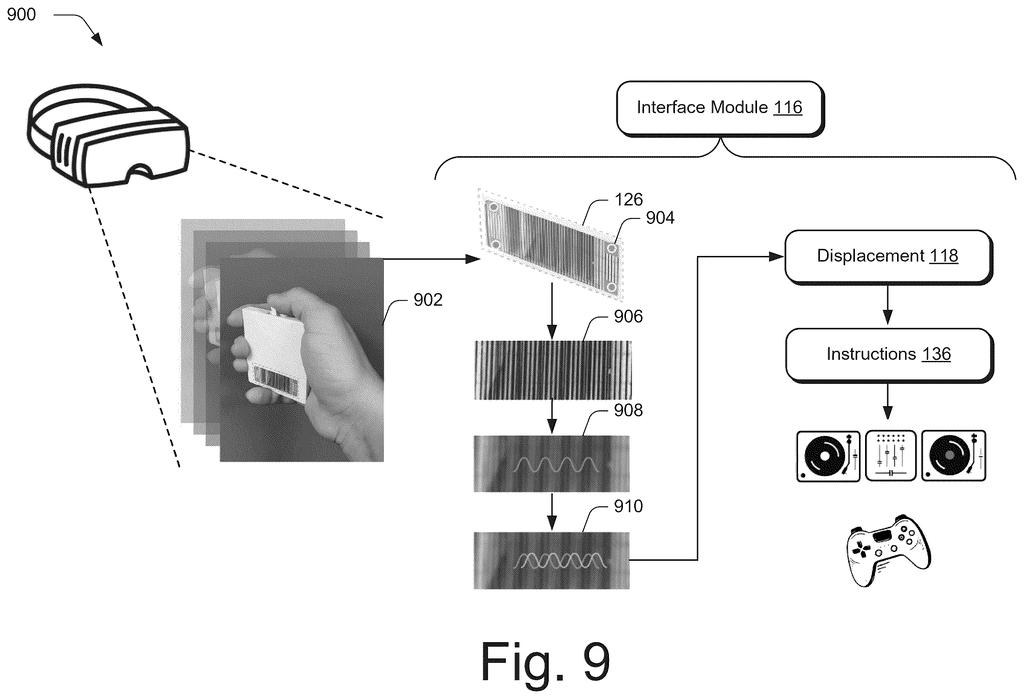
Once a phone, AR headset or similar device captures video of the control, the software works in four steps:
- Find the pattern: it looks for dots or corner markers on the control (or uses a trained model) to locate the ripple in the picture.
- Straighten and blur: it corrects for an off-center camera angle, then blurs the image to smooth out fine detail.
- Fit a wave: it fits a sine wave (a smooth up-and-down curve) to the brightness and notes where the peaks land.
- Measure: comparing peak positions between two frames gives the displacement, meaning how far one part moved against the other.
The claims cover movement along one line (sliders, buttons, switches), across a flat plane (joysticks) and in a circle (dials). The result either triggers an action directly or is passed to another device. The filing's examples include turning on a light, changing volume and adjusting temperature.
The description also covers how to build the controls cheaply: 3D-printed plastic housings with patterns printed on paper, and even invisible ink that shows under ultraviolet light.
… determining movement of passive physical interface controls, a computing device implements an interface system to receive a first image depicting a composite pattern formed by a first pattern overlapping a second pattern by a first amount …
Translation: A computer tracks how a non-electronic physical control moves by analyzing camera images of overlapping patterns.
What this means for battery-free smart homes
The practical pitch is controls that cost almost nothing to make and never need a battery. Think a 3D-printed dimmer dial for your living room, or a toy trigger for an AR game that has no circuit board inside. The filing also lists AR and VR training props shaped like surgical tools or vehicle controls, robot controls, and physical sliders for things like brush size in drawing apps.
The catch is that a camera has to be looking. Your headset or phone becomes the brain of every control in view, so the idea fits best with AR glasses and smart home setups that already watch the room. For Adobe, which makes creative software, it points toward a physical, tactile way to steer digital tools.
That makes this Adobe filing the 237th we've tracked in our Adobe coverage since May, adding to work like pose editing by description and blur-proof pixel art.
Every engineering choice here trades one cost for another. The control itself becomes dirt cheap and battery-free, but all the work moves to a camera that must see it clearly. A light switch that only works when someone is wearing the right glasses or standing in view of a phone is a big step down from a switch on the wall.
The filing also admits some limits. The math assumes two video frames are close enough that the pattern hasn't jumped a full cycle, so a very fast flick could confuse it. The stripes are thin (the description cites lines of 0.1 to 0.3 mm), which asks a lot of a camera that is dim, smudged or across the room.
Still, for hobbyists, classrooms and AR game props, the trade reads as worth it. Nobody cares about a dead battery in a plastic prop that cost pennies to print. As a replacement for the switches in your home, it is a harder sell.
Get our take in your Top Stories
Liked this breakdown? Add Patentlyze as a preferred source on Google, and our plain-English take shows up more often in your Top Stories the next time Adobe patent news breaks.
There are more where this came from
We read every patent application Big Tech publishes and send you the ones worth knowing. Plain English, free, every week.
The drawings
12 drawing sheets from US 2026/0340839 A1 · click any drawing to enlarge


Show the other 4 sheets


Want this weekly breakdown for a company we don't cover? Patentlyze Pro →
Be the first to weigh in