
Nvidia Files Patent for Turning One Photo Into a Moving 3D Head Avatar
Nvidia's patent application describes turning one ordinary photo of a face into a 3D head you can rotate and make smile, with hair, glasses and even a hat pattern intact.
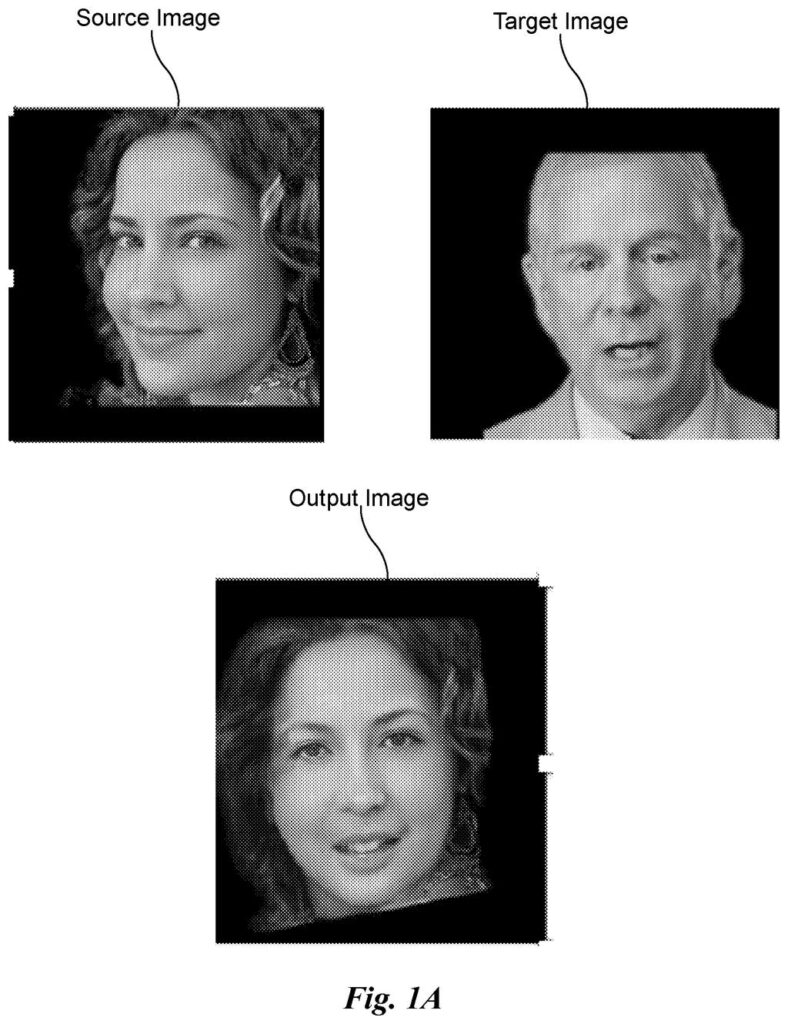
What Nvidia's one-photo head avatar actually does
Most tools that animate a single photo work by stretching and warping the picture. Turn the head too far and the face distorts, or even starts to look like someone else. Many of them also only handle the face itself, so hairstyle and glasses get lost along the way.
This Nvidia patent application describes a way to build a true 3D head from one photo of a person. The system first works out the rough shape of the head with a neutral face: eyes open, mouth closed. Then it pastes the fine details from your photo, such as a hat pattern or earrings, onto that 3D shape.
Once the head exists, a second photo supplies the expression and the angle. The result is your face, smiling or turning, without training a separate model for each person.
processing a source image depicting a subject exhibiting an expression to generate an identity surface of the subject, the identity surface representing the subject in a canonical three-dimensional (3D) space and having a canonical expression different from the expression exhibited in the source image …
Translation: The system takes a photo and builds a neutral 3D model of the person's face.
How three layers rebuild a face in 3D
The filing describes a system with three branches. Each handles one job, and their results are added together. The main claim covers the first two: building a person's identity representation from one source photo.
- Geometry branch: A 3D encoder (a neural network that turns a flat photo into 3D data) builds a rough head shape in a standard frontal pose with a neutral expression, even if the photo shows the person mid-laugh. The filing stores it as a tri-plane, which is three flat grids lined up with different axes that together describe a 3D volume.
- Appearance branch: The system renders a depth image from that shape to learn where each photo pixel sits in 3D. It then "lifts" fine details like hairstyle, glasses or a hat pattern onto the shape.
- Expression branch: A target photo's expression is run through a 3D face model (a standard mathematical model of human faces) and encoded into a third tri-plane. This part appears in a dependent claim.
Adding the three tri-planes together and applying volumetric rendering (computing what a camera would see inside the 3D volume) produces an image with the person's identity and the target's pose and expression. An optional super-resolution step sharpens the result.
To train the geometry branch, the filing compares its neutral-face output against a render from the 3D face model, using image-difference scores inside the facial region. Once trained, the system works in a single pass on photos it has never seen.
… an implicit three-dimensional (3D) head avatar is constructed that not only captures photo-realistic details within and beyond the face region, but also is readily available for animation without requiring further optimization during inference …
Translation: It creates a realistic 3D head that can move immediately without extra training.
Why this matters for video calls and games
If this works as described, making a lifelike avatar of yourself could take one photo instead of a scan or a training session. The filing names video conferencing, computer games, and VR and AR as the targets, where a stand-in for your face needs to look right from many angles.
The filing also describes splitting the work: a server can build the avatar once and send it to another device, which then draws it with whatever expression it is given. That keeps the heavy lifting off the device in front of you. The filing notes the person supplying the expression can be different from the person in the photo, so one picture of someone could be animated by anyone's face.
Nvidia's 28th filing we've tracked since May in our text-to-3D characters watch builds on earlier applications like one on mid-sentence mood shifts and one on text-driven surface detail.
No new hardware stands between this filing and a working demo. It is all software: a trained network, a standard 3D face model used as a training guide, and a graphics chip to run it. The filing even says the avatar can be built on a server and streamed to a device.
What has to exist first is the training. The model needs a large pile of portrait photos and video frames of many people, and the filing gives no speed or quality numbers. Whether it runs live on a phone or only in a data center is left open.
The shortest route to a product looks like a cloud service or toolkit that other companies plug into video calls or games. On paper that puts this close to shippable, with training data and speed as the open questions.
Get our take in your Top Stories
Liked this breakdown? Add Patentlyze as a preferred source on Google, and our plain-English take shows up more often in your Top Stories the next time Nvidia patent news breaks.
There are more where this came from
We read every patent application Big Tech publishes and send you the ones worth knowing. Plain English, free, every week.
The drawings
17 drawing sheets from US 2026/0350914 A1 · click any drawing to enlarge


Show the other 9 sheets


Want this weekly breakdown for a company we don't cover? Patentlyze Pro →
Be the first to weigh in