
Nvidia Patents a System for Building 3D Characters That Move in Any Pose
Nvidia has filed a patent for a new way to build animated 3D characters, using tiny elements placed across a body's surface whose visibility adjusts based on depth and pose. The goal is a system that can render a convincing human figure in virtually any position.
What Nvidia's opacity-based avatar system actually does
Imagine you want to create a digital version of yourself that can move, gesture, and strike any pose in a video game or virtual meeting. Doing that convincingly is harder than it looks: the body has to look right from every angle, and clothing and skin can't clip through each other or turn into a blurry mess when the arms move.
Nvidia's patent describes a system that covers a 3D body model with two layers of tiny elements. The first layer locks onto the body's surface. The second layer hovers around it, and each floating element has a built-in opacity value, meaning how visible or transparent it is, based on how far it sits from the skin. When you change the character's pose, the system recalculates all those elements and re-renders the figure accordingly.
The practical effect is a character model that stays coherent as it moves, because visibility is baked into the structure rather than painted on afterward. This is aimed at making animatable avatars easier to generate at scale.
generate a three-dimensional (3D) model of a subject based at least on one or more primitives associated with the subject and one or more attributes associated with the one or more primitives, the one or more attributes including an opacity corresponding to a position of at least one element with respect to the subject …
Translation: It builds a 3D character by combining basic shapes with properties like see-through details.
How particles and opacity values drive pose rendering
The patent describes a pipeline for creating and rendering 3D animated characters. At its core, the system uses two classes of elements attached to a 3D model of a person or subject.
First elements are anchored directly to specific locations on the body's surface in a starting pose. Think of them as anchor pins spread across the skin. Second elements are then linked to those anchors but float at varying distances from the surface. Each second element carries an opacity attribute, a number that controls how see-through it is based on how far it sits from the body. Elements close to the surface are more opaque; those farther away are more transparent.
When the system needs to render the character in a new pose, it updates all the second elements based on two inputs:
- The target pose (where the limbs and joints end up)
- Attributes of the subject (physical characteristics that affect how the body and its surrounding geometry behave)
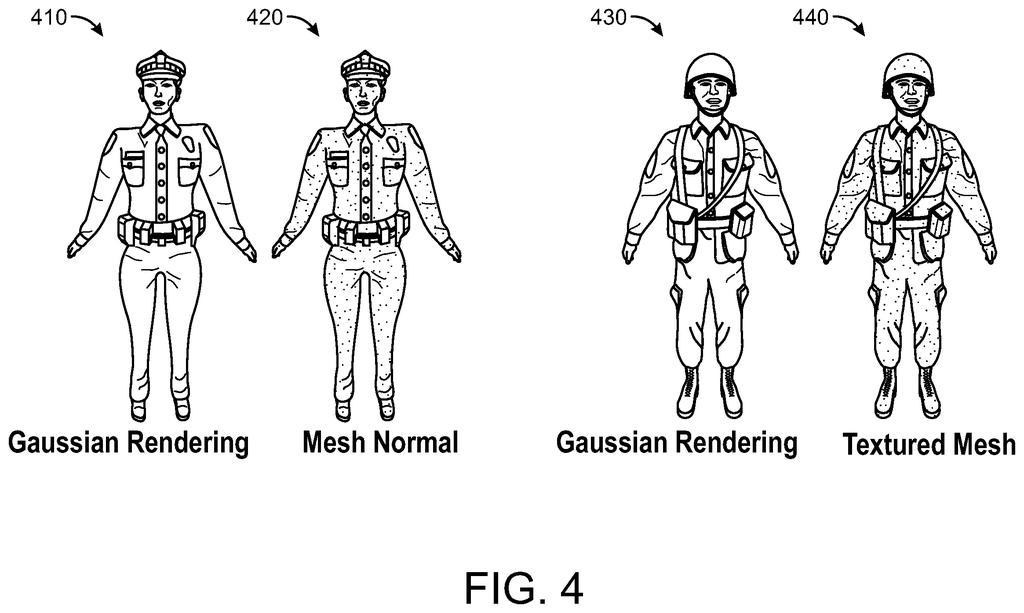
Once those elements are updated, the system renders the final image from that adjusted point-cloud-like cloud of elements. The approach is related to what researchers call Gaussian splatting, a technique (used in recent 3D scene reconstruction work) where scenes are built from overlapping semi-transparent blobs rather than traditional polygons. Nvidia's system applies that idea specifically to articulated, poseable human figures.
… update the plurality of second elements based at least on a target pose for the subject and one or more attributes of the subject to determine a plurality of updated second elements …
Translation: The system shifts the character's details to match a brand new pose.
What this means for real-time avatars and digital characters
For anyone who has tried to put a realistic avatar into a game, a video call, or an extended-reality app, the core problem is always the same: characters look fine in the poses the animator planned for, and fall apart in everything else. A system that bakes visibility information into the model's structure, rather than applying it as a post-processing fix, could make pose-flexible avatars more practical to build and cheaper to run.
Nvidia has been filing around AI-generated characters and digital humans since at least 2023, and this patent fits that pattern. If the approach works as described, the bigger opportunity is automated avatar creation from a scan or a few photos, without hours of manual rigging work.
Nvidia's 22nd filing we've tracked since May in our text-to-3D character work adds to a body that includes their patent animating faces from audio and one turning scripts into storyboards.
Claim 1 is written at a high level of generality. It covers any system that generates a 3D model using primitives with opacity attributes tied to position, then renders from that model. That framing is broad enough to touch a wide range of Gaussian-splatting-based avatar systems, not just Nvidia's specific implementation described in the abstract.
The breadth cuts both ways. A wide claim is harder to get past a patent examiner, because prior art in Gaussian splatting for human bodies is extensive and publicly documented. If it survives examination, though, that same width could make life difficult for anyone building opacity-weighted avatar representations, which is a real and active area of computer graphics research.
For readers outside the field, the honest summary is this: the underlying idea is not exotic, but the patent staking broad ownership over it is the part worth watching. The technology itself is incremental; the claim strategy is the story.
There are more where this came from
We read every patent application Big Tech publishes and send you the ones worth knowing. Plain English, free, every week.
The drawings
11 drawing sheets from US 2026/0289888 A1 · click any drawing to enlarge


Want this weekly breakdown for a company we don't cover? Patentlyze Pro →
Be the first to weigh in