
Qualcomm Files Patent for a Phone That Can Tell When Its Speaker Is Clogged
Your phone's speaker can clog with lint or water long before you hear the difference. Qualcomm's patent application describes a phone that senses the blockage and tries to clear it with sound.
What Qualcomm's blocked-speaker detection does
Every day your phone rides around in a pocket or a bag, it collects a little more lint, dust and grit, and sometimes a splash of water, around the tiny openings where sound comes out. Calls and music get quieter or muddier, but slowly enough that you may never notice. You would also have no idea which opening is the clogged one.
Qualcomm's patent application describes a phone that watches for this on its own. Instead of adding a new part, it checks the electrical signal that already drives the speaker. A clogged opening changes how the speaker moves, and that change shows up in the signal.
Once the phone spots a problem, it can tell you, show cleaning steps, or offer to play a clearing sound meant to shake the blockage loose. Afterward it checks again and lets you know whether it worked.
obtain at least one of a current signal or a voltage signal associated with an output signal for a speaker; detect a presence of a blockage of a speaker port of the speaker based on the at least one of the current signal or the voltage signal; and implement a corrective action based on the presence of the blockage of the speaker port.
Translation: The phone measures electrical signals going to the speaker to figure out if something is blocking the sound hole and then fixes the issue.
How the phone reads its own speaker signal
The patent covers a phone (or another handheld or wearable device) that measures the current or voltage feeding its speaker, uses that to decide whether a speaker port (the small opening that lets sound out) is blocked, and then takes a corrective action. The current can be read from the voltage drop across a part of the speaker circuit with a known resistance.
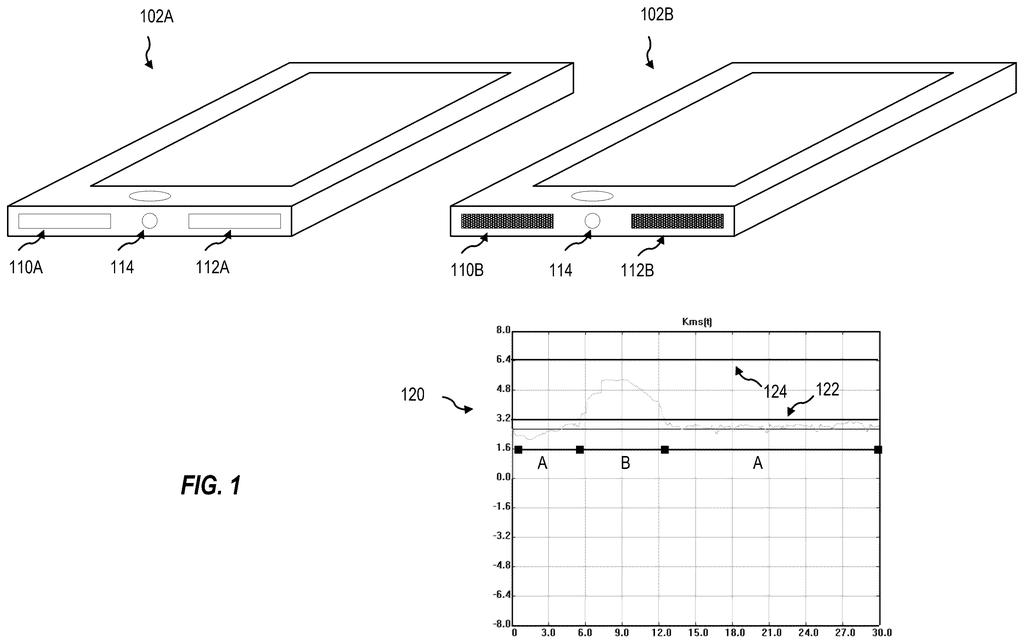
The filing describes two ways to make the call. One uses signal processing to estimate the speaker's stiffness (called Kms, a measure of how much the speaker's suspension resists moving). When that estimate rises above a set threshold, the port is judged blocked. The other feeds the current and/or voltage into a trained machine learning model (software taught from examples of blocked and unblocked ports) that predicts whether a blockage exists.
Stiffness can also sort the problem into types. In the filing's example, a reading between two thresholds points to debris, and a reading above the higher one points to liquid such as water partly filling the port.
Corrective actions include a visual alert with cleaning instructions, or a prompt offering an automatic clearing sequence, where the speaker plays chosen frequencies and volumes for a set time. The phone then rechecks the signal, repeats the clearing if the blockage remains, and notifies you once it is gone.
Why a clogged speaker is hard to notice
If this ever reached phones, the payoff is simple: you would be told when a speaker opening is clogged, which one it is, and what to do about it, instead of just turning the volume up. The optional clearing sequence could save you from cleaning the phone by hand, though the filing does not promise it works on every kind of blockage.
For Qualcomm, the appeal is that detection reuses circuitry already in the speaker driver, so no extra sensor is needed. The filing says an added pressure sensor inside the port could interfere with the sound. It uses a mobile phone as its example and says the same approach could apply to other handheld, portable or wearable devices.
Qualcomm's 69th filing in the cell phone patents we've tracked since May adds to a run that includes a watch-based car finder and a hidden light sensor.
Pocket lint in a phone speaker is a small problem, and the filing treats it at that size. Nobody swaps a phone over a slightly muffled speaker, yet plenty of people have missed a quiet alarm or strained through a call without knowing why.
The approach fits the problem. It adds no new part, only a closer look at a signal the phone already produces, followed by a tip or a clearing tone. A fix that costs nothing in hardware suits an annoyance this minor.
The filing gives no test results showing that a clearing sound actually pushes out grit or water, so the real-world payoff is an open question. As a feature, it looks like a tidy maintenance chore your phone handles for you.
Get our take in your Top Stories
Liked this breakdown? Add Patentlyze as a preferred source on Google, and our plain-English take shows up more often in your Top Stories the next time Qualcomm patent news breaks.
There are more where this came from
We read every patent application Big Tech publishes and send you the ones worth knowing. Plain English, free, every week.
The drawings
6 drawing sheets from US 2026/0353021 A1 · click any drawing to enlarge


Want this weekly breakdown for a company we don't cover? Patentlyze Pro →
Be the first to weigh in