
Qualcomm Files Patent for Car Safety Alerts That Adapt to Where You Look
Your car could learn where your eyes normally go, then react sooner when they stop going there. Qualcomm's patent application treats the driver's attention as something to measure, not just the road.
What Qualcomm's gaze-tracking car alerts do
Every time you drive your usual route, your eyes repeat the same little routine: a glance at the mirror, a look down the road, a check of the sidewalk on the right. A new Qualcomm patent application is built around the idea that your car could learn that routine and notice when you skip part of it.
Driver-assist systems already have trigger points, like braking when something is about three seconds from a collision. In Qualcomm's filing, if your eyes spend noticeably less time in one spot than they normally do (say 10% or 20% off your usual), the system becomes more sensitive. That could mean moving the trigger from three seconds to five, so alerts or braking start earlier.
The car also watches what is happening outside. A bicycle in the bike lane or a pedestrian about to step off the curb changes how strict the comparison is. Once your eyes go back to normal, the sensitivity settles back down.
… adjust a sensitivity of an advanced driver assistance system (ADAS) associated with the vehicle in response to the difference of visual engagement in a visual zone of the driver between the second gaze pattern and the first gaze pattern being greater than or equal to the threshold amount.
Translation: It changes how quickly the safety system reacts depending on how distracted the driver appears compared to their normal habits.
How the car compares your eyes to your habits
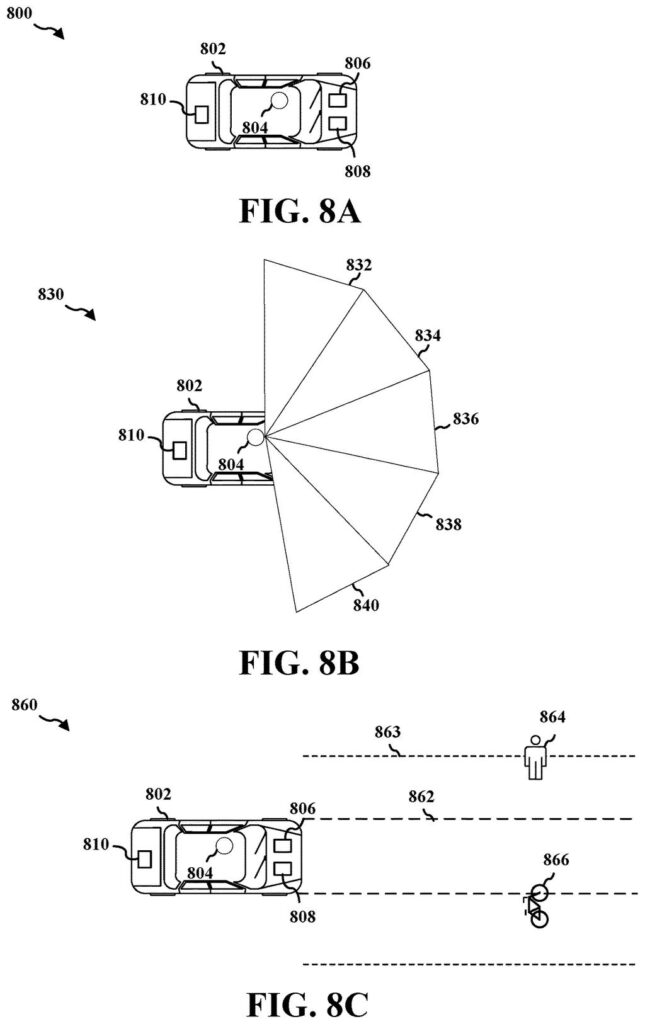
The claims cover a computer in or tied to a car (the patent calls it a "user equipment," telecom-speak for a connected device) that compares two gaze patterns. The first is the driver's typical pattern, pulled from memory or sent wirelessly from another device. The second is built from driver-facing sensors over a recent window, such as the last 5 seconds. A gaze pattern here is simply the share of time the eyes spend in each visual zone, like 10% in one zone and 50% in another.
The claimed method then works in four steps:
- Outward-facing sensors track how objects in the car's driving path are moving.
- The system calculates attention conditions (for example, how long the driver looked at an object, or how close an object's predicted path comes to the car).
- Those conditions set the threshold for how big a gaze difference counts.
- If the difference in any zone meets that threshold, the driver-assist sensitivity is adjusted.
The description gives concrete examples of sensitivity: an automatic braking trigger moving from three seconds before impact to five, or an alert getting louder, from 60 to 70 decibels. The claimed actions are braking, a visual alert, or an audio alert.
The filing also describes picking the typical pattern by context (location, weather, time of day, road type, such as a school zone versus a freeway), using different thresholds for different zones (10% near the center of the path, 20% near the edge), and resetting after about 5 minutes of normal looking. Another nearby vehicle can supply the object data.
… obtain a second gaze pattern of the driver of the vehicle based on a first set of sensor data from a first set of sensors associated with the vehicle during a first period of time.
Translation: Sensors inside the car track where the driver is looking over a specific timeframe.
Why earlier warnings come with a camera on you
Today's driver-assist features mostly react to the world outside: a car ahead, a person in the road. This filing puts you into the equation. The idea is that a driver whose eyes are in unusual places gets help earlier, before an emergency stop is the only option. The description points out that some drivers keep staring at a threat right up to the crash, so a system that only asks "are you looking at that object?" can miss the problem.
It also raises a privacy question. A camera would be studying your eyes, and your usual gaze habits would be stored on the car or in a remote database. The filing mentions identifying drivers by facial recognition or an RFID chip. It does not say how often earlier alerts would turn out to be false alarms.
Qualcomm's 55th filing we've tracked since July adds to their fog and brake light work and sensor-merging patent in our self-driving sensing race watchlist.
For a driver, the payoff is a warning that arrives a couple of seconds earlier on the days your attention drifts. The filing's own example moves a braking trigger from three seconds before impact to five, and two seconds is a long time at highway speed.
You would mostly notice it as a car that gets a bit more jumpy when you are distracted and stays calm when you are on your game. Using your own habits as the baseline makes sense, since a nervous new driver and a 20-year commuter look in very different places.
The price is a camera that studies your eyes and a profile of your habits, and the filing says little about who gets to see that profile. Whether you would trade that for earlier warnings is the real question for drivers.
Get our take in your Top Stories
Liked this breakdown? Add Patentlyze as a preferred source on Google, and our plain-English take shows up more often in your Top Stories the next time Qualcomm patent news breaks.
There are more where this came from
We read every patent application Big Tech publishes and send you the ones worth knowing. Plain English, free, every week.
The drawings
14 drawing sheets from US 2026/0346859 A1 · click any drawing to enlarge


Show the other 6 sheets


Want this weekly breakdown for a company we don't cover? Patentlyze Pro →
Be the first to weigh in