
Apple Files Patent for Headset Images That Don't Lag When You Turn Your Head
Apple's filing has a paired phone draw extra angles of a virtual scene before you turn your head, so your headset already has an image that matches where you end up looking.
What Apple's extra-angle headset patent does
A woman wearing a headset turns her head to the right to peek around a virtual vase sitting on her real kitchen table. The headset is still showing the scene from a split second ago, so the vase hiding behind the first one hasn't appeared yet. It's a small glitch, but your eyes and inner ear notice it fast, and it can leave you feeling off.
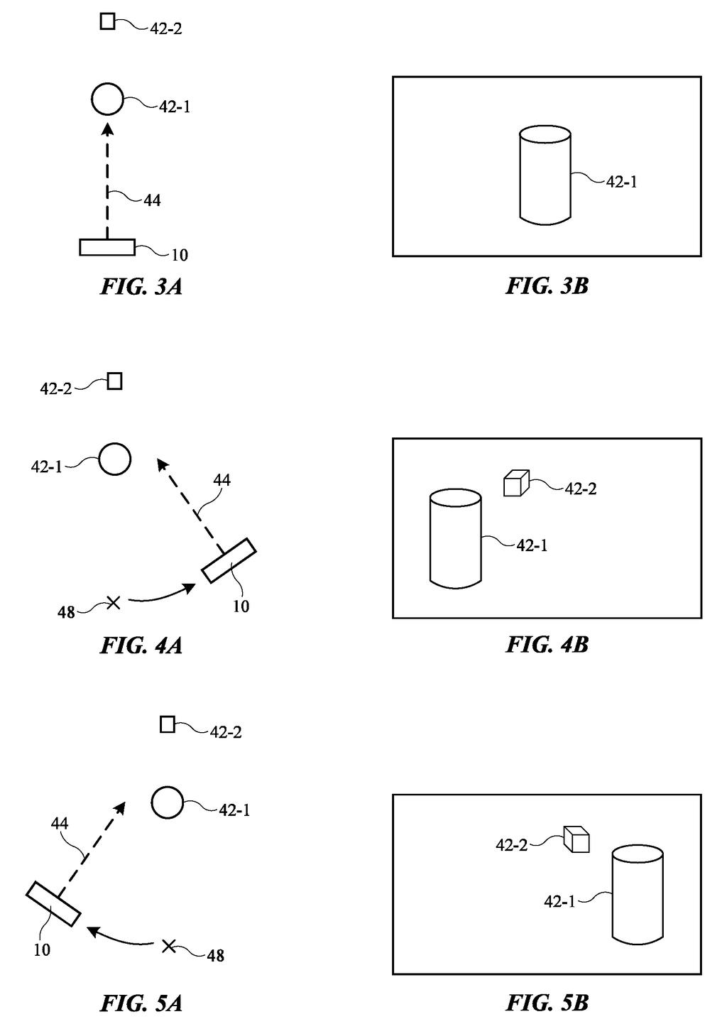
Apple's patent describes a fix. A headset can lean on a paired phone, tablet or laptop to do the heavy picture-drawing, then receive the finished images over the air. In this setup, the phone draws the view it expects you to be looking at, plus a few extra views from nearby angles, and sends them all together.
If your head ends up somewhere the phone didn't guess, the headset can grab the closest extra view instead of waiting. The catch is that extra views eat wireless bandwidth, so the phone only draws them when the connection is strong enough.
… rendering a first view of content for a primary viewing angle; for the display frame, rendering a second view of the content for an additional viewing angle that is different than the primary viewing angle …
Translation: The companion device creates multiple visual angles for the same frame in advance.
How the phone picks how many extra views to send
The system pairs a head-mounted device (the headset) with a nearby device such as a phone, watch, tablet or laptop. The headset gathers its head pose (which way your head is pointed and moving, measured with an accelerometer) and sends it to the paired device. The paired device predicts where your head will be when the next frame appears and draws a primary view for that angle. This is called remote rendering (the paired device does the drawing so the headset spends less battery).
The new part is that, for the same frame, the paired device also draws one or more auxiliary views from different angles. Every view holds a separate image for each eye, which creates the sense of depth. The extras can be lower resolution or cover a smaller field of view than the primary view, and all views can be compressed before sending.
How many extras you get depends on the wireless connection. In one example:
- Weak signal: only the primary view.
- Middle signal: the primary view plus two auxiliary views.
- Strong signal: the primary view plus four.
On the headset, if the primary guess was right, it shows that view. If not, it can show a better-matching extra view or blend two views (interpolation, mixing two images to land in between). If a frame never arrives, it can show an older view whose angle fits your current head position.
Pre-rendering may mitigate artifacts caused by latency. However, pre-rendering may require additional network bandwidth. Therefore, pre-rendering may only be performed when the network strength of the wireless connection between the head-mounted device and the paired electronic device is sufficiently strong.
Translation: This speed trick depends on having a strong wireless connection because it demands extra data.
Why headset lag matters for Apple's wearables
If you wear a headset, you want the picture to keep up with your head, and you want the headset itself to stay light and cool. Letting a phone, tablet or laptop do the heavy drawing helps with the second goal, since the filing notes it moves power use off the headset. This patent targets the downside of that arrangement: a wireless link that can hiccup and make the image lag.
By adjusting to signal strength, the system gives you extra protection when the connection is good and backs off when it is not. That could mean fewer visual glitches when you turn quickly, and less of the discomfort the filing says lag can cause. It also shows how a headset can lean on the device in your pocket for the hard work.
Apple's 125th filing we've tracked since May on our AR glasses watchlist, after one on lenses that slide to fit and one on sharpening only where both eyes look, adds yet another piece to the picture.
Nobody notices smooth tracking. They notice the moment a virtual object lags behind a head turn, and that moment breaks everything.
This fix works by drawing what you are probably about to see before you see it, and it only spends the extra effort when your connection is strong enough to handle it. On a weaker signal, it backs off automatically. You get the best experience the situation allows, without touching a setting.
The honest limit is a sudden unexpected move, which no prediction catches. But for the natural, continuous motion of someone looking around a room, this closes the gap between what your head does and what your eyes see.
Get our take in your Top Stories
Liked this breakdown? Add Patentlyze as a preferred source on Google, and our plain-English take shows up more often in your Top Stories the next time Apple patent news breaks.
There are more where this came from
We read every patent application Big Tech publishes and send you the ones worth knowing. Plain English, free, every week.
The drawings
5 drawing sheets from US 2026/0349502 A1 · click any drawing to enlarge


Want this weekly breakdown for a company we don't cover? Patentlyze Pro →
Be the first to weigh in