
Apple Files Patent for Headset Graphics That Sharpen Only Where Both Eyes Look
Headsets already blur whatever you aren't looking at, but shaky eye tracking forces them to sharpen a generous patch to be safe. Apple's filing shrinks that patch by checking where the guesses from your two eyes agree.
What Apple's two-eye gaze overlap actually does
Headsets save effort by drawing sharp detail only where you're looking and fuzzier detail everywhere else. The catch is that eye trackers are a bit noisy, so the device can't pinpoint your gaze exactly. To play it safe, it sharpens a big patch around its best guess, and that costs processing power and battery.
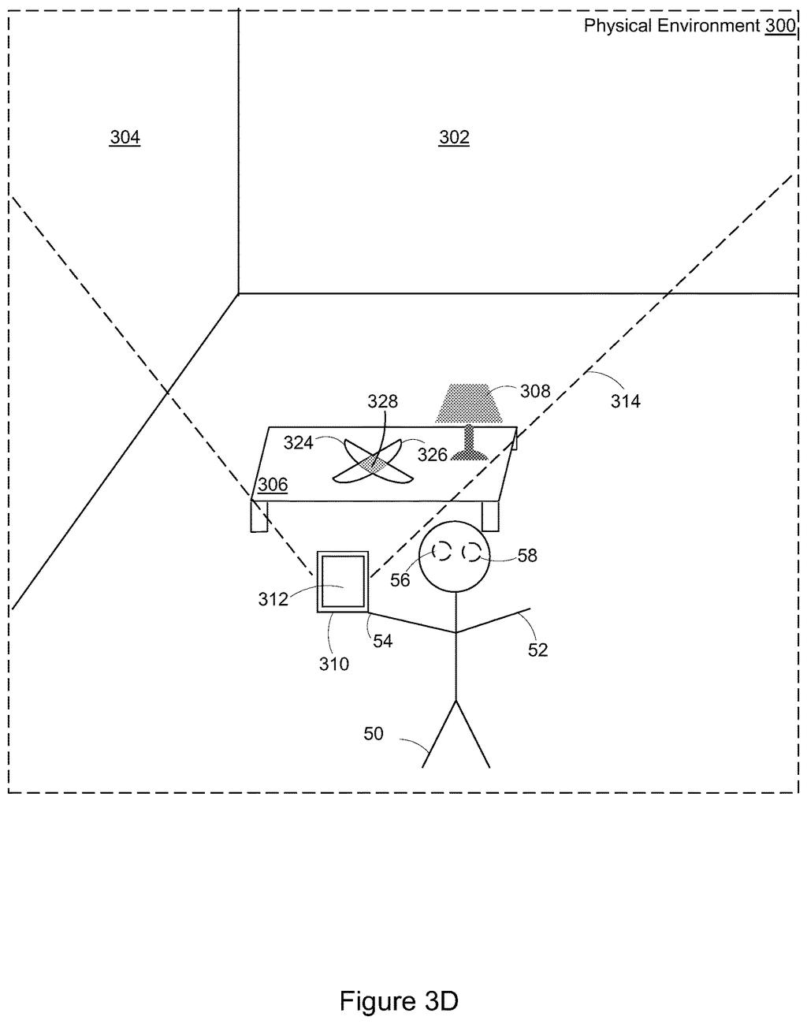
Apple's patent application tracks each eye separately and gets a fuzzy zone of possible focus from each one. Then it looks for the spot where the two zones overlap. That overlap is smaller than either zone alone, so only a small part of a virtual object gets full detail.
In the filing's example, a virtual dog sits on a real table. Its front paws get sharp detail, the upper part of one leg gets medium detail, and the rest of the dog gets rough detail. You'd still see crisp detail where you look, while your device does less work.
obtaining, from the eye tracking system, gaze data indicative of a first volumetric gaze region and a second volumetric gaze region, wherein the first volumetric gaze region is associated with a first eye of a user, and wherein the second volumetric gaze region is associated with a second eye of the user; …
Translation: The headset tracks where each of your eyes is looking independently.
How Apple finds the spot both eyes agree on
The device's eye tracking system produces a volumetric gaze region for each eye. That's a 3D zone of space (the filing mentions spheres and half-spheres) where that eye might be focused. The zone's size reflects uncertainty: noisier tracking, or a target that's farther away, means a bigger zone.
The system then finds the intersection region, where the two zones overlap. It can do this in 3D by moving both zones into a shared frame of reference, or in 2D by flattening them onto a plane at the estimated vergence depth (the distance where your two eyes' lines of sight meet). Any part of a virtual object that overlaps the intersection gets the first rendering setting, such as high resolution.
The dog example uses three tiers:
- High detail: parts inside the overlap (the front ankle and feet).
- Medium detail: parts inside one eye's zone but outside the overlap (the upper front right leg).
- Low detail: parts outside both zones (head, torso, back legs).
The filing also describes variations. Each eye can have its own confidence level, and each eye's image can be rendered separately. On a device that shows camera views of the room, the left or right camera can be set to a higher resolution or frame rate depending on which one sees more of the sharp area.
The rendering parameters may be based on overlap between the first portion of the object and the first and second volumetric gaze regions.
Translation: Graphics get sharper right where both of your lines of sight intersect.
What this means for headset battery and processing
If this works as described, a headset could draw the same scene with less processing and less battery drain, or spend the savings on sharper detail where you actually look. Less effort goes into parts of a virtual object you aren't looking at, and less data has to move through the device's graphics pipeline.
The application mentions head-mounted displays and AR glasses, where battery and chip limits are tight. The savings depend on distance: gaze zones grow as you look farther away, so objects across the room get a bigger sharp area than ones in your hands. The filing gives no measured savings figures.
Apple's 123rd filing we've tracked since May in our AR glasses work, it builds on ideas like floating resizable surfaces and warped hand fixes in headset views.
Shrinking the sharp zone is a bet that the eye tracking is right. If the overlap guess lands a little off, you could look at something that's still drawn in rough detail, and a blurry patch right where you're looking is the flaw people notice fastest. The filing offers no numbers on how often that might happen.
There's a second cost. The farther away you look, the bigger the gaze zones get, so the overlap grows and the savings shrink. A headset gets its biggest break on nearby objects and a smaller one on a distant wall.
The medium-detail tier softens the risk, since areas covered by just one eye still get decent detail and a wrong guess fades out gently. For a headset where battery and chip limits are constant, that trade reads as worth it. It's a sensible refinement of an existing technique, with a modest payoff that depends on how good the eye tracking is.
Get our take in your Top Stories
Liked this breakdown? Add Patentlyze as a preferred source on Google, and our plain-English take shows up more often in your Top Stories the next time Apple patent news breaks.
There are more where this came from
We read every patent application Big Tech publishes and send you the ones worth knowing. Plain English, free, every week.
The drawings
10 drawing sheets from US 2026/0349505 A1 · click any drawing to enlarge


Show the other 2 sheets


Want this weekly breakdown for a company we don't cover? Patentlyze Pro →
Be the first to weigh in