
Google Files Patent for Devices That Predict Their Own Overheating
Your phone usually waits until it is nearly too hot before it slows down. Google's patent application has it predict its temperature a minute or two ahead and act first.
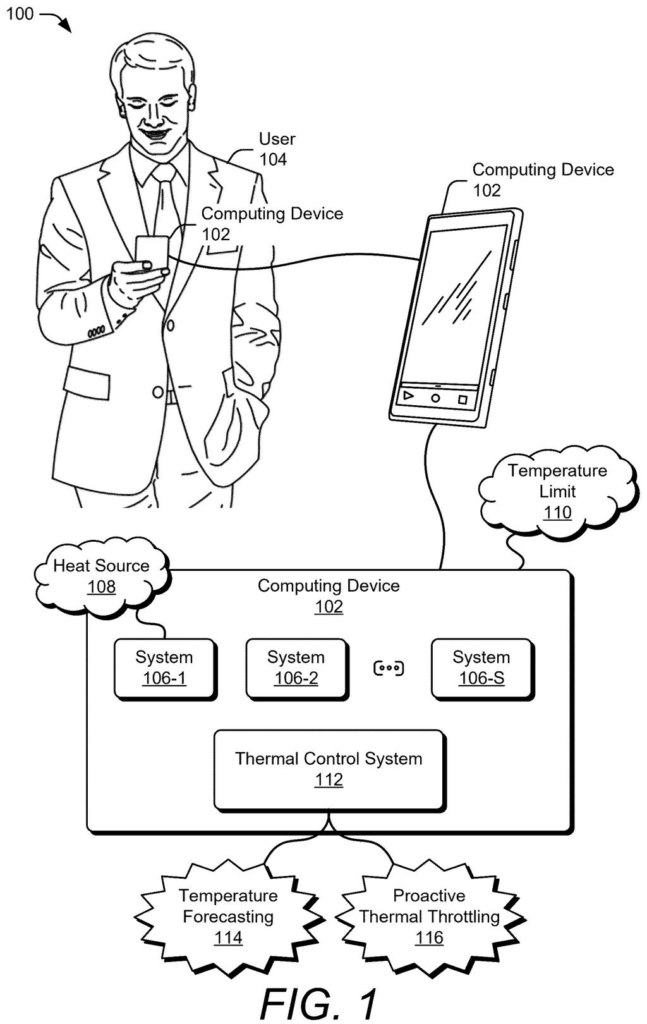
What Google's heat-forecasting device does
Ever notice your phone get hot during a long video call, then suddenly turn sluggish and dim the screen? That slowdown happens because the device waits until it is already close to its heat limit, then hits the brakes.
Google's patent application describes a different approach: guess the future. The device keeps checking its own temperature, uses those readings to predict how hot it will be in a minute or two, and only starts cooling or slowing down if that prediction crosses a line it wants to avoid.
The idea is that your phone doesn't back off too early, which wastes performance, or too late, which risks overheating. It can also look at things like how much power it is using to make a better guess.
generate forecasted temperature data based at least on the first measured temperature data, the forecasted temperature data comprising multiple forecasted temperatures of the computing device that are associated with a forecast time period that is shifted forward in time relative to the first time period based on a forecast window of the thermal control system; …
Translation: The device looks at current temperatures to predict how hot it will get in the near future.
How the forecaster learns from its own misses
The device has one or more thermal sensors that sample its temperature over time. A thermal control system takes those readings and builds a forecast of temperatures a short time into the future. The filing gives a forecast window of one or two minutes as an example. If any forecasted value reaches the target temperature, the system starts cooling.
That target sits just under the device's real temperature limit, within about 1% in the examples. The filing says older methods either wait until the measured temperature hits the target (and then overshoot the limit before cooling takes effect) or start early at a lower threshold (and waste power or performance). Forecasting is meant to avoid both problems.
Cooling can be active, like turning on a fan, or passive, like lowering clock speed (how fast the chip runs), dimming the screen, or dropping to a low-power state. The forecast can also use extra context: power draw, how close the user is, a foldable's hinge angle, or whether the flashlight is on.
The forecaster is a trained neural network (software that learns patterns from examples). One version adds a learning loop: it compares past forecasts with what really happened, trains a small correction model, and adds that correction to the forecast. A limiter caps the correction, for example at plus or minus 2 degrees Celsius, as a safeguard.
… to protect the computing device from being damaged due to overheating, to maintain reliability of the computing device, and to avoid creating a potentially unsafe situation for the user to operate the computing device.
Translation: This prevents hardware damage and keeps the device safe for people to hold.
Why a hot phone might slow down less often
For you, the payoff would be fewer abrupt slowdowns. If a device can predict that it will settle below its limit, it can skip the fan and keep full speed. If it sees trouble coming, it can start easing off early, which beats a sudden drop in game graphics or video call quality. Because the target can sit closer to the limit, the device can run harder before it needs to hold back.
Heat also changes how a device feels in your hand. The filing says the approach lets the outer casing temperature be managed directly, which affects how comfortable it is to hold. It applies to phones, laptops, TVs, watches and more, so any device that fights heat could use it. The filing even sketches a version for drones, where the same forecasting idea keeps a hover in place.
Google's 36th filing in our cell phone coverage since May adds to a run that includes a camera blur and grain patent and a wand-to-phone color pairing patent we've tracked.
Of everything a company could file, this one is easy to picture shipping. The description says the thermal control system can be software, firmware or fixed circuitry, and it works from sensors most devices already carry, like temperature and power readings. No new hardware appears to be required.
What has to exist first is a trained prediction model for each device design, since a thin phone and a laptop heat up very differently. The self-correcting version, with its capped adjustment of plus or minus 2 degrees Celsius, shows the design plans for wrong guesses and limits the damage they can do.
The shortest route to a product is a system update that swaps the old wait-and-react rule for a forecast. You would likely never see it, only notice fewer sudden slowdowns. That makes it routine in spirit and practical in effect.
Get our take in your Top Stories
Liked this breakdown? Add Patentlyze as a preferred source on Google, and our plain-English take shows up more often in your Top Stories the next time Google patent news breaks.
There are more where this came from
We read every patent application Big Tech publishes and send you the ones worth knowing. Plain English, free, every week.
The drawings
6 drawing sheets from US 2026/0349485 A1 · click any drawing to enlarge


Want this weekly breakdown for a company we don't cover? Patentlyze Pro →
Be the first to weigh in