
Google Files Patent for a Phone Chip That Sees Overheating Coming
Your phone usually slows itself down only after it gets hot. Google's patent has the chip guess the heat before it arrives and shuffle the work around in time.
What Google's overheating-prediction chip does
Every time you start a video call or launch a game, your phone's chip faces the same tradeoff: work hard enough to keep things smooth, but not so hard that the battery drains or the back of the phone gets uncomfortably hot.
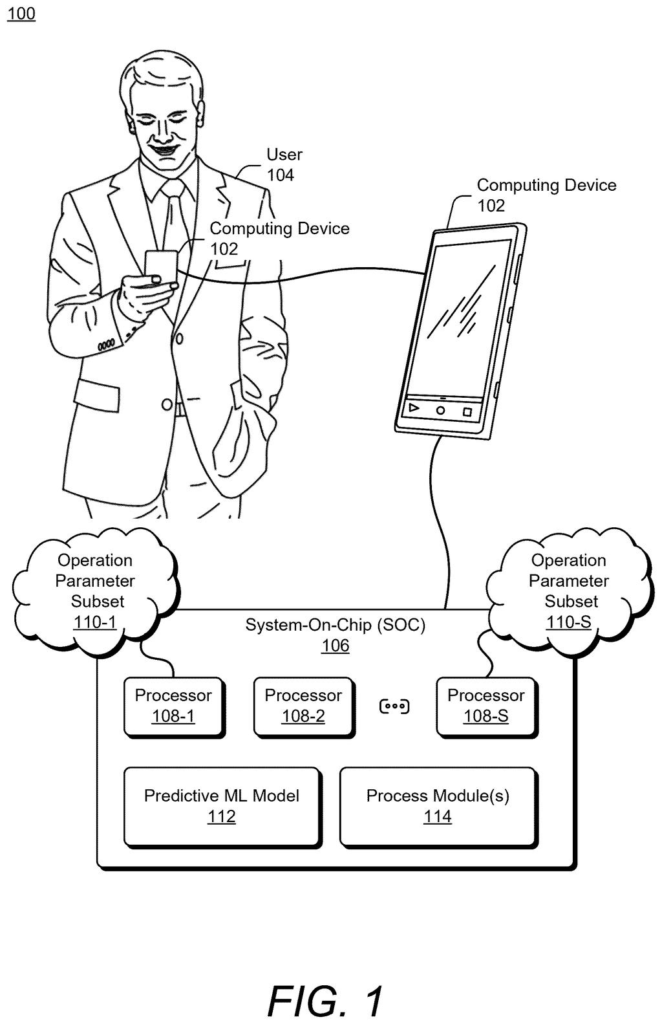
Google's patent describes a chip that keeps a small AI model watching the temperature and workload of each of its processing cores. Instead of waiting for a core to overheat, the model guesses how hot it will be a few moments from now, and other parts of the chip act on that guess.
In the filing's gaming example, one core is heating up fast while another stays cool. The chip slows the hot one down, speeds up the cool one, and can move work between them, so the game keeps running without the phone cooking itself.
… generating, by one or more process modules and based on the one or more prediction outputs, a command for the one or more processors, the command configured to change one or more of the one or more operating conditions of the one or more processors.
Translation: The chip uses the forecast to automatically issue commands that alter how the processors run.
How the chip hands hot tasks to cooler cores
The patent covers a method run by a system-on-chip (the single piece of silicon that acts as the brain of a phone or similar gadget). The chip collects readings about its own processors, such as temperature, power output and operating speed (called frequency). It feeds those readings into a machine-learned model (an AI model trained on how the chip behaved in the past), which predicts what the readings will be at a later moment.
That prediction goes to a set of "process modules," which can be hardware, software or a mix of both. The filing describes several:
- Task categorization: sorts jobs into critical ones (video calls, anything you are tapping on) and background ones (maintenance work that can wait).
- Core analyzer: ranks cores by thermal headroom (how much room a core has before it hits its heat limit) and suggests moving tasks. Important work goes to faster cores, and low-priority work goes to energy-efficient ones.
- Decision module: turns the prediction and suggestions into actions, such as throttling (deliberately slowing a core).
- Filtration module: smooths out noisy readings before they reach the model.
The decision module feeds two control paths. One reacts to the heat right now, and the other guards the chip's long-term health when a temperature spike is predicted. Their outputs are combined into a final setting, in one version by simply taking the lower of the two.
Timing matters too. The filing notes that a chip predicted to hit 100°C in 10 seconds deserves a different response than one predicted to hit it in 2 seconds. The model can also be retrained with new data, on the device or remotely, and the system can keep an idle core in reserve for sudden high-priority jobs.
The plurality of parameters are used as an input for an ML-based model, which outputs a prediction of future parameters.
Translation: Data about current conditions is fed into an artificial intelligence model to forecast future states.
Why your phone could stay cooler without lagging
If this works as described, you would feel it as a phone that holds up better during long gaming sessions, video calls or navigation, with fewer sudden slowdowns and less heat in your hand. The filing frames the whole thing as balancing speed, battery life and temperature for whatever you are doing at the moment.
The patent is not limited to phones. It lists laptops, tablets, watches, earbuds, VR and AR headsets, game systems and even vehicles as places the idea could run. It gives no performance numbers and names no product, so what it offers is a design for how a chip could plan ahead rather than react late.
Google's 17th filing we've tracked in the AI chip wars since July builds on earlier applications like skipping blank video to save battery and one reading app launches for power.
If you have ever had a phone get hot and then stutter in the middle of a game or a call, this filing is aimed at that exact moment. The idea is to see the heat coming and shift the work before the slowdown has to happen.
A good version of this would show up as nothing at all: smoother frames late in a long session and a phone that is less uncomfortable to hold. The filing gives no numbers on how much better it performs, so the benefit is a promise on paper for now.
The logic is sound for anyone who games or video chats on a phone. A few seconds of warning beats a panic response, and that is the whole pitch.
Get our take in your Top Stories
Liked this breakdown? Add Patentlyze as a preferred source on Google, and our plain-English take shows up more often in your Top Stories the next time Google patent news breaks.
There are more where this came from
We read every patent application Big Tech publishes and send you the ones worth knowing. Plain English, free, every week.
The drawings
11 drawing sheets from US 2026/0310960 A1 · click any drawing to enlarge


Want this weekly breakdown for a company we don't cover? Patentlyze Pro →
Be the first to weigh in