
Apple
Apple · Networking · Filed Jan 18, 2025 · USPTO published Nov 12, 2026 · This week's release
Apple Files Patent for Saving Phone Battery While Scanning for Satellite Signals
Your phone is always taking quick looks at nearby signals, and every look costs a little battery. This Apple filing is about deciding when two of those looks are so close together that the phone can safely do just one.
- Publication number
- US 2026/0362349 A1(US20260362349A1)
- Applicant
- Apple Inc.
- Filed · Published
- Jan 18, 2025 · Nov 12, 2026
- Inventors
- Jie Cui, Yang Tang, Dawei Zhang, Qiming Li, Chunxuan Ye, Fangli Xu, Hong He, Xiang Chen, Manasa Raghaven
- Status when we published
- Waiting for an examiner
- Document
- 20 claims
- US classification
- 370/328
- Examiner
- SUNDARA, NICK ANON (Art Unit 2479)
- Parent application
- National Stage Entry of PCT/US2023/028780 (filed Jul 27, 2023)(PCTUS2023028780)
What Apple's satellite signal-check patent does
Imagine you're out hiking with your phone linked to a satellite. Every so often it has to pause, glance around, and check how strong the nearby signals are, so it can switch to a better one if needed. Each glance uses a little battery.
Sometimes two of those glances get scheduled almost on top of each other. The usual rule says that if they are too close (the filing gives about 4 milliseconds as an example), the phone treats them as a collision and does only one. Apple's filing says that rule can be too blunt. Two glances can sit inside windows that look crowded even though the glances themselves are far enough apart to do both.
So Apple describes a finer check. The phone first sees whether the windows are crowded, then looks at the actual glances inside them. Only the ones that truly clash get skipped, which leaves more chances to measure without wasting power.
… determine whether a collision occurs between the first SMTC occasion and the second SMTC occasion or between the first SMTC occasion and a measurement gap; and in response to the collision occurring, perform the SSB measurement in the first SMTC occasion or the second SMTC occasion.
Translation: The phone checks if two scanning schedules overlap and decides to run only one to save power.
How the phone decides which checks to skip
Phones don't listen to every nearby signal all the time, because that would drain the battery. Instead, the network hands the phone short listening windows (the patent calls them SMTC occasions) that say when to measure signal strength. Separately, the network can schedule a measurement gap, a pause in normal service where the phone tunes away to check other frequencies or networks.
Claim 1 covers a phone that receives two such windows, works out whether they collide with each other or with a measurement gap, and if so measures in only one of them. If there is no collision, it measures both. A collision can mean overlapping in time or sitting within a proximity threshold of each other. Claim 16 gives 4 milliseconds as the example cutoff.
The filing describes a two-step check:
- First, test whether the two measurement gaps are close together.
- If they are, examine the individual windows inside them, using every pair, just the closest pair, or a reference window the network points to.
- Add allowance for retuning time, the moment the phone's radio needs to switch frequencies: the gap threshold plus one retuning time, or two when two gaps are involved. With 1 ms of retuning, that works out to about 5 or 6 ms.
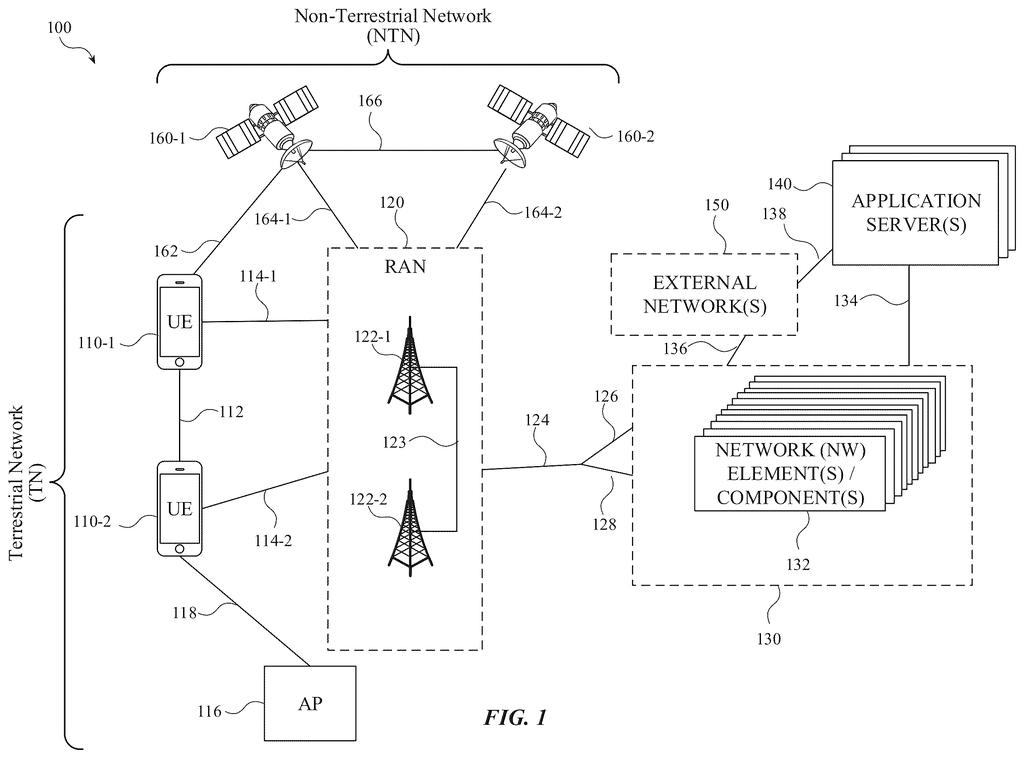
The filing says this is especially relevant for phones connected to satellites, which can act as relays or as base stations.
Why this matters for satellite battery life
The practical payoff is battery life and cleaner connections. A phone that skips a measurement only when it truly has to spends less energy on unnecessary checks, and it gets more chances to measure within each cycle. That matters for any phone that holds a radio link for a long time, including links to satellites far overhead.
The filing doesn't name a product, and you would never see this feature on a screen. It lives in the radio chip's rulebook for when to measure. It reads like a refinement meant to remove ambiguity in how phones follow wireless standards, and small details like this decide whether a phone's modem sips power or gulps it.
Apple's 647th filing we've tracked in our Apple coverage since May adds to a run of headset work that includes patents on a sliding forehead pad and lag-free head-turn images.
Source: US 2026/0362349 A1 at the USPTO (PDF). Full patent text and figures are in the official publication.
Get our take in your Top Stories
Liked this breakdown? Add Patentlyze as a preferred source on Google, and our plain-English take shows up more often in your Top Stories the next time Apple patent news breaks.
Add Patentlyze on Google
One click.
There are more where this came from
We read every patent application Big Tech publishes and send you the ones worth knowing. Plain English, free, every week.
The drawings · 12 sheets
12 drawing sheets from US 2026/0362349 A1 · click any drawing to enlarge


Show the other 4 sheets


More from Apple
All 672 Apple patents →
More in Networking
All 498 Networking patents →
Qualcomm
Qualcomm Patents a Battery-Saving Sync System for 3D Video Calls
Qualcomm
Qualcomm Patents a Method to Save Battery While Your Phone Searches for Nearby Devices
Qualcomm
Qualcomm Patents a System That Tells Your Phone Which Satellite to Point At
Samsung
No comments yet