
Apple · Filed Mar 17, 2025 · Published Nov 5, 2026

Apple Patents a Dial That Buzzes Harder as You Near a Setting's Limit

Apple has filed for a physical control that tells your fingertips when you're running out of room. The closer you get to the end of a setting, the harder it buzzes.
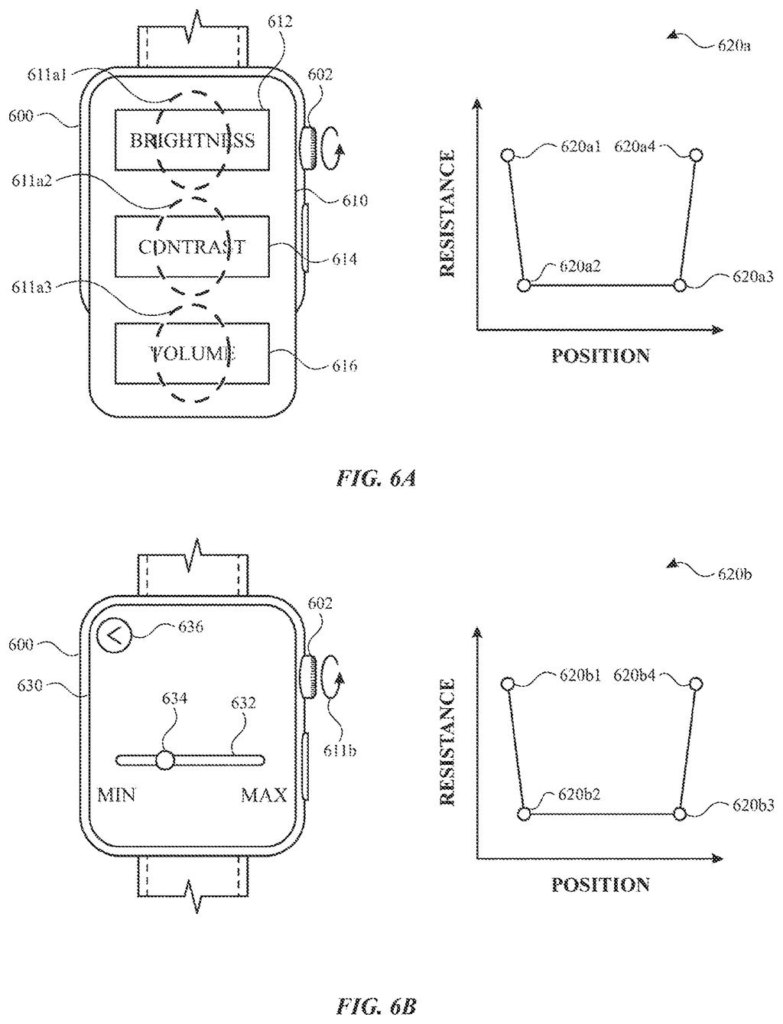
A smartwatch dial pushes back against a wearer's finger as an on-screen slider approaches its minimum or maximum limit. Drawing from patent filing US 2026/0349540 A1.
A smartwatch dial pushes back against a wearer's finger as an on-screen slider approaches its minimum or maximum limit.
See all 27 drawings from this filing ↓
Publication number US 2026/0349540 A1 US20260349540A1
Applicant Apple Inc.
Filing date Mar 17, 2025
Publication date Nov 5, 2026
Inventors Arian BEHZADI, Stephen B. LYNCH, Andrew S. KIM, Christopher P. FOSS, Corey K. WANG, Andrew W. KOOKER, Kurt R. STIEHL, Matthew J. ALLEN, Camille MOUSSETTE, Gemma A. ROPER, Megan M. SAPP, Steven J. TAYLOR, Julian JAEDE
US classification 345/184
Status when we published Waiting for an examiner (Mar 17, 2025)
Parent application is a National Stage Entry of PCTUS2023033560 (filed 2023-09-23)
Document 15 claims

What Apple's buzzing dial actually does

You're turning a dial to raise the volume, and you can't tell how close you are to the top without staring at the screen. Apple has a patent application for a physical control that answers this by touch.

When the dial gets within a set distance of a limit, it starts to buzz, and the buzz gets stronger the closer you get. Away from the limit it stays quiet, so the buzz only shows up when it has something to tell you. Your fingertip learns the end of the range before your eyes do.

The filing also covers what happens at the limit. If you reach the end and let go, the control itself can move back the other way, sometimes with its own fading buzz or none at all. A speaker can add a sound as you turn.

From the filing · CLAIM 99
… causing the physical input mechanism to provide a set of haptics with intensity levels that change in a first manner as the physical mechanism is moved in the first direction.

Translation: Making the dial vibrate differently as you keep turning it near the edge.

How the buzz grows as the dial nears its end

The claims cover a method for a computer system connected to a physical input mechanism, meaning a control you move with your hand, such as a rotating dial. The system tracks where the mechanism is as you move it in one direction. Once it is within a threshold distance of a target position (for example, the end of a range of values), it plays a set of haptics (small, precise vibrations you feel through your fingers) whose strength changes in a set pattern.

The patterns the claims describe:

  • A series of haptics, each stronger than the last, as the mechanism moves farther toward the target.
  • Or a single haptic that grows stronger over time as you keep moving.
  • No haptics at all while the mechanism is outside the threshold distance.

Then comes the return move. When the mechanism reaches the target position and certain criteria are met, such as your finger no longer touching it, the system makes the mechanism move itself in the opposite direction. That return can have its own haptics that change in a different way, for instance starting strong and getting weaker. It can also move back with no haptics.

The filing also describes an on-screen bar showing the range of a setting and a marker for the current value, which moves as you move the control. A speaker can play a sound alongside the buzz. The longer description covers related versions too, where different settings get different resistance, stopping distances or resting positions.

Why Apple cares about the feel of a dial

The practical payoff is feeling where a setting ends without looking. For things like volume or brightness, a growing buzz warns you before you hit the limit, so you overshoot less and glance at the screen less. That helps most when your eyes are busy with something else.

The filing says its goal is fewer wasted inputs, less cognitive burden and better battery life, which is typical language for interface work. Because the feedback changes with the type of setting, one physical control could feel different depending on what it is adjusting. That points to Apple treating the feel of a hardware control as something software can design.

Apple's 11th filing in input and haptics we've tracked since May adds to a run that includes a touch-sensing MacBook case and hand-wave Siri controls.

Editorial take

Anyone who has spun a volume control past the level they wanted knows the problem. A plain dial gives no hint of where its range ends. It costs a second or two each time and pulls your eyes to a screen, so the pain is small but constant.

The fix here fits that size. A stronger buzz as you approach the limit uses your sense of touch, and the self-return move gives a clear finish when you let go. Nothing in it asks you to learn a new habit.

The claims are narrow: a buzz pattern near a position, plus a return move. That makes it a careful refinement for a modest annoyance, and the best result would be one you stop noticing because it just feels right.

Get our take in your Top Stories

Liked this breakdown? Add Patentlyze as a preferred source on Google, and our plain-English take shows up more often in your Top Stories the next time Apple patent news breaks.

There are more where this came from

We read every patent application Big Tech publishes and send you the ones worth knowing. Plain English, free, every week.

The drawings

27 drawing sheets from US 2026/0349540 A1 · click any drawing to enlarge

Phone parts that run apps and buzz on tap, drawing sheet 1 from US 2026/0349540 A1
Sheet 1 Phone parts that run apps and buzz on tap
Software translating taps and button presses into actions, drawing sheet 2 from US 2026/0349540 A1
Sheet 2 Software translating taps and button presses into actions
A touch screen phone buzzing from finger pressure, drawing sheet 3 from US 2026/0349540 A1
Sheet 3 A touch screen phone buzzing from finger pressure
Computer internals connected to an external touch pad, drawing sheet 4 from US 2026/0349540 A1
Sheet 4 Computer internals connected to an external touch pad
An app home screen on a handheld device, drawing sheet 5 from US 2026/0349540 A1
Sheet 5 An app home screen on a handheld device
Moving an on-screen pointer using a separate pad, drawing sheet 6 from US 2026/0349540 A1
Sheet 6 Moving an on-screen pointer using a separate pad
External rotatable dials and buttons on a smartwatch casing, drawing sheet 7 from US 2026/0349540 A1
Sheet 7 External rotatable dials and buttons on a smartwatch casing
Watch components linking rotating knobs, motion sensors, and the screen, drawing sheet 8 from US 2026/0349540 A1
Sheet 8 Watch components linking rotating knobs, motion sensors, and the screen
Show the other 19 sheets
Corner sensors measuring pressure from touches across a screen, drawing sheet 9 from US 2026/0349540 A1
Sheet 9 Corner sensors measuring pressure from touches across a screen
Calculating the force of individual finger presses on the display, drawing sheet 10 from US 2026/0349540 A1
Sheet 10 Calculating the force of individual finger presses on the display
Selecting an app icon using light pressure on a touchpad, drawing sheet 11 from US 2026/0349540 A1
Sheet 11 Selecting an app icon using light pressure on a touchpad
Pressing harder on an app to reveal a recent document, drawing sheet 12 from US 2026/0349540 A1
Sheet 12 Pressing harder on an app to reveal a recent document
Pushing deeper to reveal additional documents from the app, drawing sheet 13 from US 2026/0349540 A1
Sheet 13 Pushing deeper to reveal additional documents from the app
Reaching maximum press intensity to show all available files, drawing sheet 14 from US 2026/0349540 A1
Sheet 14 Reaching maximum press intensity to show all available files
Adding physical resistance as a dial approaches setting boundaries, drawing sheet 15 from US 2026/0349540 A1
Sheet 15 Adding physical resistance as a dial approaches setting boundaries
Generating tactile clicks between distinct setting levels on a dial, drawing sheet 16 from US 2026/0349540 A1
Sheet 16 Generating tactile clicks between distinct setting levels on a dial
Feeling vibration feedback while adjusting different watch settings, drawing sheet 17 from US 2026/0349540 A1
Sheet 17 Feeling vibration feedback while adjusting different watch settings
How the dial changes its movement feel for different tasks, drawing sheet 18 from US 2026/0349540 A1
Sheet 18 How the dial changes its movement feel for different tasks
Enabling touch feedback only for specific on-screen controls, drawing sheet 19 from US 2026/0349540 A1
Sheet 19 Enabling touch feedback only for specific on-screen controls
Mapping different rotation gestures to different device actions, drawing sheet 20 from US 2026/0349540 A1
Sheet 20 Mapping different rotation gestures to different device actions
Turning the dial past the maximum setting triggers buzzing, drawing sheet 21 from US 2026/0349540 A1
Sheet 21 Turning the dial past the maximum setting triggers buzzing
Setting a physical stop point tailored to the active control, drawing sheet 22 from US 2026/0349540 A1
Sheet 22 Setting a physical stop point tailored to the active control
Adding virtual spring resistance as you push past a limit, drawing sheet 23 from US 2026/0349540 A1
Sheet 23 Adding virtual spring resistance as you push past a limit
Ramping up vibration intensity as the dial reaches an edge, drawing sheet 24 from US 2026/0349540 A1
Sheet 24 Ramping up vibration intensity as the dial reaches an edge
An on-screen watch knob snaps back when released, drawing sheet 25 from US 2026/0349540 A1
Sheet 25 An on-screen watch knob snaps back when released
How the watch decides if a knob snaps back, drawing sheet 26 from US 2026/0349540 A1
Sheet 26 How the watch decides if a knob snaps back
Adjusting screen feedback when you reverse the dial's rotation direction, drawing sheet 27 from US 2026/0349540 A1
Sheet 27 Adjusting screen feedback when you reverse the dial's rotation direction
Browse all the drawings 27 drawing sheets
Patent filing page

Source. Full patent text and figures from the official USPTO publication PDF.
Reader comments

Be the first to weigh in

Start the discussion

Real name or a handle, either is fine. Comments are read by a person before they appear, so allow a little time. Keep it about the filing.