
AMD
AMD · AI / ML · Filed May 8, 2025 · USPTO published Nov 12, 2026 · This week's release
AMD Files Patent for Chips That Adjust How Far Ahead a Chatbot Guesses
Chatbots speed up their answers by guessing a few words ahead and having a bigger model check the guesses, but how far ahead to guess is usually fixed. AMD's patent application has the chip adjust that distance on the fly, and steer around lengths where checking suddenly gets slow.
- Publication number
- US 2026/0359674 A1(US20260359674A1)
- Applicant
- Advanced Micro Devices, Inc.
- Filed · Published
- May 8, 2025 · Nov 12, 2026
- Inventors
- Sonali SINGH, Karthik Ramu SANGAIAH
- Status when we published
- Waiting for an examiner
- Document
- 20 claims
- US classification
- 706/46
What AMD's adaptive guess-ahead patent actually does
A junior writer drafts the next five words of a sentence, and a senior editor checks all five at once, crossing out any that are wrong. That is roughly how many AI chatbots speed up their replies, using a trick called speculative decoding. The number of words the junior guesses ahead is usually set in advance and left alone.
AMD's patent application would make that number change while you wait. If the editor keeps approving the guesses, the system lets the junior guess one more word ahead. If the editor keeps rejecting them, it cuts back by one.
There is a second wrinkle. On a given chip, checking a longer draft can suddenly take much more time at certain lengths, like a toll that jumps at particular mile markers. The filing has the chip steer clear of those lengths, so your answer keeps arriving quickly.
determine a moving average acceptance rate for draft length tokens sequentially generated for a large language model (LLM) inference call using speculative decoding (SpD) …
Translation: It tracks how often the AI accepts the words it guesses ahead of time.
How the chip avoids slow draft lengths
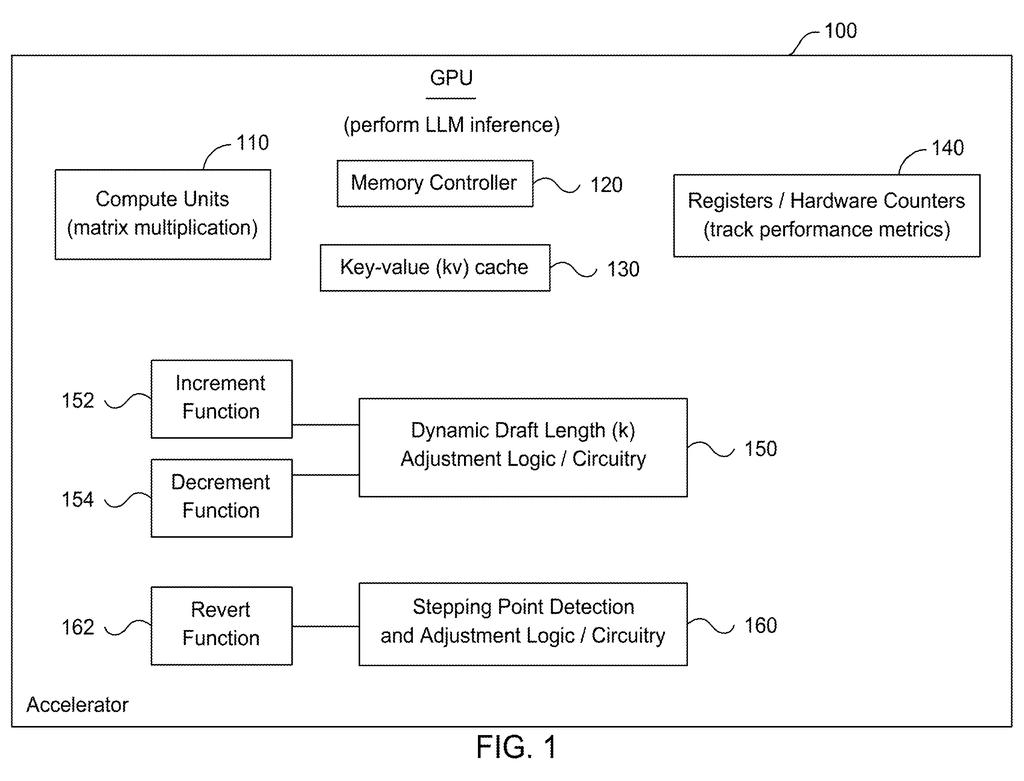
The patent covers circuitry inside a GPU or similar AI chip. In speculative decoding, a small draft model produces K tokens (word fragments) one after another, then the large target model checks all K in parallel. The filing says K is often between 2 and 10 tokens. The new part is that K changes during use.
The first piece is the draft length adjustment circuitry. It tracks a moving average acceptance rate (the share of drafted tokens the big model accepted, averaged over recent drafts) and compares it to a threshold. Above the threshold, K goes up; below it, K goes down. The main example moves K by one at a time.
The second piece is stepping point detection and adjustment circuitry. Stepping points are draft lengths where checking time jumps suddenly. The filing says they are measured ahead of time by profiling the model on the specific hardware and stored in a lookup table, not measured live. Then:
- If raising K lands on a stepping point, K goes back to its previous value.
- If lowering K lands on one, K drops one more step.
- A hysteresis factor (a damper that stops K from flipping back and forth) keeps a backlog count, so K only jumps higher after high acceptance persists.
The claims add that the damper can sit at the midpoint of two consecutive stepping points, or be set from a running average of acceptance rates.
The draft length is incremented when the moving average acceptance rate is greater than the threshold acceptance rate. The draft length is decremented when the moving average acceptance rate is less than the threshold acceptance rate.
Translation: The chip lets the AI guess more words when it is accurate and fewer when it makes mistakes.
What this could mean for AI chatbot speed
If you use a chatbot or a coding assistant, the wait before text appears is the cost you feel most. The filing names real-time AI applications like these as its target, and its aim is to keep the speedup from speculative decoding from eroding when the system guesses too far ahead or lands on a slow spot for the chip.
For AMD, the interesting angle is that the fix lives in the accelerator circuitry and is tuned to the hardware. The filing says slow spots differ from chip to chip, so a setup that works well on one GPU could run poorly on another. A chip that knows its own quirks could help AMD make the case for its hardware in AI serving. Nothing in the filing ties this to a specific product.
AMD's 49th filing we've tracked since May in the AI chip wars watchlist, following work on faster custom model switching and image AI memory cuts, adds another piece to the picture.
Source: US 2026/0359674 A1 at the USPTO (PDF). Full patent text and figures are in the official publication.
Get our take in your Top Stories
Liked this breakdown? Add Patentlyze as a preferred source on Google, and our plain-English take shows up more often in your Top Stories the next time AMD patent news breaks.
Add Patentlyze on Google
One click.
There are more where this came from
We read every patent application Big Tech publishes and send you the ones worth knowing. Plain English, free, every week.
The drawings · 6 sheets
6 drawing sheets from US 2026/0359674 A1 · click any drawing to enlarge


More from AMD
All 119 AMD patents →


More in AI assistant & agent
All 413 AI assistant & agent patents →
Nvidia
A New Nvidia Patent Reworks How Many Chips Share One Chatbot's Workload
Nvidia
A New Nvidia Patent Spreads a Chatbot's Long Memory Across Many Chips
Nvidia
Nvidia Files Patent to Regroup AI Chips in the Middle of Each Chatbot Reply
Microsoft
No comments yet