
A New Nvidia Patent Lets Chip Buyers Claim Control of What Software Runs
Chips only have so many burn-once switches, so Nvidia's patent application turns a simple count of how many have been flipped into a record of who owns the chip.
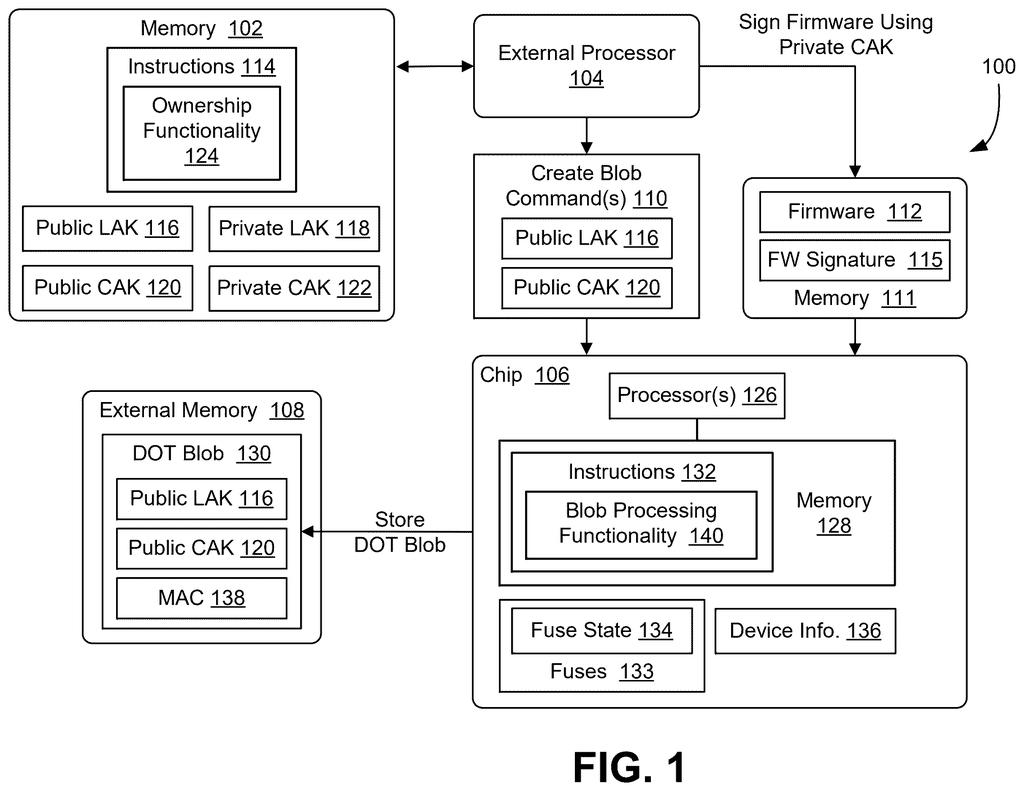
What Nvidia's chip-ownership handoff actually does
Imagine your company buys a rack of Nvidia chips and wants only its own software to run on them. One way to do that is to burn your approval key permanently into each chip, but the space for burned-in data is limited and can never be erased, so every handoff to a new owner uses some of it up.
Nvidia's filing describes a workaround. Your key goes into a small sealed package kept in ordinary outside memory, stamped with a code that only that exact chip can recreate, so nobody can slip in a fake. A tally of tiny one-time switches on the chip, odd for owned and even for free, records whether someone has claimed it.
At startup, the chip checks the seal, pulls out your key, and runs only software that carries your signature.
… a data object (e.g., a binary large object (blob)) may be bound cryptographically to a device (e.g., a silicon chip, a processor, a system, etc.), and data (e.g., keys) stored by the data object may be used to authenticate a command, firmware, and/or software.
Translation: A digital data package locks securely to a specific piece of hardware so its stored keys can verify commands and software.
How the blown-fuse counter and sealed blob work
The claims cover a chip (or a system, or a method) that, during startup, uses a value permanently written into the chip to check a key stored outside the chip. It then uses that key to check firmware (the low-level software that runs a chip's basics) or other software before startup finishes.
The permanent value is a count of blown fuses: tiny one-time switches that can be flipped once and never undone. In the filing's example, an odd count means the chip is owned (locked) and an even count means it is free. Claiming ownership blows one fuse and releasing it blows another, so the count only moves forward.
The key sits in a data object, or blob (just a chunk of data), in outside memory. To seal it to one chip, the chip builds a Message Authentication Code (MAC, a short tamper-evident stamp) from the blob, the fuse count and a chip-unique identifier. At boot:
- The chip recomputes the stamp and compares it with the stored one.
- If they match, it pulls out the owner's keys.
- It uses them to check the signatures on firmware or commands.
Because the fuse count feeds the stamp, releasing ownership makes older blobs fail the check. The filing also describes a lock key for approving ownership changes and a vendor-signed recovery command for a lost blob.
What this means for Nvidia's data center chips
If you run servers, this is about who gets the final say over what starts up on hardware you bought. A chip that can pass cleanly to a new owner, without using up its limited one-time storage, makes reselling or reassigning expensive processors less risky. Claim 12 names data centers directly, and the description also lists autonomous machines, medical devices and financial systems as possible homes.
For everyday readers the effect would be indirect: it is plumbing that helps keep tampered code off the machines behind the services you use. It is also an application, not a granted patent. The examiner's first review rejected the claims as filed, which is routine at this stage and usually followed by amendments.
Nvidia's 66th filing we've tracked in our AI chip wars watchlist since July builds on earlier applications like the chip traffic jam fix and the faster chatbot chip.
Moving the owner's key out of the chip and into ordinary memory saves scarce one-time switches, and it puts the chip's safety on a tamper seal that has to hold up. The seal looks sound, since only that exact chip at that exact switch count can recreate it.
The cost shows up when something goes wrong. Lose or corrupt the key package and the chip cannot boot your software until the manufacturer sends a signed recovery command, so ownership always has the maker standing behind it.
The switch count is the other limit. Each claim and release burns one, so a chip can change hands only a limited number of times, a fair price for hardware that gets resold.
Get our take in your Top Stories
Liked this breakdown? Add Patentlyze as a preferred source on Google, and our plain-English take shows up more often in your Top Stories the next time Nvidia patent news breaks.
There are more where this came from
We read every patent application Big Tech publishes and send you the ones worth knowing. Plain English, free, every week.
The drawings
12 drawing sheets from US 2026/0359441 A1 · click any drawing to enlarge


Show the other 4 sheets


Want this weekly breakdown for a company we don't cover? Patentlyze Pro →
Be the first to weigh in