
Google
Google · AI / ML · Filed May 12, 2025 · USPTO published Nov 12, 2026 · This week's release
Google Files Patent for Phone AI That Scales Itself Down Before Your Device Overheats
Run a chatbot during a video call and your phone can turn into a hand warmer, then start to stutter. A new Google patent application describes a way to shrink the AI's workload on the fly so the heat never gets that far.
- Publication number
- US 2026/0359663 A1(US20260359663A1)
- Applicant
- Google LLC
- Filed · Published
- May 12, 2025 · Nov 12, 2026
- Inventors
- Mohsen Heidarinejad, Arpit Mittal, Arjang Shahriari
- Status when we published
- Waiting for an examiner
- Document
- 20 claims
- US classification
- 706/16
What Google's heat-aware AI chatbot setup does
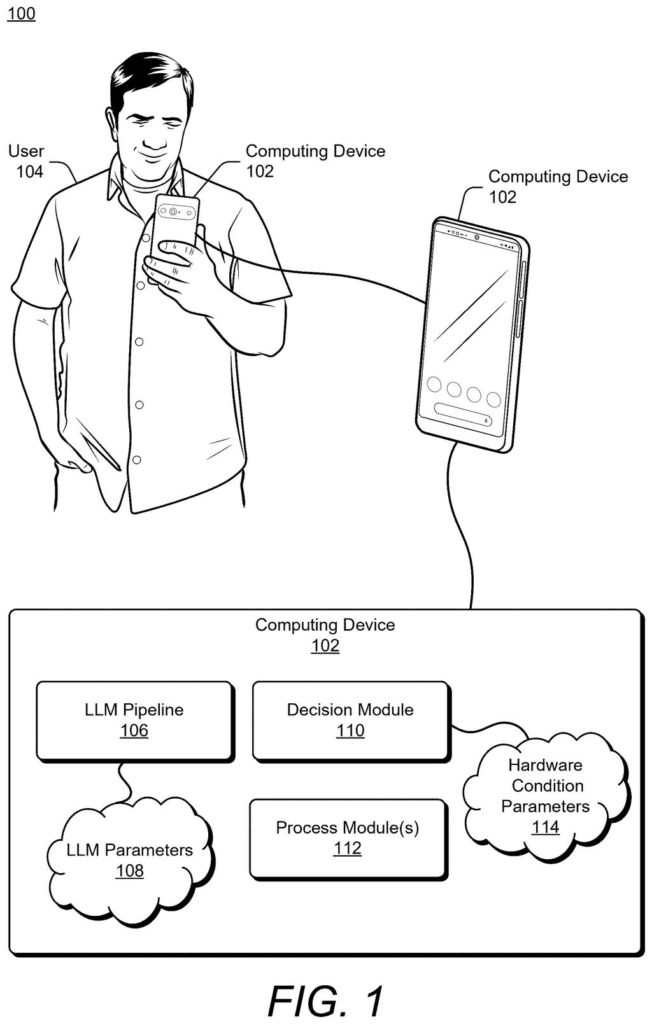
You're on a video call, and you ask your phone's AI to turn the meeting into bullet points. The phone starts to feel warm, the video stutters, and the AI takes forever to answer. Your phone is doing too much at once, and the chip inside is cooking.
Google's filing describes a referee that watches the chip's temperature, its power draw, and how warm the whole device feels. When things heat up, the referee makes the AI do less work. It might remember less of your chat history, skip some of its internal steps, or switch to a lighter version of itself.
The point is to ease off early and gently, instead of letting the phone slam on the brakes once it's already too hot.
… the decision module can dynamically scale computational demands within an LLM pipeline, such as balancing temperature, power, and latency requirements, to make an informed LLM pipeline mitigation decision while maintaining a satisfactory user experience.
Translation: The system adjusts AI workloads on the fly to keep your phone cool without slowing things down too much.
How four monitors tell the AI to ease off
The patent centers on a decision module, a piece of software that sits between the device's sensors and the language model (the AI that writes the answers). It collects readings such as chip temperature, chip power use, and the temperature of the device's outer shell. It also collects suggestions, which the patent calls LLM pipeline configuration (LPC) recommendations, from several helper modules. It then picks or blends them into one new configuration and applies it to the AI.
The helpers each watch something different:
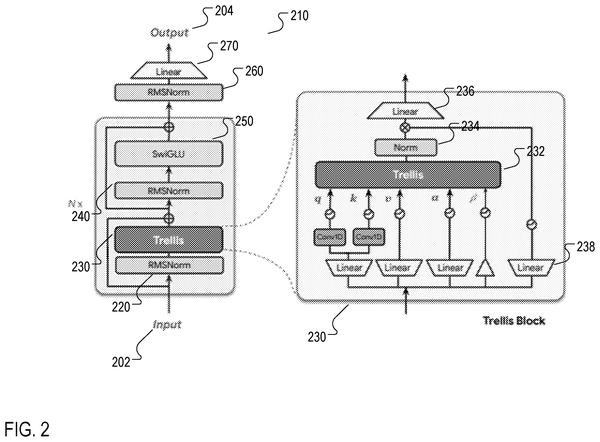
- Fast monitor: checks chip temperature against a limit. In the filing's example, it cuts the prompt history from 2,048 to 1,024 tokens (chunks of text) or drops the model from 32 layers to 24.
- Power monitor: smooths out the power readings with a low-pass filter (a filter that ignores brief spikes). It can switch to a cheaper way of choosing words.
- Enclosure monitor: watches the device's outer temperature, with one example limit of 39 °C. It can move the AI's work to a more efficient part of the chip.
- Selective scaling: trims whichever part of the AI burns lots of power without making answers much faster.
A prediction module, which can be a machine-learned model, forecasts upcoming temperatures and even the likelihood that you will use the AI soon. That lets the system avoid unneeded slowdowns when there is still thermal headroom.
Why your phone's AI may soon run cooler
If your phone, watch, or glasses are going to run AI all day, heat becomes the limit. Today a hot device often just throttles hard, and everything stutters, including the video call you were on. A system that trims only the AI's workload, and does it early and gradually, could keep the rest of your phone smooth and the case comfortable to hold.
The filing lists phones, watches, glasses, earbuds, VR headsets, cars, and more. That suggests the same idea could apply to nearly any gadget with a small chip and an AI feature. Google's interest in running AI directly on devices makes sense here: on-device AI only works if the hardware can handle it without cooking itself.
Google's 26th filing we've tracked since July in the AI chip competition follows one on rewriting chip instructions with AI and one on a sectioned chip with memory lanes, showing how the company keeps rethinking chip design.
Source: US 2026/0359663 A1 at the USPTO (PDF). Full patent text and figures are in the official publication.
Get our take in your Top Stories
Liked this breakdown? Add Patentlyze as a preferred source on Google, and our plain-English take shows up more often in your Top Stories the next time Google patent news breaks.
Add Patentlyze on Google
One click.
There are more where this came from
We read every patent application Big Tech publishes and send you the ones worth knowing. Plain English, free, every week.
The drawings · 12 sheets
12 drawing sheets from US 2026/0359663 A1 · click any drawing to enlarge


Show the other 4 sheets


More from Google
All 1,079 Google patents →
More in AI assistant & agent
All 413 AI assistant & agent patents →
Microsoft
Microsoft Files Patent for Rounding AI Numbers More Carefully to Speed Up Chatbots
Samsung
Samsung Files Patent for Keeping AI Chatbots Quick When Many People Ask at Once
Nvidia
Nvidia Files Patent to Regroup AI Chips in the Middle of Each Chatbot Reply
Nvidia
No comments yet