
Qualcomm
Qualcomm · AI / ML · Filed Aug 14, 2025 · USPTO published Nov 12, 2026 · This week's release
Qualcomm Patents an AI Coach That Watches You Cook and Catches Mistakes
Qualcomm's patent application describes an AI that watches your hands through a camera, tells you the next step, and speaks up the moment you reach for the wrong ingredient.
- Publication number
- US 2026/0359625 A1(US20260359625A1)
- Applicant
- QUALCOMM Incorporated
- Filed · Published
- Aug 14, 2025 · Nov 12, 2026
- Inventors
- Apratim BHATTACHARYYA, Roland MEMISEVIC, Sanjay HARESH, Litian LIU
- Status when we published
- Waiting for an examiner
- Document
- 20 claims
- US classification
- 706/16
- Parent application
- Claims priority from a provisional application 63803458 (filed May 9, 2025)
What Qualcomm's AI cooking coach actually does
Ever followed a recipe and realized three steps too late that you grabbed pepper instead of sugar? A coach that watches through a camera could catch that the moment it happens.
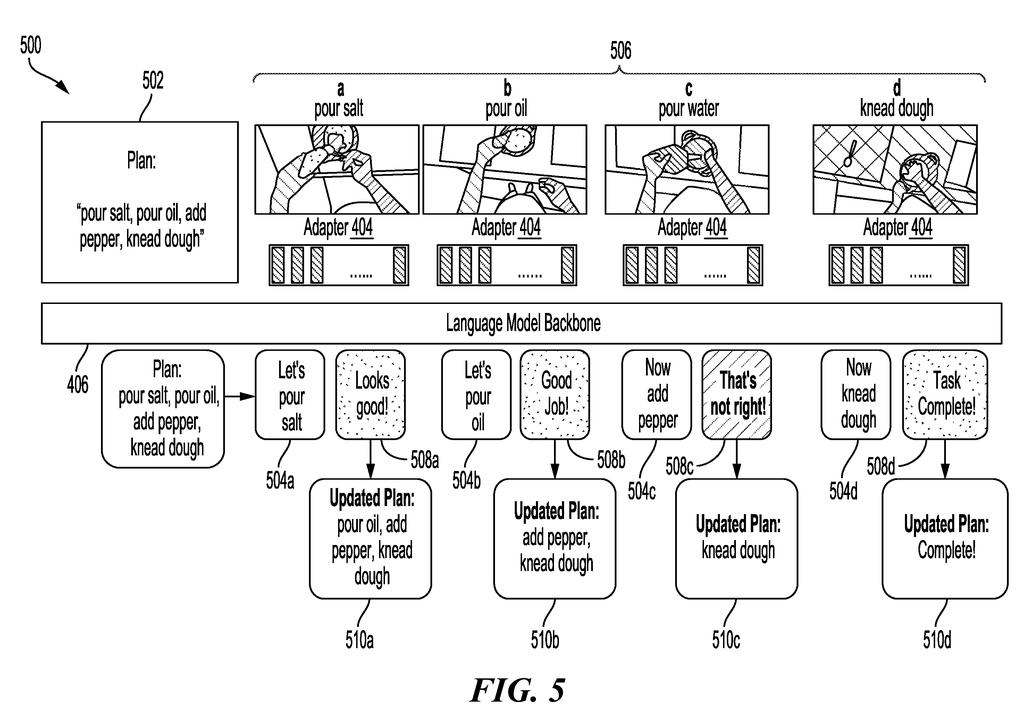
That is the scenario in this Qualcomm patent application. You give the system a plan, such as a short recipe. It tells you the first step, then watches your video feed to see whether you did it. If you did, it says something like 'Looks good!' and moves on. If you poured the wrong thing, it speaks up and works out how to fix it.
The twist is that the plan keeps rewriting itself. After each step, the system updates the plan and drops what you already finished. That means it does not have to remember every second of a long video, which is how the filing says it can run on a phone or smart glasses.
receive, by a vision-language model, a plan for performing a target activity; process, by the vision-language model, the plan to generate one or more instructions for performing the target activity; prompt, by the vision-language model, a user to perform a first user action based on a first instruction …
Translation: The system reads a recipe and tells you the first step to take.
How the model re-plans after every step
The claims describe a loop. The system (a vision-language model, meaning an AI that reads both text and video) receives a plan for some activity, turns it into instructions, and prompts you to do the first one. It then takes in a frame of live video and makes an inference (a judgment) about whether what you did matches the instruction. Based on that judgment, it writes an updated plan and prompts your next action.
Dependent claims add that a wrong move leads to a corrective step in the next plan, and that the model can be a recurrent state space model (a type of AI that carries a running memory forward instead of rereading everything).
The description splits the model into three parts:
- Vision encoder: looks at each frame and picks out things like your hands, what is in them, and a bowl.
- Adapter: squeezes each frame into a fixed number of small data chunks, using six layers of attention (a way of focusing on the important parts).
- Language backbone: reads those chunks alongside the text of the plan, instructions and feedback.
After every feedback message, the model re-plans and drops finished steps. That lets it delete stored data for old video frames, which matters for sessions of 30 minutes or an hour. In the filing's example, a skipped step gets added back, and a minor slip can be waved through.
The vision-language model receives at least a first frame of a video stream. The vision-language model determines a first inference indicating whether the first user action corresponds to the first instruction. The vision-language model generates a first updated plan for performing the target activity based on the first inference.
Translation: The AI watches you through a camera to see if you did it right, then updates the steps.
Why a coach that fits on your phone matters
Today's AI models that can see images mostly answer questions about them, one turn at a time. The filing says that falls short of a live helper that follows what you are doing and reacts as it happens. This application aims at that gap: coaching for cooking, exercises like jumping jacks or a yoga pose, or any step-by-step task.
The practical hook is where it runs. The filing says the approach allows a reduced model size suited to smartphones and wearables, and it describes phone-style chips with a neural processing unit (a part built for AI work). For you, that could mean a helper that lives on the device you already carry.
Qualcomm's second filing we've tracked on our AI agents that act for you watchlist since October builds on its self-grading robot control application.
Source: US 2026/0359625 A1 at the USPTO (PDF). Full patent text and figures are in the official publication.
Get our take in your Top Stories
Liked this breakdown? Add Patentlyze as a preferred source on Google, and our plain-English take shows up more often in your Top Stories the next time Qualcomm patent news breaks.
Add Patentlyze on Google
One click.
There are more where this came from
We read every patent application Big Tech publishes and send you the ones worth knowing. Plain English, free, every week.
The drawings · 6 sheets
6 drawing sheets from US 2026/0359625 A1 · click any drawing to enlarge


More from Qualcomm
All 624 Qualcomm patents →
More in AI vision
All 339 AI vision patents →
Microsoft
Microsoft Patents an AI Game Tester That Finds Bugs by Watching the Screen
Microsoft
Microsoft Patents an AI That Detects When a Meeting Needs a Brainstorm and Runs It
IBM
IBM Patents an AI System That Diagnoses and Fixes IT Outages Automatically
Apple
No comments yet