
Samsung Patents a Space-Saving Internal Layout for Foldable Phones
Foldable phones have a space problem — you're cramming a dual-display device into a body that needs to fold in half. Samsung's latest patent tackles that constraint by deliberately overlapping two components that usually compete for the same real estate.
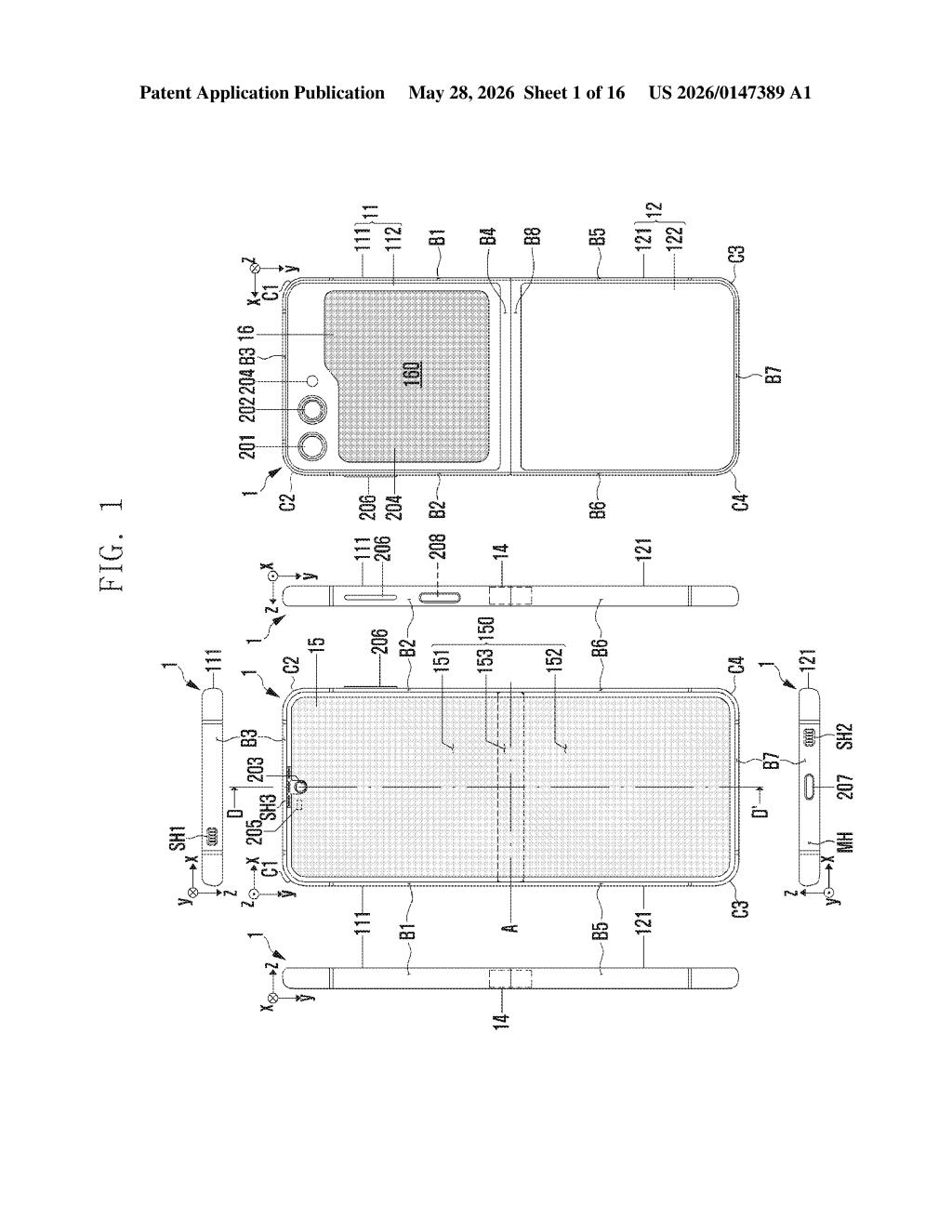
How Samsung fits more hardware into a folding phone
Imagine trying to pack two full displays, a big battery, and all the chips that drive them into something that folds down to roughly the size of a wallet. Every millimeter of internal space is a battle.
Samsung's patent describes a specific arrangement of components inside a foldable phone. The battery inside the device is split into two zones: one area holds the actual battery cells (where the energy lives), and a smaller zone holds the battery protection circuit — the electronics that keep charging safe and prevent overheating. That protection circuit zone sits slightly deeper inside the device, away from the cover display.
Here's the clever bit: the chip that drives the cover display — called the display driver IC — is positioned so that, when you look straight down through the device, it lines up directly over that battery protection circuit zone. Instead of both parts demanding their own unique floor space side by side, they share a column. It's the hardware equivalent of stacking shoes in a small closet.
How the DDI and battery protection circuit stack up
The patent covers a foldable device with two displays: a large foldable inner display that spans both halves of the phone, and a smaller cover display on the outside of the first housing (the half that holds the battery and main board).
The display driver integrated circuit (DDI) — the chip that tells the cover display what pixels to illuminate — sits on the rear surface of that cover display. The patent is specific about where it ends up relative to everything else:
- The printed circuit board (PCB) sits between the battery and one lateral edge of the housing.
- The battery's first part (the actual cells, which are thicker and bulkier) sits closer to the cover display surface.
- The battery's second part (the protection circuit module, which is thinner) sits farther from the display surface and closer to one side of the housing.
- The DDI, extending along the first direction, is aligned to overlap the second part of the battery when viewed from above.
The protection circuit module is typically thinner than the battery cells themselves, so there's a natural recess or height differential there. Placing the DDI in that overlapping zone uses that recess productively — the DDI can nestle into space that would otherwise go unused, rather than requiring the overall device to be any thicker.
What this means for Galaxy Z Fold's internal design
Foldable phones have some of the tightest internal packing tolerances in consumer electronics. Every component that needs its own dedicated footprint either pushes the device thicker or forces something else to shrink — including the battery. A layout that lets the DDI share vertical space with the battery's protection circuit zone instead of competing with it for floor area is exactly the kind of incremental engineering that lets Samsung keep battery capacity up while chasing a slimmer profile.
This is clearly aimed at the Galaxy Z Fold line, where the cover display has become a more functional screen over successive generations. A bigger, more capable cover display needs a more capable driver chip — and that chip has to live somewhere. This patent is Samsung's answer to where.
This is bread-and-butter mechanical engineering work — not a flashy AI feature, but the kind of unglamorous internal layout optimization that directly determines whether a Galaxy Z Fold 7 can be thinner than its predecessor without sacrificing battery life. It's genuinely worth paying attention to if you follow the foldable space, because it's a window into exactly how constrained Samsung's engineers are and how deliberately they're solving it.
There are more where this came from
We read every patent application Big Tech publishes and send you the ones worth knowing. Plain English, free, every week.
Want this weekly breakdown for a company we don't cover? Patentlyze Pro →