
IBM Patents a Graph Neural Network Approach to Supply Chain Routing
Figuring out the best way to ship products across a sprawling network of warehouses, ports, and distribution centers is one of the nastiest optimization problems in logistics. IBM thinks graph neural networks can cut through it.
What IBM's GNN-based transportation optimizer actually does
Imagine you run a company that ships products from dozens of factories to thousands of stores, passing through a web of warehouses and distribution centers in between. Figuring out which routes to use, which hubs to activate, and which connections to skip is an enormous puzzle — and traditional software often grinds to a halt trying to solve it.
IBM's patent describes a system that first turns your entire shipping network into a graph — a mathematical map where factories, stores, and warehouses are nodes, and the shipping lanes between them are edges. A graph neural network (a type of AI that's particularly good at reasoning about connected structures) then scans that map and predicts which routes and intermediate stops are likely to belong in a good solution.
The clever part: rather than running a brute-force optimizer cold, the system uses those AI predictions as a warm start — a smart initial guess. That head start means the final optimization step has far less work to do, potentially arriving at a good answer much faster.
How the GNN predicts routes before the optimizer runs
The system takes input data describing a product transportation network — origin points, destination points, intermediary hubs, and the connections between them — and constructs a graph neural network (GNN) that mirrors that structure.
A GNN is a type of neural network designed to operate on graph-structured data (think: anything with nodes and edges, like social networks, molecules, or road maps). Here, the GNN is used to do something specific: for each edge (a shipping lane) and each intermediary node (a warehouse or transit hub), it predicts whether that element should be included in the final transportation solution.
Those per-element predictions then feed directly into a model optimization step. Instead of starting the optimizer from scratch — which, for large networks, can be computationally brutal — the system initializes it from the GNN's predicted state. This warm-start approach (sometimes called learning to optimize in the ML literature) lets the solver converge on a high-quality solution faster than cold-start methods.
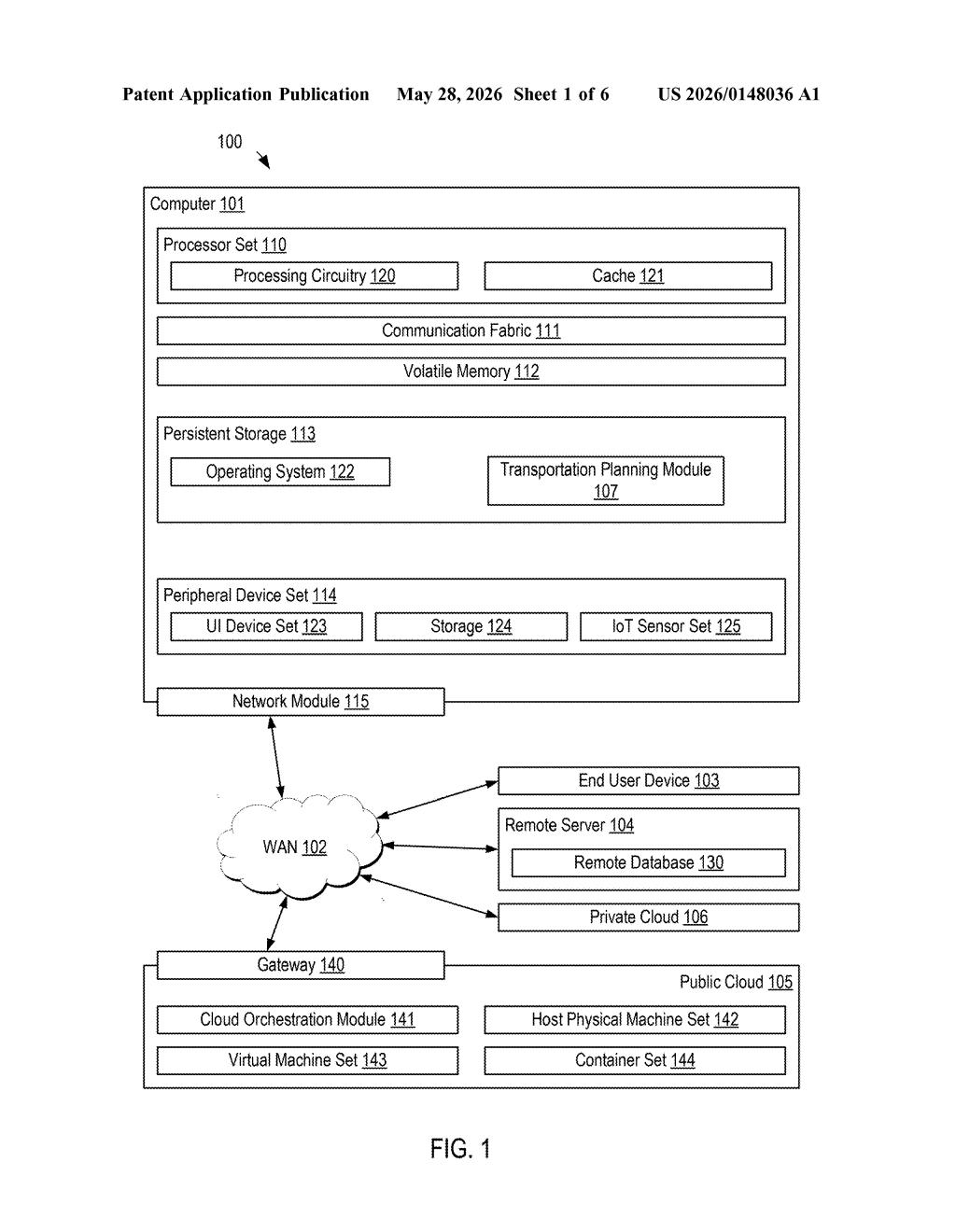
The hardware architecture described in the patent includes:
- A Transportation Planning Module running on a processor set
- IoT sensor integration for real-time network data ingestion
- Both private and public cloud components for scalable compute
- A remote database for storing network state and solutions
What this means for large-scale logistics and supply chain AI
Large-scale transportation optimization is one of the core computational problems in enterprise logistics, and it's notoriously slow for real-world network sizes. Using a GNN to predict a warm starting point before handing off to a classical optimizer is a well-regarded hybrid approach in the combinatorial optimization research community — IBM filing a patent on this signals they're looking to productize it, likely within their supply chain management or Sterling platform offerings.
For you as an end user, this kind of system wouldn't be a consumer app — it's enterprise infrastructure. But it's the kind of technology that quietly determines whether your online order arrives in two days or two weeks, by helping large retailers and manufacturers run their logistics networks more efficiently.
This is solid applied-ML work targeting a real and expensive enterprise problem, not a moonshot. The warm-start-via-GNN approach has genuine research backing, and IBM has the supply chain software portfolio (Sterling, Watson) to put this to use. It's not flashy, but logistics optimization at scale is genuinely hard and genuinely costly — companies pay tens of millions to shave percentage points off routing inefficiency.
There are more where this came from
We read every patent application Big Tech publishes and send you the ones worth knowing. Plain English, free, every week.
Want this weekly breakdown for a company we don't cover? Patentlyze Pro →