
Qualcomm Patents a Feedback-Driven Multi-Technology Positioning Engine
Your phone uses GPS, Wi-Fi, and cellular towers all at once to figure out where you are — but what if those sources contradict each other? Qualcomm's new patent describes a positioning engine that doesn't just fuse those signals, it grades them in real time and tells each source how much to trust itself next time.
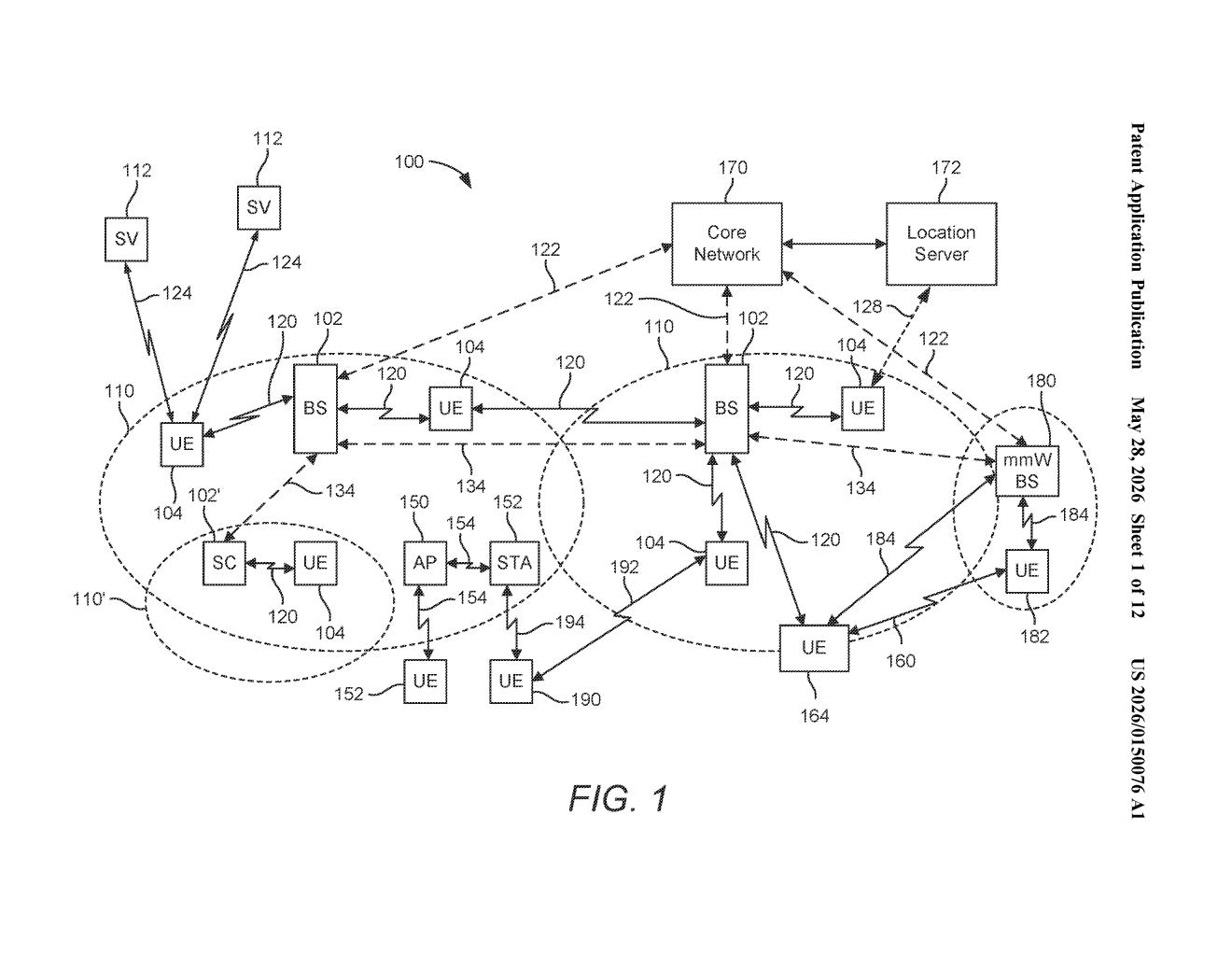
How Qualcomm's positioning engine ranks its own signal sources
Imagine you're navigating inside a shopping mall. Your phone is getting location guesses from GPS satellites, nearby Wi-Fi access points, and cellular towers — all at the same time. The trouble is those sources often disagree, and some of them are just plain wrong in certain environments (GPS, for instance, is notoriously unreliable indoors).
Qualcomm's patent describes a two-layer filtering system. Each signal type — GPS, Wi-Fi, cellular — first cleans up its own data and hands off only its most trustworthy anchor points (fixed reference locations). Then a second, higher-level filter looks at all of those anchor points together, tosses out the ones that look like outliers, and assigns a confidence score to each remaining one.
The clever part: those confidence scores get fed back to each individual signal source. So if the GPS layer keeps contributing unreliable anchors, it learns to be more skeptical of its own data. Over time, the whole system self-calibrates, making your location estimate more reliable without requiring you to do anything.
How the inter-technology filter reweights and feeds back
The patent describes a hierarchical positioning architecture made up of two layers of filters working in tandem.
The intra-technology filtering blocks are the first layer — one per signal type (think: a GPS block, a Wi-Fi block, a 5G NR block). Each block independently processes its own raw signals and outputs a cleaned-up list of "inlier" anchor points (reference nodes that passed its internal plausibility checks). Inliers are essentially the measurements that weren't thrown out as noise or spoofing artifacts.
The inter-technology filtering block is the second layer. It receives the inlier sets from all the technology-specific blocks simultaneously and runs a cross-technology outlier rejection pass — meaning it can spot cases where, say, a Wi-Fi anchor looks fine in isolation but is wildly inconsistent with what GPS and cellular are saying. It then assigns a relative weight to each surviving anchor point, reflecting how much it should contribute to the final position fix.
The key innovation is what happens next: those relative weights are sent back as feedback to the individual intra-technology blocks. A block receiving low-weight feedback can tighten its own filtering thresholds or adjust its internal model — a closed-loop mechanism that improves the quality of future inputs to the inter-technology layer. The architecture can run on the device itself, on a base station, or distributed across a network entity.
What this means for indoor and urban location accuracy
Location accuracy in dense urban canyons and indoors has been a stubborn problem for years. The standard approach — take all your signals, shove them into a Kalman filter, hope for the best — doesn't handle the case where one entire signal class is systematically misleading. Qualcomm's feedback loop addresses exactly that by letting the system dynamically demote unreliable sources rather than treating all technologies as equally trustworthy.
For Qualcomm, this fits squarely into its modem and positioning chip roadmap, where it supplies the silicon that handles location in a huge share of Android phones. A positioning engine with cross-technology feedback could tighten the gap with dedicated indoor positioning systems, which matters for everything from emergency 911 dispatch accuracy to AR navigation and asset tracking in warehouses.
This is solid, non-flashy positioning infrastructure work — the kind of thing that rarely makes headlines but directly affects how well your phone knows where it is when GPS fails. The feedback loop between the inter-technology and intra-technology layers is the genuinely interesting architectural choice here, and it's the kind of detail that could meaningfully improve real-world location performance in 5G chipsets over the next few years.
There are more where this came from
We read every patent application Big Tech publishes and send you the ones worth knowing. Plain English, free, every week.
Want this weekly breakdown for a company we don't cover? Patentlyze Pro →