
Google Patents AR Glasses That Track Your Eyes Without a Visible Camera
Google has filed a patent for an AR waveguide that handles both your display image and infrared eye tracking inside the same thin optical slab — no separate camera module required.
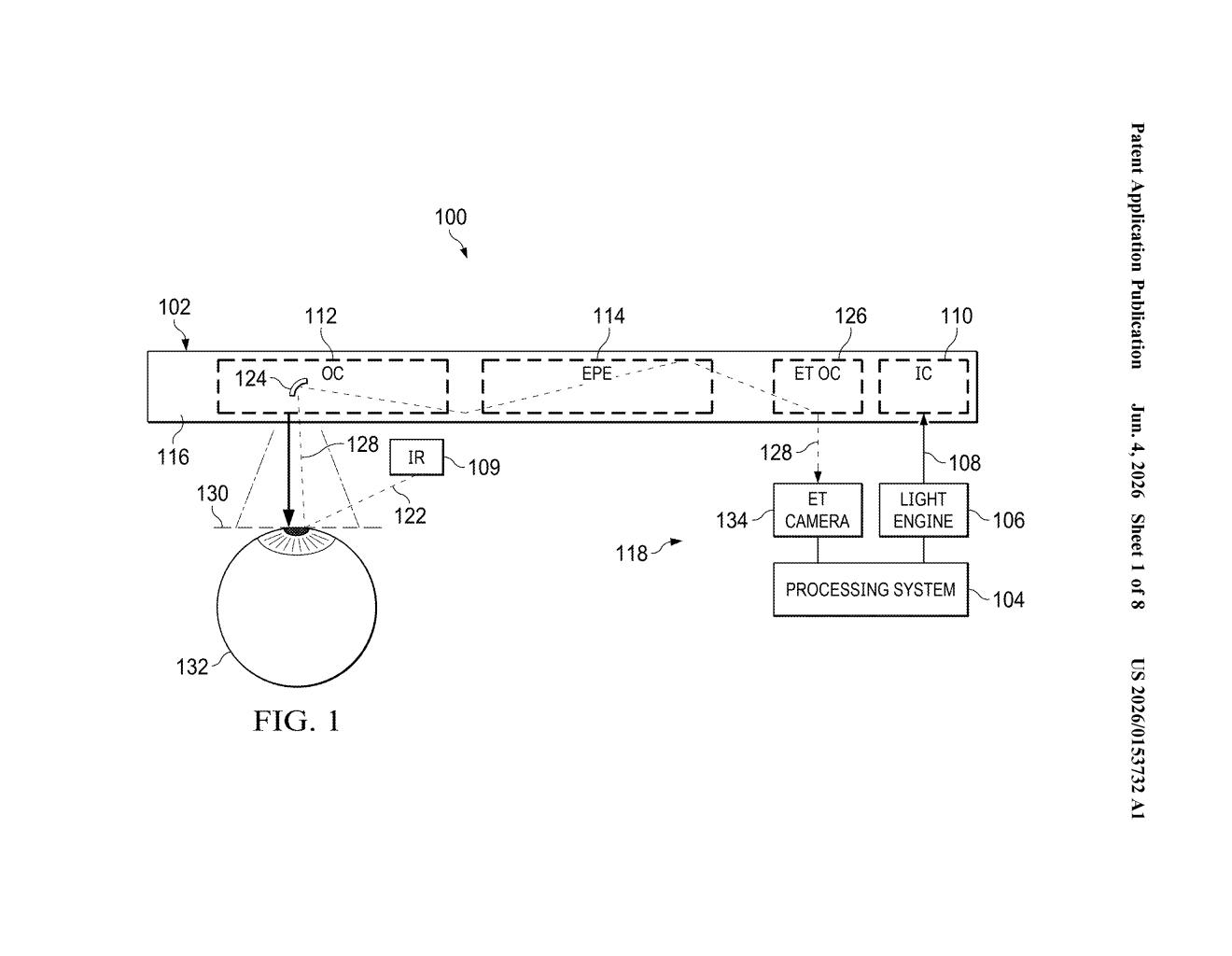
How Google hides eye tracking inside an AR display lens
Imagine wearing a pair of AR glasses that can tell exactly where your eyes are pointing, but the tracking hardware is invisible — no bulky camera bumps, no extra sensors bolted onto the frame. That's the idea behind this Google patent.
The lens itself — called a waveguide — is the thin optical element that bounces display light toward your eye in AR glasses. Google's design adds a special coating called a hot mirror to that same waveguide. A hot mirror reflects infrared light (the kind used to track your eyes) while letting normal visible light pass straight through, so your display image is unaffected.
The result: the waveguide does double duty. It guides your AR visuals and captures the infrared signals needed to follow your gaze — all within one compact, embedded structure. That's a meaningful step toward AR glasses that are thin enough to actually wear in public.
How the hot mirror splits IR and visible light in the waveguide
The patent describes a reflective waveguide — the core optical component in AR headsets that takes a tiny projected image and bounces it across a transparent slab until it exits toward your eye at the right angle and size.
Google's twist is embedding an input hot mirror directly onto one or more of the waveguide's internal partially-reflective prisms (tiny angled facets etched into the substrate that redirect light). A hot mirror is a wavelength-selective coating: it reflects near-infrared (NIR) light — the kind emitted by an eye-tracking illuminator — while remaining transparent to visible wavelengths. This means NIR light gets coupled into the waveguide at that prism, while the display image passes through undisturbed.
The full waveguide structure includes:
- An incoupler — feeds display light (from a projector or microdisplay) into the waveguide
- An exit pupil expander — a subset of prisms that spreads the image horizontally or vertically as it travels
- An outcoupler — a second subset of prisms that redirects the expanded display light out toward your eye
- The input hot mirror — uses the same prism array to route infrared eye-tracking light along a separate optical path
By reusing the prism substrate for both functions, Google avoids needing a physically separate IR optics module, which saves space and reduces assembly complexity.
What this means for the next generation of AR glasses
Eye tracking is increasingly central to AR and VR — it enables foveated rendering (rendering only what you're actually looking at in full resolution, saving GPU load), gaze-based UI control, and personalized focus adjustment. But integrating eye-tracking optics into a waveguide thin enough to resemble eyeglasses is genuinely hard. Separate IR emitters and sensors add bulk that defeats the whole point of lightweight AR.
Google's embedded approach could let future AR glasses keep the waveguide as thin as current designs while adding gaze tracking without a visible sensor array. For you as a wearer, that means a device that knows where you're looking without looking like it's watching you — a real usability and form-factor win if it makes it into production hardware.
This is a technically credible, well-scoped patent that addresses a real engineering bottleneck in AR glasses design. Cramming eye tracking into the waveguide itself — rather than strapping sensors onto the frame — is exactly the kind of integration work that separates prototype-grade AR from something you'd actually wear. Whether Google ships it is another question, but the underlying problem is real and this approach is genuinely clever.
There are more where this came from
We read every patent application Big Tech publishes and send you the ones worth knowing. Plain English, free, every week.
Want this weekly breakdown for a company we don't cover? Patentlyze Pro →