
Amazon Patents a System That Makes Its AI Explain Its Own Decisions
Ever wonder why Alexa recommended something or gave you a specific answer — and wish it would just tell you? Amazon has filed a patent for exactly that: a system that generates plain-English explanations of why an AI reached the conclusion it did.
What Amazon's AI self-explanation system actually does
Imagine asking Alexa a question and getting an answer that feels oddly specific to you — but you have no idea why. Did it use your purchase history? Your location? A preference you set six months ago? Right now, most AI systems are black boxes: they give you outputs but skip the receipts.
Amazon's patent describes a system that would change that. When an AI makes a decision — say, recommending a product, answering a question, or filtering results — the system would generate a natural-language explanation of why, tailored to your personal history and the context of your request. Instead of just getting a result, you'd get something like: "I suggested this because you've ordered similar items on weekday evenings."
The twist is that the system doesn't just write an explanation and hope it's accurate. It actually predicts what decision the AI must have made based on your history, and only shows you the explanation if that prediction closely matches what really happened — a built-in accuracy check on the explanation itself.
How the system checks its own reasoning before explaining
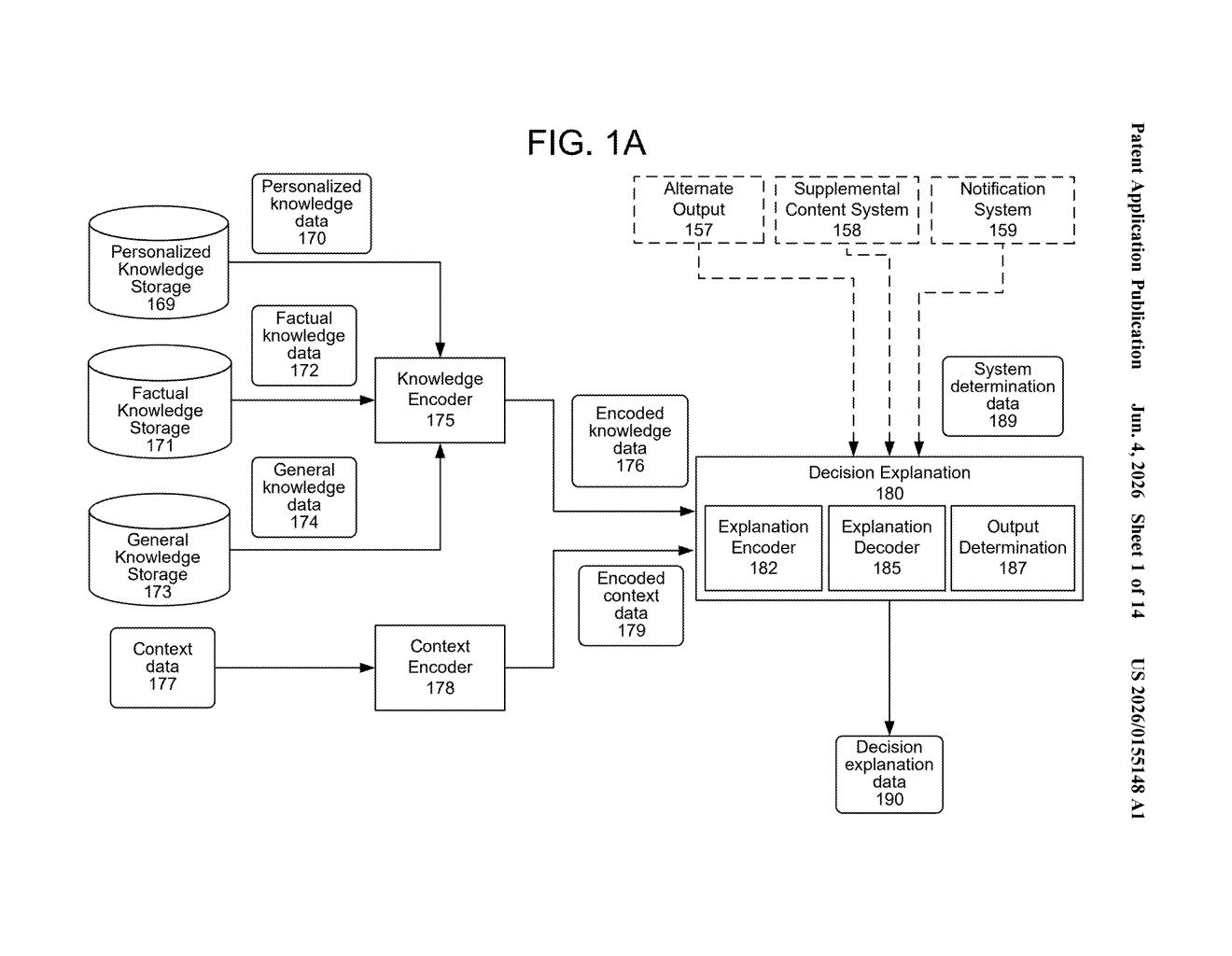
The patent describes a pipeline with a few distinct steps. First, a machine learning component processes your natural language input (a question, a command, a search) and generates an intermediate representation — essentially a structured interpretation of what you asked and what it means in context.
Based on that intermediate data, the system produces the actual output: an answer, recommendation, or action. Separately, it pulls your profile history — past interactions, preferences, behavioral patterns — and combines that with context data about the current request.
From those two inputs, the system does two things in parallel:
- Generates a natural language explanation describing why the output was produced the way it was
- Produces a predicted determination — essentially reconstructing what decision the AI must have made to produce that output, based purely on your history and context
The explanation is only surfaced to the user if the predicted determination is sufficiently similar to the actual determination the system made. This similarity check acts as a confidence gate — preventing the system from showing you a plausible-sounding-but-wrong explanation. Both the original output and the explanation are then presented together.
What this means for Alexa and AI transparency
AI explainability has become one of the central pressures on tech companies — from regulators asking why a loan was denied to users wondering why their feed looks the way it does. Amazon building this into a general-purpose system (not just a one-off feature) suggests they're thinking about explainability as infrastructure, something that could sit underneath Alexa, AWS recommendation APIs, or any service that makes personalized decisions.
For you as a user, this could mean finally getting a straight answer about why your AI experience looks different from someone else's. The accuracy-check mechanism is also notable — it's a rare case where a company is patenting a safeguard against its own AI making up justifications for things it didn't actually do.
This is one of the more thoughtful AI transparency patents to come out of Big Tech recently. The self-verification step — checking the explanation against a predicted reconstruction of the actual decision — is a genuinely interesting design choice that addresses a real failure mode in AI explainability. Whether it ships as a user-visible feature or stays under the hood as an internal audit tool, it's worth watching.
There are more where this came from
We read every patent application Big Tech publishes and send you the ones worth knowing. Plain English, free, every week.
Want this weekly breakdown for a company we don't cover? Patentlyze Pro →