
Google Patents an AI That Finishes Your Sentences Through Your Earbuds
Ever lost your train of thought mid-sentence in a meeting? Google is patenting a system that listens for the moment you stumble — and quietly feeds you the words you were reaching for, straight to your earbuds or glasses.
What Google's sentence-completion earbuds actually do
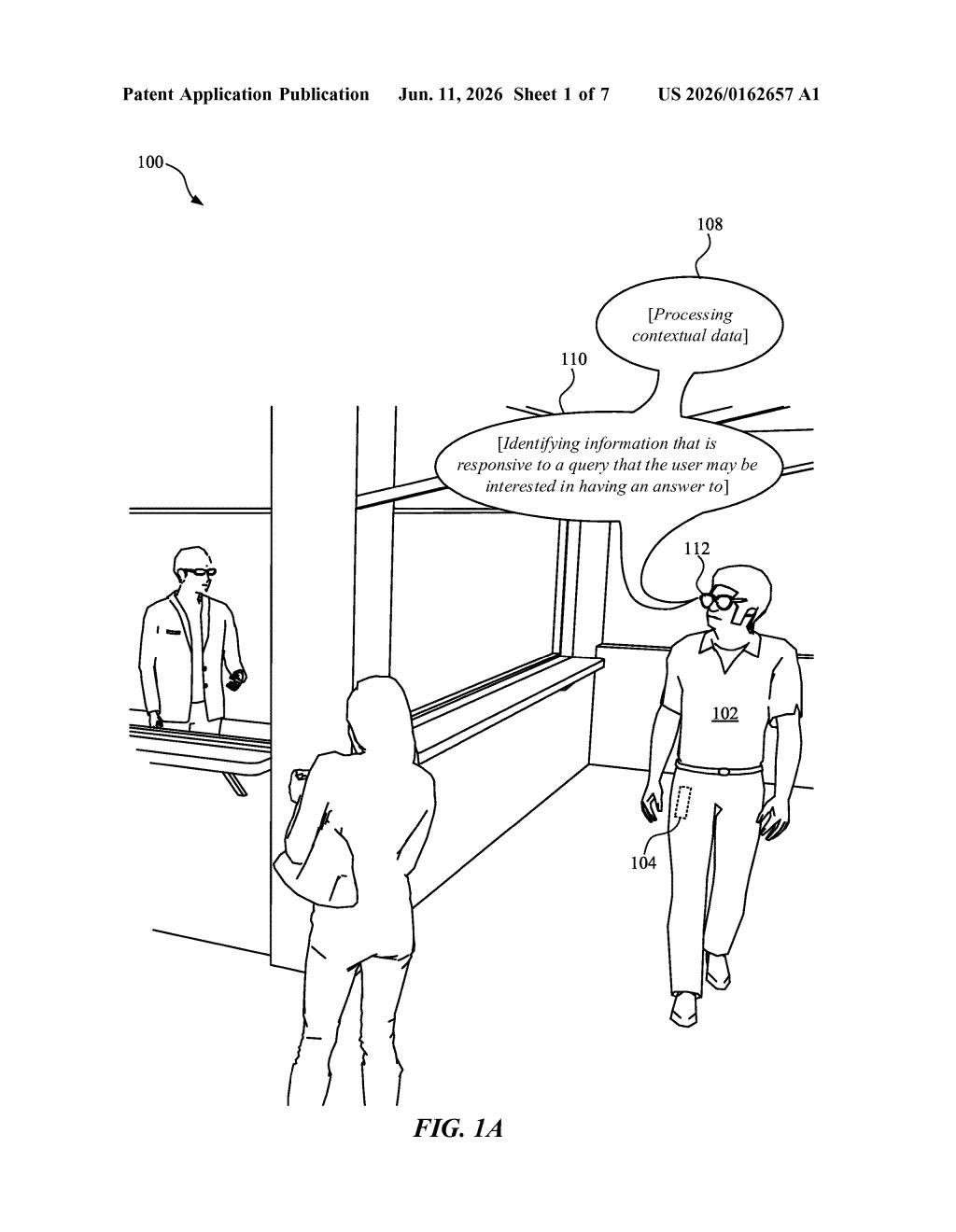
Imagine you're mid-conversation and you suddenly blank on a word or lose the thread of what you were saying. Google's new patent describes a system that quietly listens to your speech in real time and, the moment it detects you're struggling — a stutter, a filler word, a pause — it automatically suggests how you might finish your sentence. You'd see or hear the suggestion through a wearable like earbuds or smart glasses, with no need to ask for help.
The key detail is that the system triggers on its own. You don't press a button or say a wake word. It watches for specific signals — like a stumble in your speech — and only then offers the suggestion. That way it's not constantly interrupting you when you're speaking fine.
Think of it as autocomplete, but for your mouth, running live during a real conversation.
How the AI detects a stumble and feeds you the next words
The patent describes a pipeline that starts with automatic speech recognition (ASR) — the same technology that converts your voice to text in real time — running continuously on audio captured by a wearable device's microphones.
That recognized text is then fed into one or more machine learning models that predict what words or ideas are likely to come next. The output isn't just a single suggested word; the patent describes a "following content output" that encodes features about the probable continuation — things like topic, syntax, or word probabilities — which the system uses to assemble a concrete text suggestion.
Critically, the system decides on its own whether to show you that suggestion. The patent specifies two triggers:
- Disfluency detection — the system recognizes hesitation markers like "um," "uh," repeated words, or unusual pauses
- Properties of the predicted continuation itself — if the model is highly confident about what comes next, it may surface the suggestion proactively
Once triggered, the suggestion is rendered through the wearable's interface — visually on smart glasses, or potentially as audio through earbuds. The whole loop happens without any tap, voice command, or explicit user request.
What this means for AR glasses and real-time AI assistants
For Google, this fits squarely into its push to make AI assistants ambient — present without being summoned. Wearables like the Google Pixel Buds or any future smart glasses (the company has been exploring glasses-based AI features publicly) would be the natural delivery surface. Real-time conversation assistance could also matter for people who stutter, have word-retrieval difficulties, or are speaking in a second language.
More broadly, this is part of a race among big tech companies to make AI useful during conversations, not just before or after them. If this works reliably without being intrusive, it would be a meaningful step toward the kind of always-on AI assistant that's been promised for years but rarely delivered without annoying interruptions.
This is one of the more genuinely useful-sounding AI patent filings in recent memory — not because the underlying technology is exotic, but because the use case is so immediately relatable. The clever part isn't the sentence prediction; it's the conditional rendering logic that tries to make the system unobtrusive. Whether Google can actually nail that trigger threshold in the real world — where conversation is noisy and messy — is the real question.
There are more where this came from
We read every patent application Big Tech publishes and send you the ones worth knowing. Plain English, free, every week.
Want this weekly breakdown for a company we don't cover? Patentlyze Pro →