
Google Patents an AI Assistant That Budgets Its Own Thinking Time
What if your AI assistant could look at a complex question, figure out how long it has to answer, and automatically reorganize its own thinking to hit that deadline? That's exactly what Google is patenting.
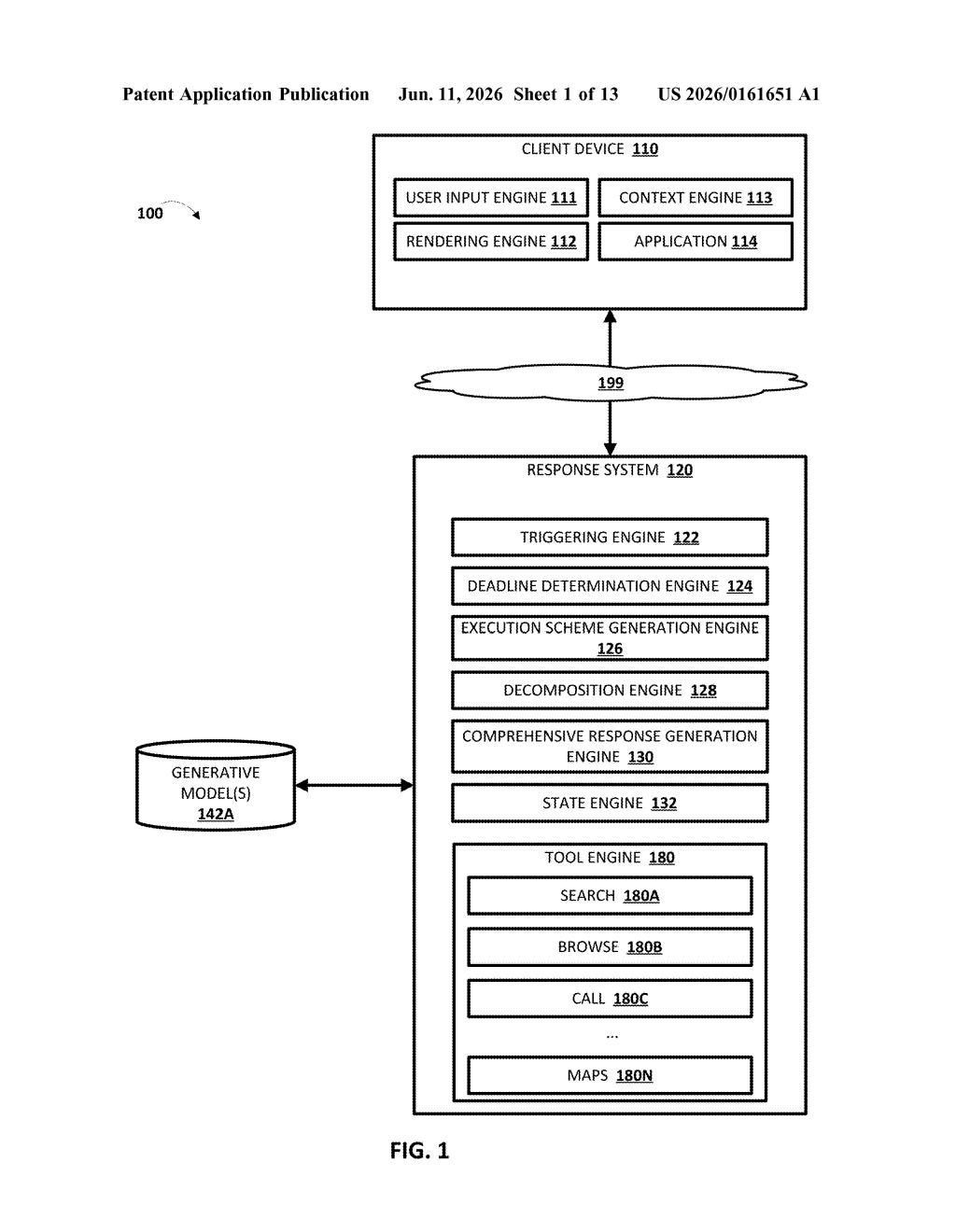
What Google's deadline-aware AI actually does for you
Imagine you ask your AI assistant, "I have a meeting in 10 minutes — can you research our three competitors and summarize their pricing?" Right now, a typical AI either rushes through all of it and gives you something shallow, or it takes as long as it needs and you're late. Google's patent describes a system that actually reads the time pressure in your question and plans accordingly.
The AI breaks your big question into smaller pieces — like three separate competitor lookups — and estimates how long each one will take. It then builds a work plan that fits within your deadline, cutting or trimming tasks if needed, before reassembling everything into one coherent answer.
Critically, the deadline doesn't have to be something you spell out. The system is designed to pick up on implied urgency — words like "quickly" or "before my call" — and factor that in automatically. The final answer lands on whatever device you're using, or even a different device Google determines you're paying attention to.
How the system splits, times, and reassembles your query
The patent describes a pipeline with several distinct stages:
- Deadline detection: A generative model reads your query and extracts either an explicit time limit ("in 5 minutes") or an implied one ("quickly," "before I leave"). This produces a concrete deadline the system must honor.
- Query decomposition: A planning model breaks your question into a list of sub-queries — discrete research tasks, each matched to one or more "tools" (think: web search, a database lookup, a calculator, a calendar check). Each sub-query gets an estimated execution time.
- Execution scheme generation: The system arranges the sub-queries into a plan where the sum of all estimated times fits within the deadline. If something won't fit, the plan is trimmed before work even starts.
- Parallel or sequential processing: Sub-queries are then run using their assigned tools, generating individual responses.
- Synthesis: Once all sub-queries complete, a generative model stitches the individual responses into one comprehensive answer, rendered on your device — or on another device Google has identified as associated with you.
The system uses at least two generative models: one for planning and decomposition, another (or the same one) for final synthesis. The architecture is designed to be adaptive — if early sub-queries finish faster than estimated, the plan can theoretically breathe; if they run long, the deadline constraint has already forced a realistic scope from the start.
What this means for AI assistants under real time pressure
For everyday users, this is about AI that respects your schedule rather than its own processing convenience. Today's AI assistants either give you everything (slowly) or nothing useful (fast). A system that intelligently scopes its own work to a time budget could make AI assistants genuinely reliable for time-sensitive tasks — morning briefings, meeting prep, quick research sprints.
For Google specifically, this fits neatly into the Gemini assistant roadmap, where the company is pushing AI agents that take multi-step actions on your behalf. Getting those agents to operate under real-world time constraints — rather than theoretical ones — is a non-trivial engineering problem, and this patent suggests Google is building the plumbing to solve it.
This is a genuinely practical piece of AI infrastructure, not a flashy capability demo. The hard part of agentic AI isn't just breaking problems into steps — it's doing so responsibly under real constraints, and deadline-aware planning is exactly the kind of boring-but-critical feature that separates a useful assistant from an unreliable one. If this ships inside Gemini, most users will never notice the mechanism, but they'll feel the difference.
There are more where this came from
We read every patent application Big Tech publishes and send you the ones worth knowing. Plain English, free, every week.
Want this weekly breakdown for a company we don't cover? Patentlyze Pro →