
A weekly read of what the world’s biggest technology companies just told the U.S. patent office.
We wrote up 267 filings this week, up from 213. Samsung led with 75, including Samsung Display, then Google at 39, or 47 with Waymo, Verily, DeepMind and other Alphabet companies, Sony at 27, Nvidia at 26 and Apple at 19.
The full run lives under this week’s Big Tech patents; these fourteen stood out.
1. Apple Files Patent for a Headset Window That Shows You the Room Next Door
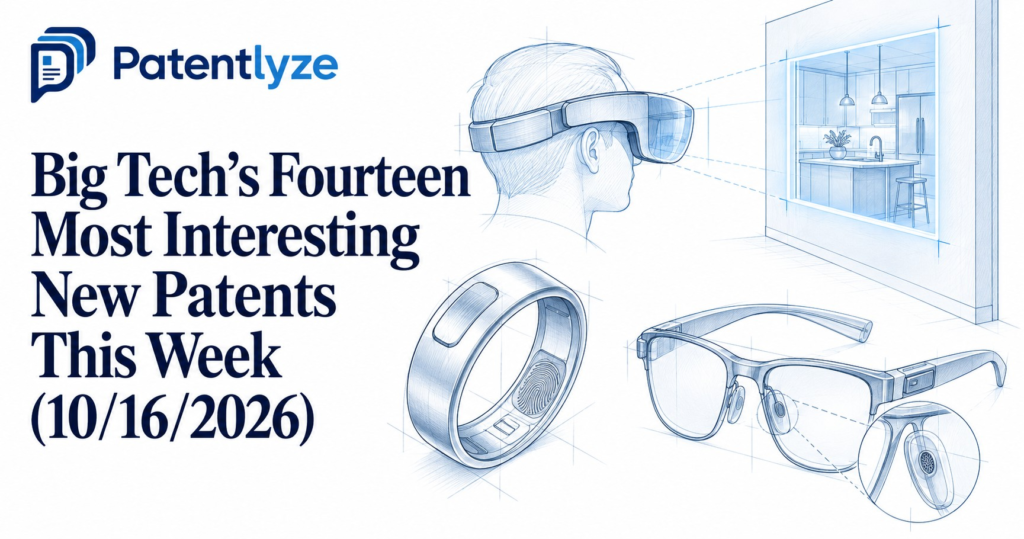
Checking on a sleeping baby or a pot on the stove means getting up and walking over. Apple has filed for a headset view that cuts a window through your wall and fills it with live video from a camera in the next room.
Claim 1 is a method for a device with displays. It shows your view from where you stand, where a wall blocks part of another location. When it detects a triggering condition, it shows a second view that includes the hidden part, built from an image sensor sitting in that other location.
The triggers include looking at the wall, dragging a virtual portal onto it, a gesture, or gazing at a hidden activation point for at least a second. The camera’s video becomes a depth map and a point cloud, then gets redrawn from your eye position, so the view shifts as you move your head.
The catch is the camera. A claimed alignment check wants it facing roughly the way you face, within a threshold angle, and one claim moves it with an electromechanical device such as a servo. The filing lists a TV, a table, a child and a crib as things you might want to see.
One inventor, Emmanuel Piuze-Phaneuf. Filed in April 2026, claiming priority to a provisional from April 2025, twenty claims. It is one of two Apple filings in this list that open a hole in a wall; the other does it for sound.
2. Sony Files Patent for a Camera That Scrambles Faces Before the Image Is Even Recorded
Camera privacy features usually blur faces after a sharp picture already exists somewhere. Sony has filed for a camera that scrambles the scene with an optical filter and records it at very low detail, so a clear image of a face never exists.
Claim 1 is a system with four parts: an optical filter set by chosen parameters, an imaging chip that captures the filtered image, a converter that digitizes it at a chosen bit depth, and a model that estimates a person’s attributes. The settings must make identification hard while attribute estimation still works.
The filter is based on a Gabor pattern, a math shape that responds to edges and textures. Light cannot be negative, so Sony adds 1 to the wave to keep every value at zero or above. One claim caps the bit depth at 4 bits, which strips out brightness detail that could still identify someone.
What survives is enough to estimate traits such as gender, expression, glasses, the number of people, gait or whether someone is smiling. The filing says it can be applied to a monitoring camera. It suits jobs that never need to know who someone is, and it rules out the ones that do.
Two inventors, Hideki Oyaizu and Ryuichi Tadano. Filed in April 2026 with no parent application, twenty claims. It comes from Sony Semiconductor Solutions, the unit that makes Sony’s image sensors.
3. Samsung Files Patent for an AI Undo Button on Photos Whose Originals Are Deleted
AI photo editing makes it easy to erase a stranger and hard to change your mind once the original is gone. Samsung has filed for photos that carry a small rebuild kit inside their own file, so an AI can restore what an edit removed.
Claim 1 is a phone that shows an edited image with an on-screen button tied to the changed object. When you tap it, the phone reads restoration information from the image’s metadata, runs an AI model on the edited picture plus that information, and shows the AI-generated result.
The kit can hold the original prompt, a written description of what used to be there, a low-resolution patch, a compressed feature vector or plain pixel differences. To undo an addition, it can store an opposite instruction, such as “Remove a portion above the lamp.” A slider steps back through each edit.
One version uses the photo’s location to pull road view images or social media photos of the same spot as reference. Another keeps real pixels for a face and only a text description of clothing. The result is still the AI’s best rebuild, and the filing treats it that way.
Five inventors, including Nagyeom Yoo and Jihun Mun. Filed in June 2026 as a continuation of a Korean international application from November 2024, twenty claims.
4. Samsung Files Patent for a Ring That Reads Your Fingerprint as You Slide It On
A smart ring has almost no room for a fingerprint pad, and nobody wants to hold a finger still on one. Samsung has filed for a ring that reads your fingerprint in the moment you slide it onto your finger.
Claim 1 is a ring-shaped wearable with a button on the inside of the band and a fingerprint sensor on that button. Pressing the button counts as a fingerprint input event, and the ring reads your print from a sliding input as your fingertip moves across the sensor.
The sensor stays off until the button is pressed, which saves battery. To register, the ring stitches a series of image strips into one print. To check it later, it can grab a single frame. Magnets, a spring or a hinge push the button toward your skin for a cleaner read.
A paired phone can switch the ring into registration or check mode when its own fingerprint screen opens. A match can approve a login or a payment. The open question is how well a quick swipe reads a finger that is damp, cold or moving fast.
Seven inventors, including Byunghyun Lee and Geunwoo Jeong. Filed in February 2026 as a continuation of a Korean international application from June 2024, twenty claims. It is one of two Samsung jewelry filings in this list.
5. Adobe Files Patent for AI That Swaps a Video’s Food and Scenery to Suit Another Country
Localizing a video ad usually means a reshoot or an editor hunting for local footage. Adobe has filed for an AI pipeline that rewrites a clip’s scenery for a target country and generates the new version.
Claim 1 is a chain of model calls. A language model writes a video description from descriptions of key frames, picks out cultural concepts, then rewrites both descriptions for a target region. A generative video model builds the new clip from a culturalized first frame and the rewritten description.
Key frames come from grouping frames by brightness patterns. A vision language model describes each one, including camera moves such as panning left. The filing’s example turns a plate of biryani into sushi on a tatami mat table. Its guidelines run region, concept, entity: in Japan, a crane signals luck.
The filing says every step can run with no human intervention, and it names Adobe Firefly as one possible video generator. That speed is the pitch for brands with one ad and many markets. The risk sits in the stored guidelines, since one wrong cultural note would repeat in every version.
Two inventors, Divyanshu Goyal and Akhil Eppa. Filed in April 2025 with no parent application, twenty claims.
6. Sony Files Patent for Putting Game Characters in Your Living Room
A fighting game draws its fighters, its arena and its camera as one scene on your TV. Sony has filed for a system that pulls just the fighters out of a running game and stands them in your room, seen through a headset or a handheld screen.
Claim 1 is short. A server runs the game, and an intercept circuit watches the API calls the game sends to the graphics chip. Calls for assets on a chosen list, such as a character’s 3D model, go to your device. Everything else is ignored, so the game itself needs no changes.
Your device places the models in your real room, with their feet on your floor, and can shrink distances. In the filing’s example, fighters who start 6 meters apart in the game start 4 meters apart in your room, with their speed scaled to match. Props such as boxing gloves travel with them.
Walking around the fight creates a control problem, since left on the stick may now point at you. Once you circle more than 45 degrees, the controls remap. The filing names a DualSense controller and a PlayStation Portal, and sending only the characters cuts network bandwidth.
Three inventors, Murshed Choudhury, Jeffrey R. Stafford and Ueli Gallizzi. Filed in April 2026, claiming priority to a provisional from April 2025, twenty claims.
7. Google Files Patent for AR Glasses That Warn You Before a Coffee Cup Meets Your Hard Drive
Setting up a router still means squinting at port labels and typing questions into a phone. Google has filed for AR glasses that work out what you are pointing at and pin the answer onto the object.
Claim 1 is a method. It identifies one object at the scale of a part, such as a single port, and another at the scale of how objects relate, such as a phone that needs the router. A model writes a prompt from those objects, retrieves information, and the glasses show a visual overlay.
The first model can turn a gesture into a paragraph-long instruction and check the second model’s answer. A scene graph tracks how objects connect, and digital anchors keep labels on things even after you move them. How close your fingertip gets, how steady a gesture stays and where your eyes rest all count as cues.
The safety example is the memorable one: set a cup of liquid next to a portable hard drive, and the glasses highlight the cup with a prompt to move it. The filing also describes scrubbing faces, framed photos and printed documents on the device before anything reaches the cloud model.
Six inventors, including Mar Gonzalez Franco and Andrea Colaco. Filed in April 2026, claiming priority to a provisional from April 2025, twenty claims.
8. Red Hat Files Patent for Decoy Servers That Trap Hackers Mid-Attack
A reverse shell flips a break-in around: the hacked machine calls out to the attacker, and many defenses trust connections that start inside. Red Hat, the software company IBM owns, has filed for a system that spots the attempt and moves the intruder onto a decoy without tipping them off.
Claim 1 runs a machine-learning model over a machine’s logs to find a reverse shell signature. When it finds one, it deploys a honeypot that mimics the target, sandboxes it from the rest of the network, and redirects the attacker’s connection from the real machine to the decoy.
A lighter check runs first, comparing processor, memory and storage use with a baseline built over a week, a month or three months. The decoy is built from the same image as the real machine and copies its IP address, MAC address and hostname. Port numbers and session identifiers survive the switch.
Defenders then get time to watch what the attacker does, and the model can be trained on reverse shell signatures that security staff supply. The approach rests on the first detection being right, since a false alarm would move a legitimate session into a sandbox.
Two inventors, Paolo Antinori and Andrea Cosentino. Filed in April 2025 with no parent application, twenty claims. The examiner rejected the claims in a first review, and Red Hat’s response reached the examiner in late September.
9. Samsung Files Patent for an Earring Whose Jewelry Doubles as a Bluetooth Antenna
The smaller a gadget gets, the less room it has for a good antenna. Samsung has filed for an earring that hides its radio and battery in the earring back and uses the metal jewelry as the antenna.
Claim 1 is two lines long: an earring with an accessory that includes a conductive pattern, and an earring back with wireless circuitry that sends and receives signals through that pattern. In the description, the post through your piercing and the decorative piece form the antenna.
A springy metal clip inside the back grips a groove in the post, holding the earring on and carrying the signal. Another version uses a spring-loaded pogo pin. With the jewelry off, a second antenna in the back handles Bluetooth alone. With it on, both antennas cover Bluetooth and Wi-Fi.
The jewelry’s design is part of the radio design. A plastic covering changes how the metal resonates, and in one example a piece shortened from about 40 mm to about 30 mm performed about the same under a covering with a dielectric constant of about 3.5.
Nine inventors, including Hua Li and Jaehyung Kim. Filed in May 2026 as a continuation of a Korean international application from September 2024, fifteen claims.
10. Google Files Patent for Turning One Sweep of Your Camera Into a Panoramic Video
Sweep a phone across a river and you only ever capture a slice of it. Google has filed for an AI method that turns one panning video into a wide panoramic video, painting in the parts the camera never saw.
Claim 1 reprojects each frame of a panning video onto a wide panoramic canvas, leaving missing regions. A generative model fills them by first making a coarse base video, then upsampling it in time, merging the real pixels back in and regenerating the invented areas so they match.
In one example the base video has 11 frames, doubled to 22 and then 44, before being resampled to 35. The model could be a diffusion model or a token-based one. The filing’s examples include kayaking, scuba diving, skating and people walking around a landmark.
The filing admits the trade-off: a panoramic video can end up with more synthesized pixels than original ones. That makes it a creative tool more than a record, since a paddle stroke outside the frame was guessed rather than filmed.
Eight inventors, including Tali Dekel, Michael Rubinstein and Brian Curless. Filed in November 2025 as the U.S. entry of an international application from December 2024, twenty claims.
11. Sony Files Patent for a Mouse That Becomes a VR Controller When You Lift It
Reviewing a design in VR means putting down the mouse and finding a controller, then doing it all again in reverse. Sony has filed for one device that works as a mouse on the desk and as a 3D controller once you lift it.
Claim 1 is a controller with a mouse section that reports flat coordinates, a 6DoF section that reports position and angle in the air, and a section that sends a switching signal telling the display whether to show a 2D image or a 3D one.
A distance sensor sets off the switch once the controller rises past a threshold, higher than the small hops of normal mouse use. Buttons change roles with the mode. A chevron-shaped body flares near the top so it lifts without a tight grip, and a headset or PC can do the distance math.
The drawings show a virtual monitor beside a 3D model of a camera, and a user drawing a line on a 3D car in midair. For designers who bounce between drafting and inspecting, one device in one hand is the whole pitch.
Five inventors, including Ikuo Yamano and Tsuyoshi Ishikawa. Filed in November 2025 as the U.S. entry of a Japanese international application from April 2024, sixteen claims. The examiner rejected the claims in a first review, and Sony’s response reached the examiner in late September.
12. Meta Files Patent for Glasses That Shine a Laser on Your Nose to Hear You
Smart glasses struggle to tell your voice apart from a loud restaurant around you. Meta has filed for an optical microphone in the nose pad that reads your voice from tiny vibrations in the skin of your nose.
Claim 1 is an audio system with a light source that splits its output into a reference beam and a sensing beam. The sensing beam hits a spot on your skin, the reflection mixes with the reference beam at a detector, and an audio controller processes sound using that mixed signal.
The description puts skin movement at about 50 nanometers for a whisper and up to 1.5 microns for a yell. Skin dulls sounds above roughly 2 kHz, so a machine-learning model can rebuild them. The claims allow a self-mixing interferometer, a Michelson interferometer or a laser Doppler vibrometer.
Because the sensor reads your skin, it hears far less of the room, which helps with voice detection, noise cancelling and commands. The filing even describes sending your cleaned-up voice to a friend’s device in a crowd, such as at a football game.
Nine inventors, including Morteza Khaleghimeybodi and Andrew John Ouderkirk. Filed in January 2026 as a continuation of a November 2021 application, twenty claims, so the idea has been in Meta’s pipeline for almost five years.
13. Apple Files Patent for Making Video Calls Sound Like One Shared Room
On a video call, each side hears the other room’s echo layered on top of its own. Apple has filed for a way to join two rooms’ acoustics, so sound travels between them as if a doorway connected them.
Claim 1 builds a 3D mesh of each environment, merges them into one mesh joined at a chosen location, works out a transfer function for how sound travels from a spot in one room to a spot in the other, and applies it to audio before playback.
A device can build the mesh from a depth camera, pull a generic one from a library, such as a conference room with a rectangular table, or use one a person draws. The joined location can sit beside a wall, and a merged mesh can place one room nested inside another.
The filing pictures more than meetings: a living room opened to a concert hall or stadium, so the event sounds like it reaches your sofa. Avatars or other content can appear at the joined spot. It pairs with Apple’s other filing in this list, which opens a window through your wall.
Two inventors, Aidan G. Meacham and Dirk Schroeder. Filed in February 2026, claiming priority to a provisional from April 2025, twenty claims.
14. Salesforce Files Patent for Headset Stories That Let You Walk Through Your Data
Charles Minard’s map of Napoleon’s 1812 campaign, an army shrinking on its way to Moscow, is a classic of data storytelling, but it is flat. Salesforce has filed for a toolkit that turns data like that into a story you walk through in a headset.
Claim 1 takes time-ordered event data and 3D assets, binds each data point to a scene object with a place and a time, generates transition logic and narrative assets, builds an overview plus linked close-up scenes, and sends it all to a separate headset for playback.
The transition logic is a state machine of scenes, triggers and animations, and narration can come from a text-to-speech model. Viewers pick a guided walkthrough or free exploration, select options with a two-finger tap, and get data cards for each city. Pick the Kremlin and you land in a 3D scene of it.
The inventors built the Minard example on Apple Vision Pro to show the toolkit at work. The pitch is authoring: a team feeds in event data and 3D models and gets a guided tour. Whether business dashboards gain as much from walking around them as history does is the open question.
Two inventors, Samuel Jean Claude Ridet and Vidya Raghavan Setlur. Filed in April 2026, claiming priority to a provisional from April 2025, twenty claims.
What ties them together
Six of the fourteen mix your room with somewhere else. Apple opens a window through your wall and, in a second filing, joins two rooms’ acoustics. Sony stands game fighters on your rug and turns a mouse into a 3D controller. Google pins answers to objects, and Salesforce puts a campaign map on a table.
Three hide technology in things you already wear: Samsung’s fingerprint ring and earring antenna, and Meta’s laser microphone in a nose pad. Each solves a space problem by borrowing a part that is already there, from the band of a ring to the jewelry to the bridge of your nose.
Three let AI fill in what is missing. Samsung rebuilds a deleted original, Google paints the parts of a river the camera missed, and Adobe rewrites a clip for another country. Samsung and Google both describe the output as generated, which is the honest way to frame it.
Privacy runs through the rest. Sony’s camera never records a clear face, Google’s glasses scrub faces and documents on the device, and Red Hat’s decoy keeps an intruder busy and away from real data. Apple’s wall window needs a camera already sitting in the next room, which is the part worth watching.
Two of the fourteen, Red Hat’s decoy and Sony’s mouse, already drew a first-round rejection, and both companies have answered. The other twelve are still waiting for their first review.
Patentlyze reads every new patent application that Apple, Google, Microsoft, Meta, Nvidia, Samsung, OpenAI, Qualcomm, Sony, Intel, AMD, IBM, Adobe, Salesforce, Tesla, Amazon, and Disney file at the USPTO, and writes a plain-English breakdown of the ones that say something about where products are heading. New filings drop every Thursday. The full archive lives in our patent library.
Get lists like this in your inbox
We read every patent application Big Tech publishes and send you the ones worth knowing. Plain English, free, every week.