
Samsung Files Patent for a Ring That Reads Your Fingerprint as You Slide It On
Samsung's patent application turns putting on a ring into the moment it checks your fingerprint. The sensor sits inside the band, where your fingertip passes over it.
What Samsung's fingerprint ring actually does
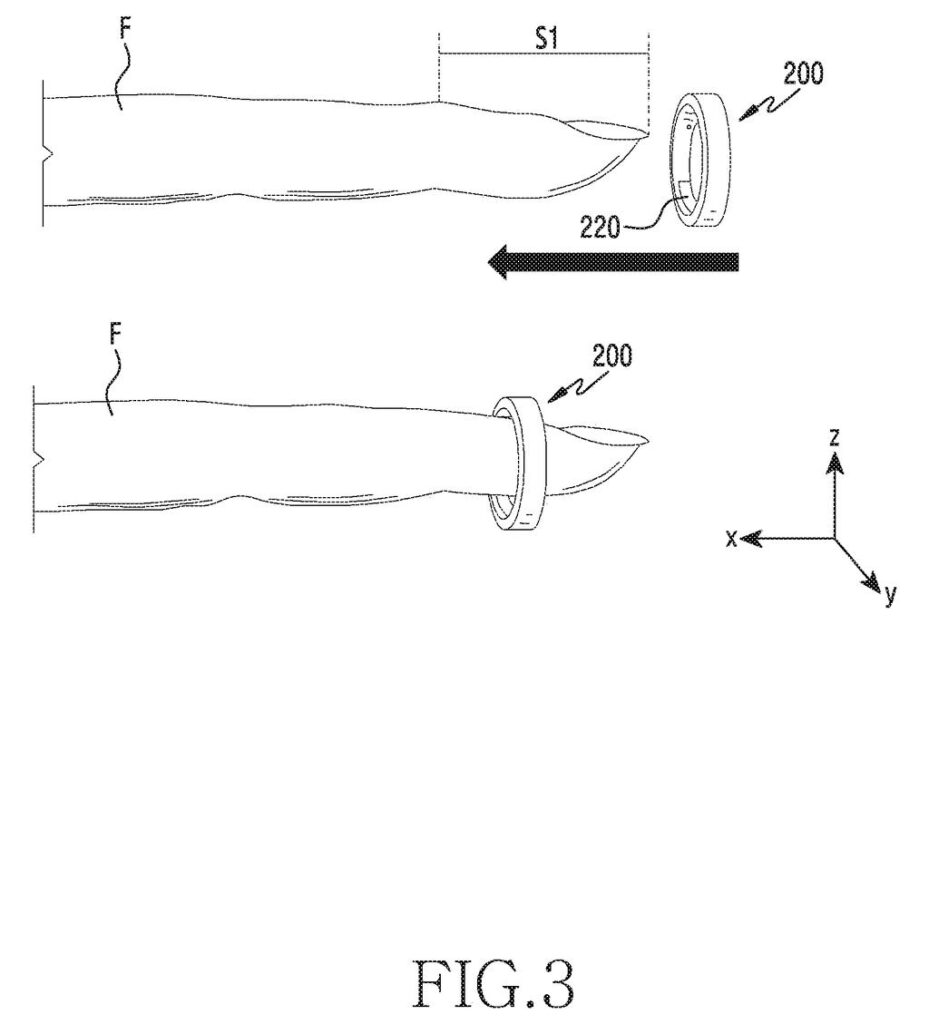
A ring slides onto a finger, and the inside of the band drags across the fingertip for a split second. In that moment, a Samsung patent application says, the ring could read your fingerprint.
The filing describes a ring with a small button on the inner side of the band, the part that touches your skin. A fingerprint sensor sits on that button. Press it as you push the ring on and your fingertip slides across the sensor, so you don't need to hold still on a pad. That matters because a ring has almost no room inside for a big sensor.
Once your print is saved, the ring can check it later to confirm it's you, for things like unlocking a device, logging in or paying. The ring also notices when the button pops back out, which tells it you've taken the ring off.
a housing including at least one hole into which a finger of a user is inserted; a button disposed on an inner surface facing the at least one hole of the housing; a fingerprint sensor disposed on the button …
Translation: The ring has an inner button with a built-in fingerprint scanner that touches your finger when you put it on.
How a fingertip swipe becomes a fingerprint
The device in the filing is a ring-shaped wearable with a hole for your finger. On the inner surface of the band, facing that hole, sits a button with a fingerprint sensor built into it. Pressing the button counts as a fingerprint input event (the cue to start a scan) and powers up the sensor, which otherwise stays off to save battery.
The scan relies on a sliding input. As your fingertip slides across the sensor, it captures a series of image strips (frames). For registration, the ring stitches those frames into one fingerprint and stores it. For authentication (checking it's you later), it can repeat the full scan or grab a single frame at one chosen moment, which the filing says speeds up scanning and processing.
The ring can also take cues from a paired device. If your phone opens a fingerprint registration or authentication screen, it signals the ring, which switches to the matching mode. A match can trigger an unlock, login or payment, and a poor match or poor image quality brings up a prompt to try again.
The filing also describes hardware options: magnets that repel each other (with a metal shield to protect the sensor), a spring, or a hinge to push the button toward your skin for a cleaner scan.
… obtain fingerprint information of the user through the fingerprint sensor based on a sliding input to the fingerprint sensor.
Translation: It reads your fingerprint automatically as your finger slides into the ring.
Why Samsung's ring needs to know it's you
If a ring is going to do more than count steps, it needs a way to know it's really you wearing it. This filing offers one. Your ring could help unlock a device, log you in or confirm a payment, with the check happening as you put the ring on.
The extras address everyday annoyances. Magnets or a spring press the sensor against your finger for a better scan, and the sensor only powers up when you press the button, which spares a tiny battery. Because the button sits on the inside of the band, it is shielded from knocks and scrapes. The ring can also tell your phone when you take it off.
Samsung's 25th filing we've tracked since June in our wearables that read your body watchlist builds on blood pressure finger screen and pulse-reading phone screen.
A ring has no screen, no keyboard and nowhere to type a PIN. If it is ever going to unlock a laptop or approve a payment, it needs another way to know the person wearing it is you. That matters a lot, because a ring is easy to lose and a lost ring that can approve payments is a liability.
Samsung's answer fits the size of that problem. A sliding sensor needs only a thin strip of space, and the swipe happens naturally when you put the ring on. Having the button pop out when the ring comes off, then telling your phone, adds a sensible check on who is wearing it.
The filing says nothing about how well a swipe scan holds up on sweaty or dry fingers, and it reports no test results. It is a sensible piece of engineering aimed at a clear problem.
Get our take in your Top Stories
Liked this breakdown? Add Patentlyze as a preferred source on Google, and our plain-English take shows up more often in your Top Stories the next time Samsung patent news breaks.
There are more where this came from
We read every patent application Big Tech publishes and send you the ones worth knowing. Plain English, free, every week.
The drawings
17 drawing sheets from US 2026/0321051 A1 · click any drawing to enlarge


Show the other 9 sheets


Want this weekly breakdown for a company we don't cover? Patentlyze Pro →
Be the first to weigh in