
Samsung Files Patent for an Earring Whose Jewelry Doubles as a Bluetooth Antenna
Samsung has filed a patent application for an earring whose decorative part is secretly an antenna, with the radio hidden in the little backing that holds it on your ear.
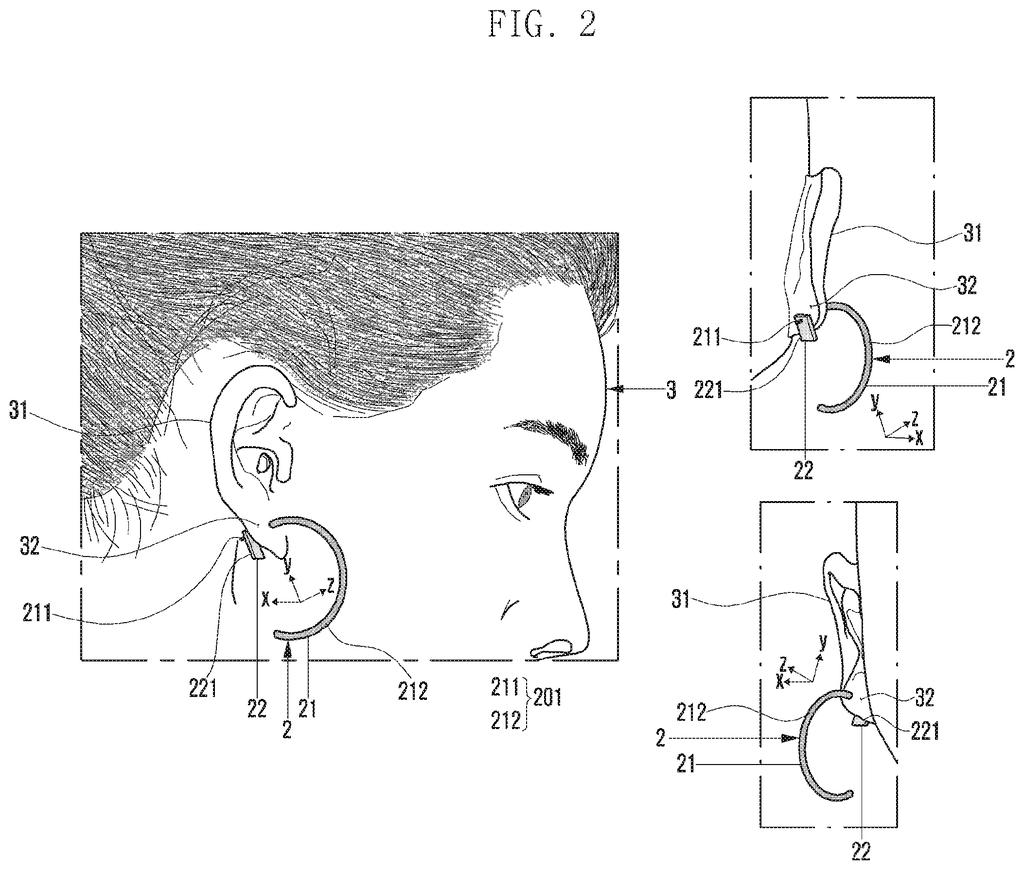
What Samsung's antenna earring actually does
Every time you push an earring back onto the post behind your earlobe, that tiny piece does exactly one job: keeping the earring from falling off. This Samsung patent application gives it a second job.
The idea is to hide a small radio and a battery inside the earring back. The post that passes through your piercing, and the decorative piece attached to it, are made of metal, so they can act as the antenna. A tiny spring clip inside the back grips the post and passes the signal into the jewelry.
Why bother? Wearable gadgets have to be small and light, which leaves little room for a good antenna. Borrowing the jewelry itself gives the radio more to work with. The filing says the earring could handle Bluetooth and Wi-Fi.
an accessory including a first conductive pattern comprising conductive material; and an earring back, including wireless communication circuitry, configured to transmit and/or receive a signal in at least one predetermined frequency band via the first conductive pattern.
Translation: The jewelry piece doubles as an antenna for the wireless parts housed in the back.
How the earring back feeds signal to the jewelry
The earring has two main pieces. The accessory is the visible part: a post (pin) that passes through your piercing, plus a metal decorative piece attached to it. Together they form the first conductive pattern, which works as the antenna. The earring back holds the wireless circuitry, a small battery and a printed circuit board (the card that carries the chips).
A springy metal clip (the flexible conductor) inside the back grips a narrow groove in the post. It holds the earring on and also carries the radio signal into the jewelry. In another version, the post is a pogo pin (a spring-loaded pin) that presses against a contact pad on the circuit board. A matching circuit tunes the connection so less signal bounces back and goes to waste.
The back can carry a second antenna, built into the circuit board or made by laser-patterning metal onto plastic. With the jewelry detached, the radio uses that antenna alone, for Bluetooth. With the jewelry attached, both antennas work together and cover Bluetooth and Wi-Fi.
A non-conductive covering, such as plastic, shifts how the metal resonates (the frequency it naturally responds to). In one example, a metal piece shortened from about 40 mm to about 30 mm kept similar performance thanks to a covering with a dielectric constant of about 3.5. The filing also describes a hinged version where the back swings toward a support on the other end, with your ear between them.
What this means for jewelry with a radio inside
If you like the idea of electronics tucked into things you already wear, this points that way. The hard part for tiny devices is fitting a good antenna, and this filing answers it by borrowing the decorative metal. The description also mentions a ground structure meant to reduce how much radio energy reaches the wearer.
For you, the practical angle is design freedom. The filing shows that different jewelry shapes shift the antenna's frequency response, and that a plastic covering lets the metal piece be shorter, which leaves more room for looks. What the earring would actually do with its connection is left open. The filing describes only the radio, the battery and the antenna, so treat it as early groundwork.
Samsung's 15th filing in our antenna and radio work we've tracked since May adds to a run that includes a heat-triggered call fix and a cable type detector.
The filing describes a nearly complete radio earring: a chip, a small battery, a tuning circuit, and a clip that links it all to the jewelry. Nothing in it needs new software or a new wireless standard, since it sticks to everyday Bluetooth and Wi-Fi bands.
What is missing is a reason to wear one. The document never says what the earring would do once connected: no sensors, no speaker, no health tracking. Someone has to add that, and every added part must fit in a backing small enough to sit behind your earlobe all day.
The shortest route to a shelf would be a basic earring that pairs with your phone, with the real feature added later. The antenna trick itself looks buildable now, since the filing's own example keeps similar performance with a 30 mm piece instead of a 40 mm one. Hardware is the whole challenge here, and it is a small one.
Get our take in your Top Stories
Liked this breakdown? Add Patentlyze as a preferred source on Google, and our plain-English take shows up more often in your Top Stories the next time Samsung patent news breaks.
There are more where this came from
We read every patent application Big Tech publishes and send you the ones worth knowing. Plain English, free, every week.
The drawings
17 drawing sheets from US 2026/0314762 A1 · click any drawing to enlarge


Show the other 9 sheets


Want this weekly breakdown for a company we don't cover? Patentlyze Pro →
Be the first to weigh in