
Adobe Wins a Patent for Carrying Video Graphics Over to a Fresh Take
Adobe has been granted a patent for editing software that takes the graphics you placed on one video and drops them onto a re-shot version, matched to what the speaker says and where they stand.
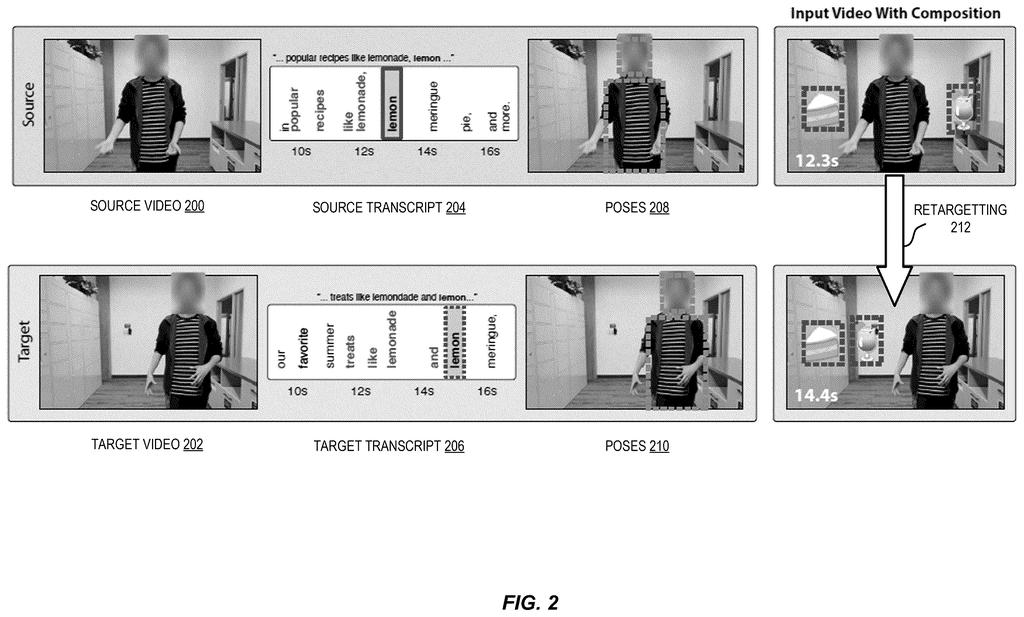
What Adobe's video graphics retargeting does
A video creator spends an afternoon placing a picture of a lemon pie right when the host says 'lemon.' Then the host re-films the scene, talks a little faster and stands off to one side, and every graphic lands in the wrong spot. If you have ever edited a video, you know the next step: do it all over again.
Adobe has now been granted a patent for software that does the redo for you. It reads what is said in both versions, finds the matching moment in the new one (even when the wording changed), and places each graphic there. It also shifts graphics out of the way so they don't cover the speaker's face or body.
The filing says this could work across different takes, different speakers, different languages, and even wide versus vertical video.
identifying at least one asset and associated source lexical data based on a source video; identifying corresponding target lexical data based on a target video; determining at least one asset retargeting time associated with the at least one asset using the source lexical data and the target lexical data; …
Translation: The software compares words from a source video and a target video to figure out when graphics should reappear.
How the patent matches words, hands and space
The system starts with two videos: a finished one with graphics already placed (the source) and a new take of the same scene (the target). Speech recognition turns both into transcripts. For each graphic, the system records the word it is tied to and the phrase around it, which the filing calls lexical data.
A large language model (an AI trained on huge amounts of text) then finds the matching spot in the new transcript by meaning, so rephrased lines, swapped order and even another language can still match. The graphic keeps the same delay after the matched word that it had before. Optional hand tracking can nudge the timing so a graphic pops up as the speaker waves.
Placement comes next. The graphic starts in its old position, and the system checks whether it overlaps boxes drawn around the speaker's face and torso:
- Simple rules go first: mirror it across the frame, snap it to the screen edges, center it, or scale it.
- If graphics still collide, integer programming (a math method that guarantees no overlap) finds a layout close to the rule-based spot.
- If no layout works, it relaxes the torso rule first, then the face.
At least one asset retargeting position associated with the at least one asset is determined based on the at least one asset retargeting time and the target video. The at least one asset is added to the target video using the at least one asset retargeting time and the at least one asset retargeting position.
Translation: It calculates exactly where on the screen the graphic should go and inserts it into the new video.
Why re-shooting a video gets less painful
If you make videos for a living, or just for a channel, re-shooting a line often means redoing every overlay by hand. This patent describes automating that, and the same trick could cover a translated version, a vertical clip for social media, or a cut with a different host. The filing pictures it as a button inside a video editor.
It is already a granted patent, though the final granted claims may read a little differently from the published application described here. The filing points to video editing apps as the natural home for this, but it does not name a specific product.
Adobe's 48th filing we've tracked in the AI photo editing race since May adds to a run that includes a fix for drifting video edits and context-aware photo suggestions.
The price of this design is that it leans on spoken words. Each graphic is tied to a word and the phrase around it, so a video with little talking gives the system little to hold onto.
An AI model also has to decide which sentence in the new take means the same thing as the old one, and the filing sets its randomness low to keep answers consistent. Hand tracking is added to fix leftover timing errors, which tells you the first pass is not always right. When graphics cannot all fit, the system lets them cover the speaker's torso first, then the face.
Those are fair costs. An editor who spends a few minutes checking the result still beats one who re-places every graphic by hand, so the trade reads as worth it.
Get our take in your Top Stories
Liked this breakdown? Add Patentlyze as a preferred source on Google, and our plain-English take shows up more often in your Top Stories the next time Adobe patent news breaks.
There are more where this came from
We read every patent application Big Tech publishes and send you the ones worth knowing. Plain English, free, every week.
The drawings
11 drawing sheets from US 2026/0332836 A1 · click any drawing to enlarge


Show the other 3 sheets


Want this weekly breakdown for a company we don't cover? Patentlyze Pro →
Be the first to weigh in