
Adobe Patents Technology to Turn Transparent Images Into Infinitely Resizable Files
Converting a pixel-based image to a scalable vector file is already tricky. Doing it without losing glass effects, soft shadows, or translucent layers is where most tools fall apart. Adobe's new patent takes a direct run at that specific problem.
What Adobe's transparency-to-vector conversion actually does
Every time a designer exports a logo or icon, they face the same headache: pixel images and vector graphics do not speak the same language, and transparency is usually the first thing lost in translation.
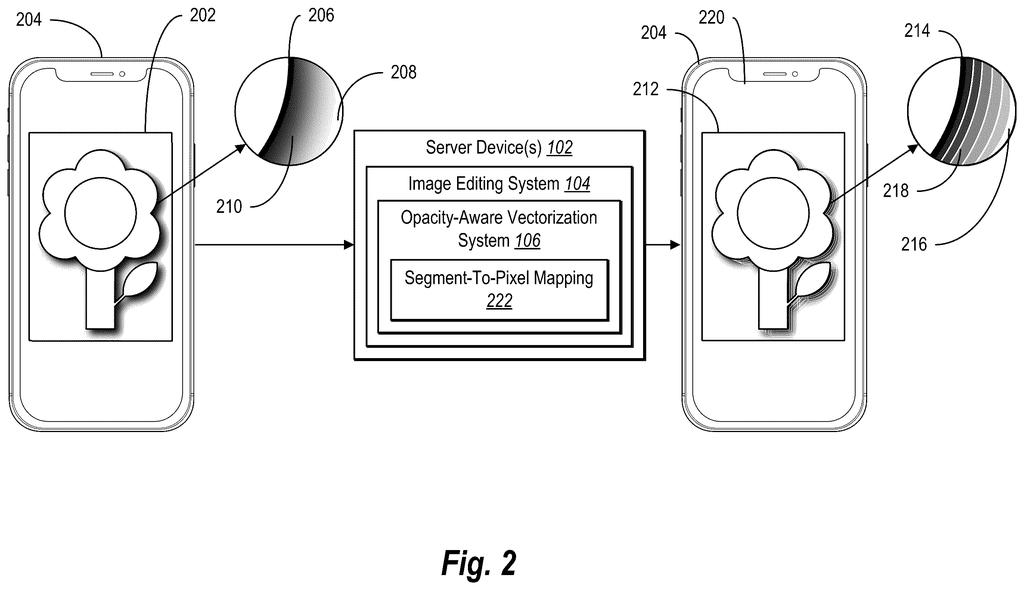
Adobe's patent describes a system that can look at a pixel-based image, identify which parts are see-through or partially transparent (think frosted glass, soft drop shadows, or a sticker with a feathered edge), and carry those qualities over into the vector version. The result is a scalable graphic that still looks right when you blow it up to billboard size or shrink it to a thumbnail.
For you as a designer, that means fewer manual touch-ups after an auto-trace. The system uses an AI model to carve the image into segments, then carefully tracks which segments belong to the transparent areas, so the final vector file preserves the effect rather than replacing it with a hard edge.
… extracting, using a segmentation model, a plurality of segments from the raster image; generating, from the raster image, a segment-to-pixel mapping that maps a segment from the plurality of segments to the set of pixels having the transmissive property; …
Translation: The system uses AI to break the image into pieces and track which pixels are transparent.
How the segmentation model maps pixels to vector paths
At its core, the patent describes a pipeline with three stages:
- Segmentation: A trained AI model (a segmentation model, meaning software that draws boundaries around distinct regions of an image) splits the raster image into labeled chunks. Each chunk maps to a recognizable object or region.
- Transmissive-property mapping: The system builds a lookup table that connects each segment to the specific pixels flagged as having a "transmissive property" (Adobe's term for transparency or translucency, i.e., pixels you can see through, fully or partially). This segment-to-pixel map tracks not just where those pixels are but which segment they belong to.
- Vector generation: Using that map, the system draws vector paths (mathematical curves that define shapes) and bakes the transparency values directly into those paths, so the final vector graphic carries the same see-through qualities as the original pixels.
The claim covers software running on a server that receives an image from a client device and sends back the finished vector file, which makes this a good fit for a cloud-based Creative Cloud workflow.
The patent does not describe a new AI architecture from scratch. It leans on existing segmentation models and adds the transmissive-property tracking layer on top, which keeps the engineering scope focused.
… vectorize raster images while translating transmissive properties portrayed therein.
Translation: The software converts pixel pictures into vector graphics while keeping transparent areas intact.
What this means for designers working with logos and icons
Rasterization to vector conversion is one of those tasks that sounds simple until you try it on real-world assets. Logos with glassy buttons, UI icons with soft glows, product photos with frosted overlays: all of them currently require manual cleanup after an auto-trace because today's tools flatten transparency into hard opaque shapes. If Adobe ships this as a feature in Illustrator or Firefly, it could save production designers a meaningful chunk of their day on asset-prep work.
The patent is software-only, meaning Adobe does not need new hardware to put it in front of users, and the segmentation models it relies on already exist inside Adobe's product stack. The shortest path from this filing to a shipping feature is probably a new option inside Illustrator's existing Image Trace panel, or a batch conversion tool inside Express. Adobe files a steady stream of interesting tech patents around its core creative tools, and this one sits squarely in the asset-workflow category that affects a large slice of its paying subscribers.
That makes this Adobe's 142nd filing in our Adobe coverage since May, a corpus that includes an AI scene builder and 3D hole-filling by text.
This patent is practical rather than flashy, and that is what makes it credible. The problem it solves is real and well-defined, the engineering approach is incremental rather than speculative, and the output (a vector file that actually looks like the source image) is something designers can use immediately.
Because it is pure software and leans on segmentation models Adobe already has access to, the gap between this filing and a shippable feature is unusually short. The main open question is accuracy: whether the AI segmentation is good enough in practice to handle complex transparencies like layered glass or overlapping soft shadows without introducing artifacts. That is a quality threshold, not an architectural barrier.
If Adobe's internal testing clears that bar, this could plausibly appear as a checkbox in Image Trace within a major Illustrator update. Patents do not guarantee shipping features, but the absence of exotic hardware requirements or unproven science makes this one of the more grounded conversion-tool filings Adobe has published.
Get our take in your Top Stories
Liked this breakdown? Add Patentlyze as a preferred source on Google, and our plain-English take shows up more often in your Top Stories the next time Adobe patent news breaks.
There are more where this came from
We read every patent application Big Tech publishes and send you the ones worth knowing. Plain English, free, every week.
The drawings
10 drawing sheets from US 2026/0253276 A1 · click any drawing to enlarge


Want this weekly breakdown for a company we don't cover? Patentlyze Pro →
Be the first to weigh in