
Samsung Patents a Frequency-Domain Image Upscaling System That Denoises Before It Sharpens
Most image upscaling works directly on pixels — Samsung's new patent takes a detour through the frequency domain first, stripping out noise before reconstructing a sharper image. It's a subtle but meaningful difference in how you get from a blurry photo to a crisp one.
What Samsung's frequency-based photo upscaling actually does
Imagine you're trying to sharpen a blurry, grainy photo on your phone. Most upscaling tools just try to guess what the missing pixels should look like — but they often end up amplifying the grain and noise in the process, making the result look artificially crunchy.
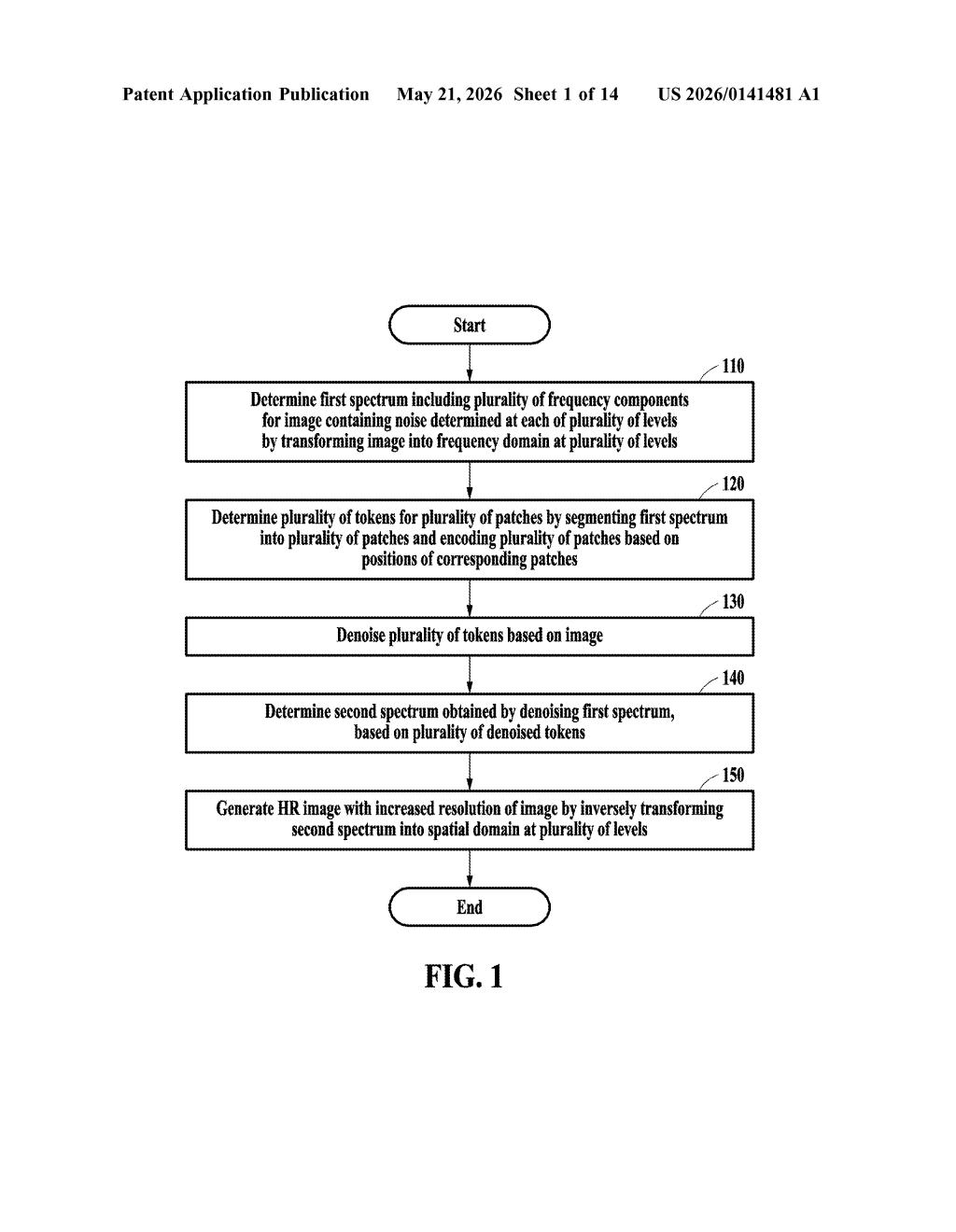
Samsung's approach works differently. Instead of sharpening the image directly, it first converts the photo into a mathematical representation of its frequencies — think of it like separating a song into its individual instrument tracks before remixing. It then cleans up the noise from those frequency components at multiple detail levels before reassembling the image.
The result is a high-resolution image that's been sharpened and denoised in a smarter order — cleaning first, then upscaling — which should reduce the artifacts and smearing that plague conventional methods. This kind of processing is aimed at the chips inside phones, cameras, and potentially TVs.
How the multi-level spectrum denoising pipeline works
The patent describes a pipeline with several distinct stages, all operating in the frequency domain (a mathematical space where an image is represented as overlapping waves of different frequencies, rather than as a grid of pixels).
- Multi-level frequency decomposition: The input image is transformed into a spectrum — essentially broken into layers of fine detail, medium detail, and broad structure — at multiple resolution levels simultaneously.
- Patch tokenization with positional encoding: The frequency spectrum is then sliced into small patches, and each patch is turned into a token (a compact numerical representation, like those used in transformer-based AI models). Crucially, each token carries information about where in the image its patch came from.
- Token-level denoising: A model then denoises those tokens using the original image as a reference, selectively cleaning noise from the frequency representation rather than from the raw pixels.
- Inverse transform and HR reconstruction: The cleaned-up spectrum is converted back into pixel space at each level, producing a high-resolution output image.
The key insight is that doing denoising in frequency space — before the inverse transform back to pixels — lets the system suppress noise more precisely, because noise and signal occupy different frequency bands.
What this means for Galaxy camera and display processing
For Samsung Galaxy devices, this kind of pipeline could live inside the image signal processor (ISP) or a neural processing unit, improving both camera output and display upscaling. Cleaning noise in the frequency domain before reconstructing pixels is a well-regarded approach in computational photography research, and seeing Samsung formalize it in a patent suggests it may be moving toward on-device implementation.
For you as a user, the practical promise is sharper low-light photos and higher-quality zoom without the plasticky, over-processed look that aggressive AI sharpening often produces. It's also relevant to Samsung's display business — the same technique could upscale streaming video on QLED TVs or Galaxy tablets.
This is a technically solid patent targeting a real problem: conventional super-resolution methods that sharpen and denoise in the wrong order. The frequency-domain approach is well-grounded in signal processing theory, and the transformer-style tokenization of frequency patches is a smart modernization. It's not a flashy consumer feature announcement, but it's the kind of foundational image processing work that quietly improves every camera shot you take.
There are more where this came from
We read every patent application Big Tech publishes and send you the ones worth knowing. Plain English, free, every week.
Want this weekly breakdown for a company we don't cover? Patentlyze Pro →