
Sony Patents an AI Engine That Remixes Your Music to Match Video Game Moments
Imagine playing a tense boss fight — but instead of the game's original score, your own playlist is dynamically remixed in real-time to match that exact moment's energy. That's exactly what Sony is trying to build.
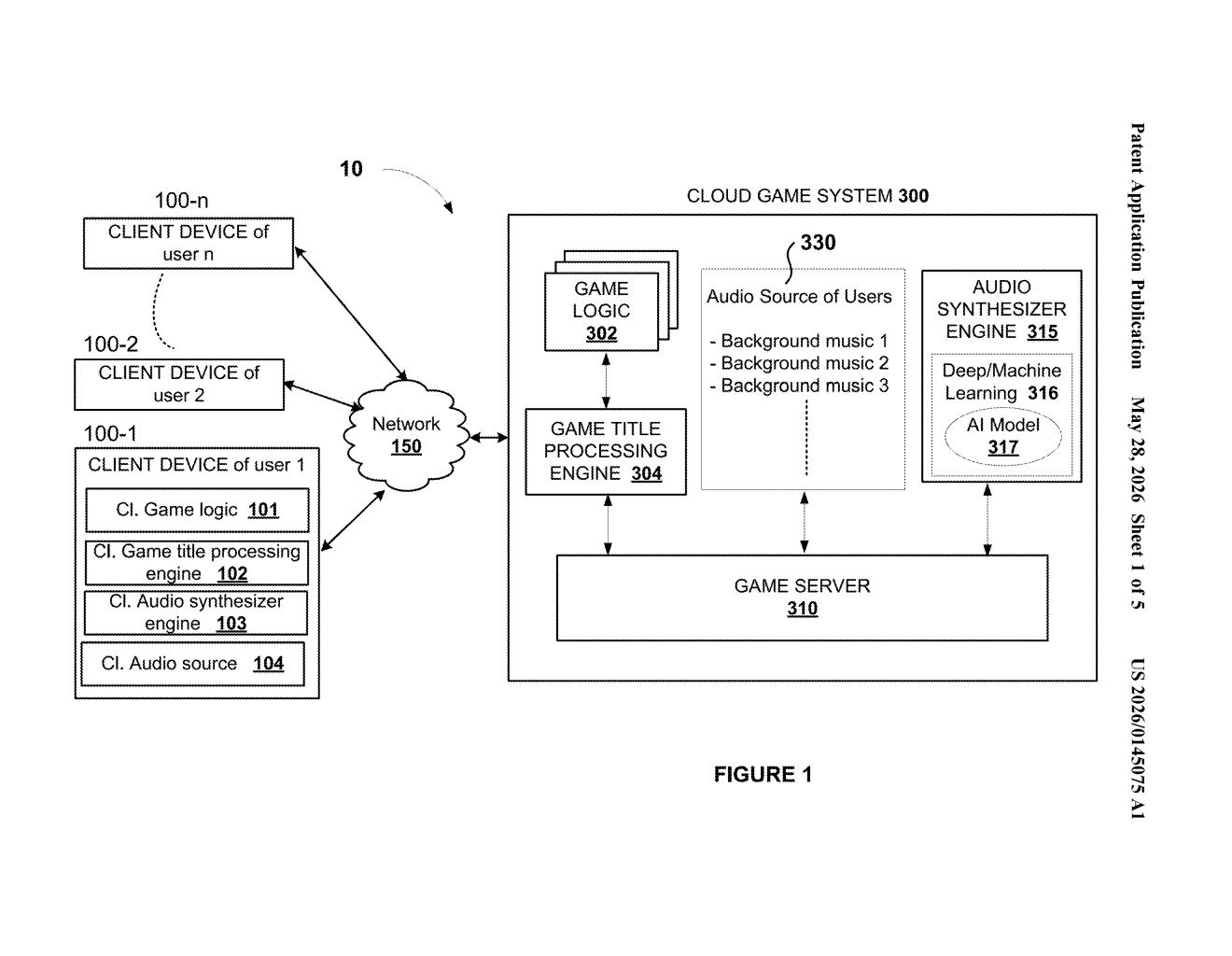
How Sony's system swaps game music for yours — contextually
You know how video game music is carefully designed to shift with the action — quiet and eerie when you're exploring, intense and driving when you're in a fight? Sony's new patent wants to let your music do that job instead, without just swapping in a flat playlist.
The system analyzes your personal background music — think your Spotify library or uploaded tracks — and picks out specific clips that match the mood and style of what's happening in the game at any given moment. When a new activity kicks off (a boss battle, a cutscene, a puzzle), the audio is adjusted on the fly to slot in the right clip from your library.
The whole thing runs server-side as part of a cloud gaming setup, so your device doesn't need to do any of the heavy lifting. It's a personalization feature that tries to make your music feel native to the game, rather than just playing over it.
How the synthesizer engine matches clips to game activities
The patent describes an audio synthesizer engine that operates in two phases: an analysis phase and a real-time playback phase.
During analysis, the system examines the game's original score to identify musical attributes for each type of in-game activity — things like tempo, key, intensity, and instrumentation style. Separately, it analyzes the user's background music library to find clips whose attributes closely match those defined for each activity. Think of it as building a lookup table: "for this game's chase sequence style, use this 30-second clip from your library."
During gameplay, the engine watches for activity detection signals from the game server — essentially game state events that say "a combat sequence just started" or "the player entered a stealth zone." When one fires, the engine dynamically adjusts the current audio stream, replacing or modifying the corresponding portion of the background music with the pre-matched clip from your library.
Key components the patent calls out:
- Deep/machine learning models — used to identify and match musical attributes across the original score and user-provided tracks
- Cloud game server — the engine runs server-side, so the synthesizer can process multiple users' audio sources at scale
- Audio clip identification — the matching isn't just "find a similar song," it isolates specific clips within a longer track that best mimic the target mood
What this means for PlayStation personalization and cloud gaming
For PlayStation and Sony's cloud gaming ambitions, this is a meaningful personalization layer. Letting players soundtrack their own games is not new — you've been able to play custom music in games like GTA for decades — but doing it contextually, where the audio actually responds to game state, is a different proposition entirely. It closes the gap between "I want my music on" and "I want my music to feel like it belongs here."
From a platform strategy angle, this kind of feature is a stickiness play. If Sony's cloud gaming service can do something to your music that your local PS5 can't, that's a genuine reason to stay subscribed. The server-side architecture also means this could theoretically work across any title without developer buy-in, which is the more interesting long-term angle.
This is a genuinely clever idea that sits at the intersection of personalization and game audio design — two things that have historically been kept separate. The technical challenge of making your Drake track feel emotionally appropriate during a FromSoftware boss fight is real and unsolved, so it's worth watching how well the ML matching actually performs in practice. Whether this ships as a PlayStation feature or stays a patent is the open question, but it's the kind of thing that would actually get people to talk about cloud gaming in a positive light.
There are more where this came from
We read every patent application Big Tech publishes and send you the ones worth knowing. Plain English, free, every week.
Want this weekly breakdown for a company we don't cover? Patentlyze Pro →