
Amazon Files Patent for Helping Alexa Pick the Right Picture for Your Answer
Ask Alexa who invented the telephone and the answer names a person, a year and even a patent. Amazon's filing describes how a computer could decide which one of those deserves the picture on your screen.
What Amazon's Alexa answer-picture patent does
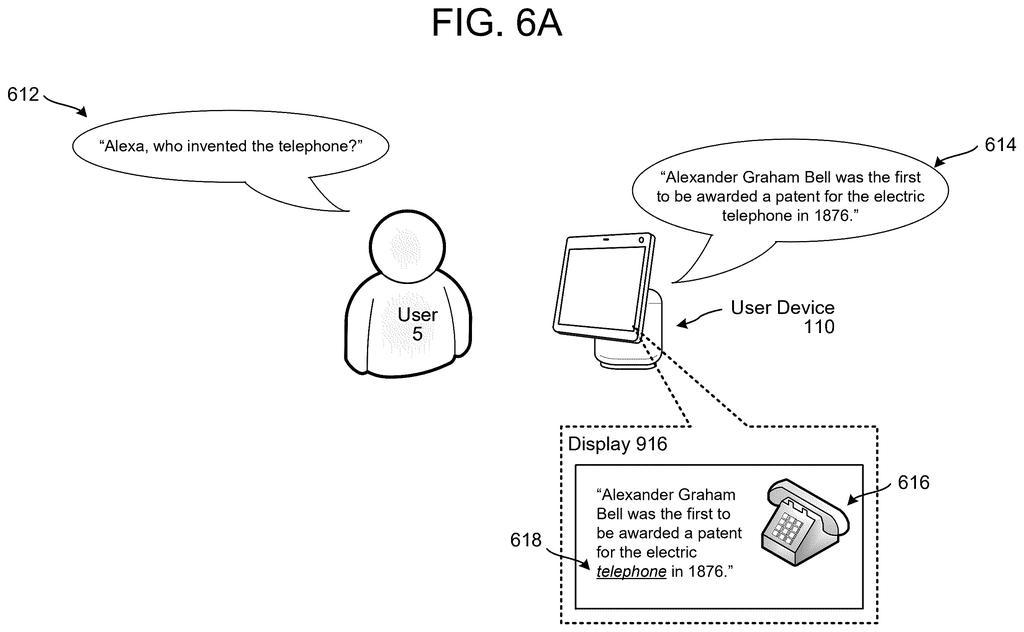
You ask your speaker, "Who invented the telephone?" The answer comes back full of names: Alexander Graham Bell, a patent, the year 1876. Your screen has room for one picture or one link. Which one should it be?
This Amazon filing describes a way for a computer to settle that. It reads the question and the answer together, then scores each person, place or thing mentioned by how central it is to the whole exchange. In the telephone case, the winner is "telephone," so you get a photo of a telephone instead of a picture of a patent or a link to a different 1876 invention.
The filing says this is hard with very short text, like a voice assistant's reply, because the usual clues (where a word sits, how often it repeats) don't tell you much. The system is built for exactly that short-answer case.
… where salience may refer to the importance or centrality of the entity to the content of the text …
Translation: The system figures out how important a specific person, place, or thing is to what you are reading.
How the model scores each name in an answer
The method starts with a short piece of text, such as a question and its answer joined together. A neural network encoder (a program trained on large amounts of text) turns that passage into an embedding, a long list of numbers that captures its meaning.
Each named thing in the passage gets its own embedding too. The system can add a short description from a knowledge graph (a database of facts about people, places and products), such as a line from an encyclopedia entry. It then measures how similar each name's numbers are to the passage's numbers, for example with a standard comparison called cosine similarity. The result is a salience score, meaning how central that name is to the text.
According to the claims, the system outputs the answer and, based on the score, also offers a pointer to extra material about that entity. That could be an image shown on a display or a hyperlink added to the name.
The filing also describes other versions:
- A version that reads each word's meaning in context, which skips a separate step for names.
- A "cross-encoder" that reads the passage and the name together and works as a more powerful teacher model.
- Training on machine-made labels, then shrinking the result into a smaller model that could run on a device.
What this means for Alexa answers on screen
If you use a speaker with a screen, the picture or link next to an answer should match what you actually asked about. A system that scores each name can make that choice automatically. The filing says the score could also help rank possible answers or filter possible readings of a request.
The filing is upfront about the hard part: voice assistant replies are only a sentence or two, so clues like word position and repetition carry little weight. The approach is built for that short-text case, and it can store the number lists for common questions and common names so it can respond with low delay.
Amazon's 14th filing we've tracked in our Alexa taking action watchlist since May builds on earlier applications like picking the right tool and ranking caller emotions by topic.
You will almost never notice this feature working. A good pick looks obvious: ask about the telephone, see a telephone. You would notice it only when it fails, like a photo of Mojave, California after a question about the highest altitude a plane has flown.
That makes it a small fix that matters to anyone who uses a speaker with a screen. The picture or link beside an answer either helps you or clutters the display, and a better choice saves you a tap and a moment of confusion.
The filing also keeps costs in mind. It describes a smaller model that could run on the device and score names quickly enough to finish just before the reply goes out, so you would not wait longer for an answer. Routine engineering, aimed at a small daily annoyance.
Get our take in your Top Stories
Liked this breakdown? Add Patentlyze as a preferred source on Google, and our plain-English take shows up more often in your Top Stories the next time Amazon patent news breaks.
There are more where this came from
We read every patent application Big Tech publishes and send you the ones worth knowing. Plain English, free, every week.
The drawings
12 drawing sheets from US 2026/0351250 A1 · click any drawing to enlarge


Show the other 4 sheets


Want this weekly breakdown for a company we don't cover? Patentlyze Pro →
Be the first to weigh in