
Amazon Patents a Pre-Fetching Code Completion System That Chains Suggestions in Real-Time
Amazon's latest patent describes a code completion engine that doesn't wait for you to accept a suggestion — it's already generating the next one while you're deciding on the first. The result is a chain of syntax-valid completions that appear instantly, one after another, with no lag between them.
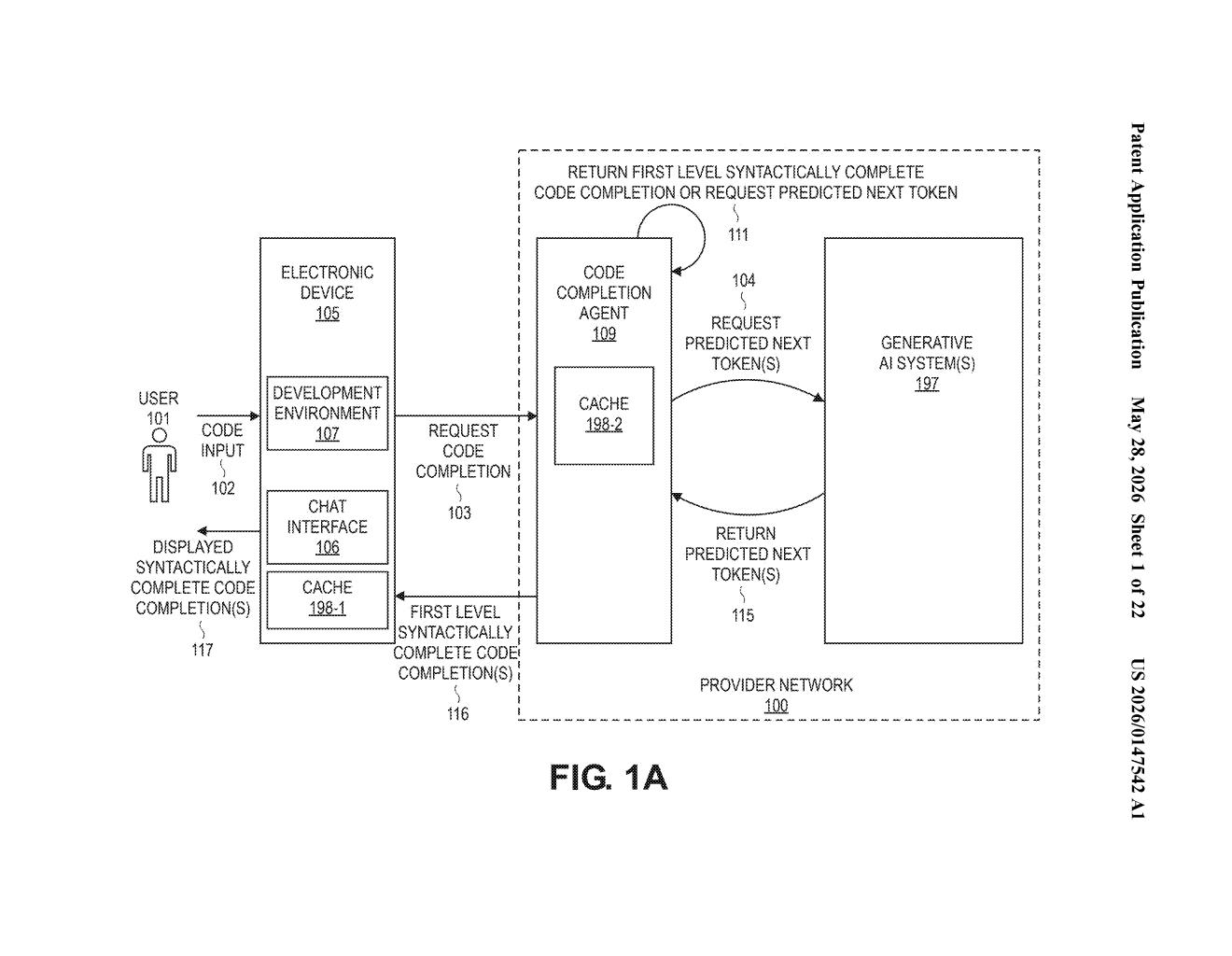
How Amazon's chained code suggestions stay ahead of you
Imagine typing code in your editor and getting a suggestion from an AI tool. You press Tab to accept it — and instantly another suggestion appears, perfectly lined up to follow the first. No spinner, no half-second pause. The next piece was already waiting for you.
That's what this Amazon patent describes. The system generates a suggestion for your current code, checks that it's syntactically complete (meaning it won't break your program), and then — before you even decide whether to accept it — starts generating the next suggestion based on what your code would look like if you did accept. That second suggestion gets stored in a cache, ready to fire the moment you say yes.
The goal is to eliminate the tiny but annoying delay that current AI code tools create between accepting one suggestion and seeing the next. Instead of waiting, the suggestions flow like a conversation — each one building on the last.
How the cache pre-generates each next completion level
The patent describes a multi-level, sequential code completion system built around a prefetch-and-cache architecture. Here's the chain:
- The system receives a request for a code completion, generates a candidate, and verifies it is syntactically complete — meaning it forms a valid, executable unit of code with no syntax errors when added to the existing file.
- While that first suggestion ("Level 1") is being shown to the user, the system immediately begins generating a "Level 2" completion — one built on the assumption that the user will accept Level 1. This Level 2 completion is also verified as syntactically valid and structurally appropriate to follow Level 1.
- The Level 2 completion is stored in a cache. The moment the user accepts Level 1, the cached Level 2 suggestion is presented in real-time or near-real-time — no new inference call required at that instant.
The "syntactically complete" check is the load-bearing piece here. Rather than offering a raw token stream that might stop mid-expression or produce broken code, the system ensures every suggestion stands on its own as a valid code unit. The sequential dependency — each level based on acceptance of the prior — means the cached suggestions stay contextually coherent rather than being generic pre-computed guesses.
What this means for AI coding tools like Amazon Q
For developers using AI coding assistants, latency is the silent killer of flow state. Even a half-second pause between accepting a suggestion and seeing the next one is enough to break concentration. This patent targets that gap directly, essentially turning AI code completion into a streaming experience rather than a request-response loop. If Amazon ships this in a tool like Amazon Q Developer (its AI coding assistant), it could make multi-step completions feel genuinely fluid.
The broader signal is that Amazon is thinking about agentic, multi-turn coding assistance — not just single-shot autocomplete. Pre-generating chains of dependent suggestions implies the system has a forward model of where your code is going, which is a step toward longer-horizon code generation without requiring the user to wait at each step.
This is a well-scoped engineering patent tackling a real and specific problem: the latency seam between chained AI completions. The cache-prefetch approach is sensible and the syntactic validity constraint is a smart guardrail. It's not a fundamental research advance, but it's the kind of product-quality detail that separates a tool developers actually enjoy from one they merely tolerate.
There are more where this came from
We read every patent application Big Tech publishes and send you the ones worth knowing. Plain English, free, every week.
Want this weekly breakdown for a company we don't cover? Patentlyze Pro →