
Amazon's Zoox Files Patent for Robotaxis That Warn You About Ice and Crowds
Your robotaxi could scan the sidewalk for ice and crowds while you're still inside, then send your phone a safer walking route to the car. Zoox, Amazon's robotaxi company, describes exactly that in a new patent application.
What Zoox's hazard-warning robotaxi actually does
Ever walked out to meet your ride and nearly slipped on ice you couldn't see from inside? Zoox, Amazon's robotaxi company, has filed a patent application for a car that spots trouble like that first and warns you.
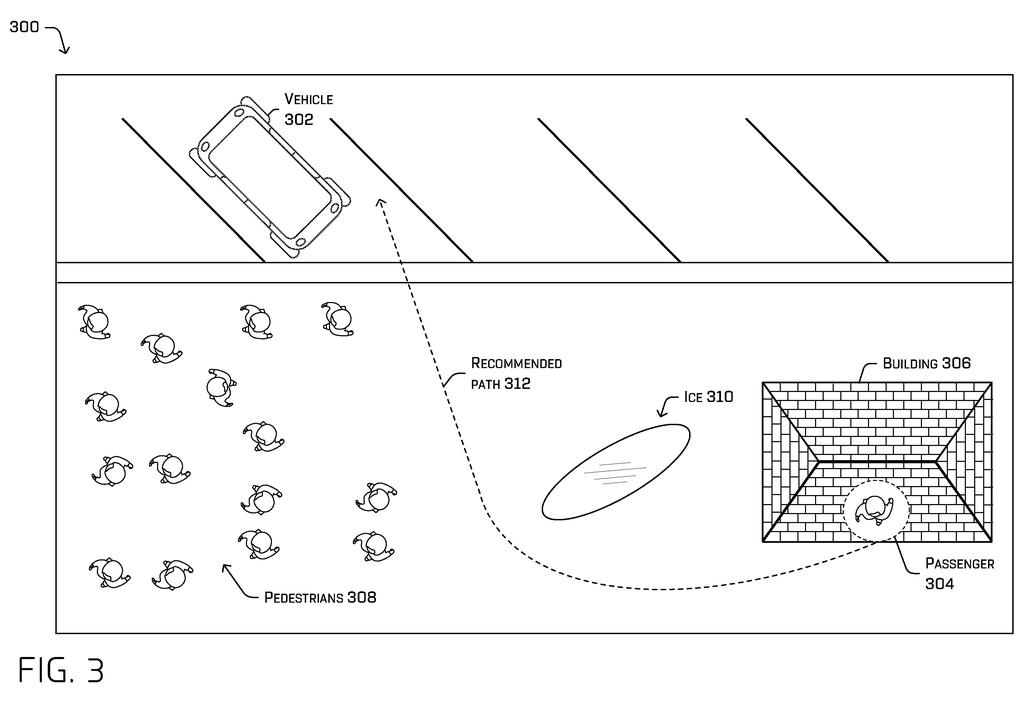
Here's the idea. When the car pulls up and you aren't at the pickup spot yet, it looks around with its cameras and other sensors. If it sees ice, a big group of pedestrians, a pothole, or a blind spot behind a parked van, it sends a message to your phone app.
The message comes with a map and a recommended walking route, such as heading for the side of the car farthest from the crowd. You can also tell the app which dangers you care about most, ask the car to move to a better parking spot, or cancel the ride.
… determining, based at least in part on a ranking of a plurality of potential hazards, the potential hazard, and the passenger not being located at the pickup location, a recommended path for the passenger to follow to the vehicle; …
Translation: The vehicle ranks surrounding hazards to figure out the safest walking route for the missing passenger.
How the car picks a safer route to its door
The patent covers a system that runs when a robotaxi arrives at a pickup spot and the rider isn't there yet. It first checks whether the rider's location meets a threshold condition, meaning something like being far from the car, having no line of sight to it, or standing inside a blind spot the car can't see into.
Next, the car reads its sensors (cameras, radar, and lidar, which measures distance with laser pulses) to look for hazards. The filing lists ice, snow, water, potholes, bike lanes, heavy traffic, crowds, animals, emergency sirens, and objects likely to enter the area. A blind spot counts as a hazard when its risk score passes a cutoff. The score weighs its size, past problems there, distance from the car, lighting, and the direction you're walking from.
The claims also stress a ranking of hazards. The ranking can come from your profile, so a wheelchair user might rank stairs and steep sidewalks above wind or ice, and a deaf rider might rank sound-dependent dangers higher. The car picks a path that may brush a low-ranked hazard to avoid a high-ranked one, then sends the hazards and route to your phone or controls the car based on that route.
The filing also describes moving the car to a better parking spot after asking you, and pulling in hazard reports from other cars in the fleet that can see around corners.
The vehicle may transmit a message that includes the potential hazard(s) and/or the recommended path to a user device of the passenger.
Translation: It texts your phone to warn you about dangers and tell you which way to walk.
Why robotaxi pickups need hazard warnings
Pickup is the messy moment of any ride-hailing trip, and a robotaxi has no driver to lean out and tell you to watch out for the ice. This filing gives the car that job. Because the sensors that find hazards are already on the vehicle, the warning could reach you through the ride app you already use.
It also matters for accessibility. The ranking idea lets riders who use a wheelchair or can't hear tell the app which dangers count most, so the route fits them. It is still a patent application, and the text doesn't say when or whether Zoox would build it into a service.
Amazon's 35th filing we've tracked since May in the self-driving sensing race adds to a thread that includes which streets robotaxis can handle and which path a car checks first.
This idea sits close to a shippable feature. It needs no new hardware: the car's cameras, radar and lidar already watch the curb, and the ride app already knows where you are and can show a map.
What has to exist first is trustworthy hazard spotting. A crowd or a van blocking the view is easy to describe, but judging a patch of ice or a pothole from a parked car is harder. A wrong warning also teaches riders to ignore the next one. The shortest route to a product is probably a plain message about busy sidewalks and blind spots, with personalized rankings added later.
The checkbox screen where you pick which hazards you care about is the most appealing detail. It is ordinary app work, and it turns a generic warning into one that fits you.
Get our take in your Top Stories
Liked this breakdown? Add Patentlyze as a preferred source on Google, and our plain-English take shows up more often in your Top Stories the next time Amazon patent news breaks.
There are more where this came from
We read every patent application Big Tech publishes and send you the ones worth knowing. Plain English, free, every week.
The drawings
12 drawing sheets from US 2026/0348732 A1 · click any drawing to enlarge


Show the other 4 sheets


Want this weekly breakdown for a company we don't cover? Patentlyze Pro →
Be the first to weigh in