
AMD Patents a GPU Dispatch System That Skips Unnecessary Work Between Processor Cycles
GPUs waste time when they have to scan through assignments meant for other parts of the chip before finding their own. AMD's new patent describes a dispatch system that lets each section of a GPU jump straight to its assigned work, cycle after cycle, without the detour.
What AMD's cycle-by-cycle GPU dispatch actually does
A modern GPU chip divides itself into clusters, each one handling a slice of a big computing job. Every cycle, each cluster needs to know exactly which piece of work to grab next. Right now, figuring that out can mean scanning through a list of tasks, skipping over entries meant for other clusters before landing on the right one.
AMD's patent describes a way to skip that scanning entirely. Each cluster's controller uses a single programmable number to calculate exactly which block of tasks belongs to it, then picks up the next block on the very next processor cycle, with no wasted steps in between.
For you as a user, fewer wasted cycles means the GPU can push through more work in the same amount of time, which matters any time you're running graphics-intensive games, AI models, or video processing that hammers the chip continuously.
… dispatching, during a second processor cycle immediately following the first processor cycle, the second segment to the first compute cluster.
Translation: The system sends out the next piece of work in the very next clock cycle without any delay.
How the segment selector picks work without scanning the whole grid
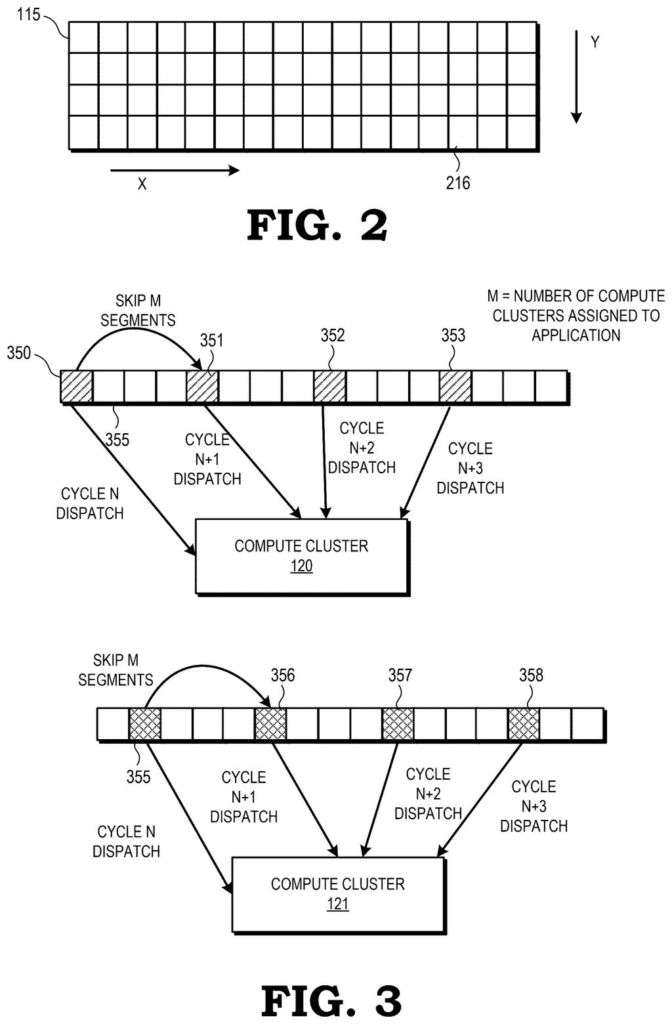
The patent centers on what AMD calls a thread grid, which is a structured list of small units of work (called workgroups or thread groups) arranged along multiple dimensions, similar to a spreadsheet with rows and columns of tasks.
When a GPU is split into several compute clusters, each cluster needs its own dispatcher to hand out tasks. The problem is that if each dispatcher has to look at the whole grid to find which tasks belong to it, it wastes time reviewing entries that belong to other clusters.
AMD's solution introduces a programmable segment size: a value that tells each dispatcher how large a chunk of the grid to claim, calculated based on how many clusters are active. Key mechanics include:
- Each dispatcher selects a contiguous segment of the thread grid along one dimension
- After dispatching that segment, the controller calculates the next segment automatically, skipping over segments assigned to other clusters
- Because the math is simple and pre-configured, the next segment can be dispatched in the immediately following processor cycle, with no gap
The programmable part is important: if the chip's configuration changes (say, fewer clusters are active), the segment size adjusts, so the system stays efficient regardless of how the hardware is set up at any given moment.
… the dispatch controllers are able to omit review of grid segments targeted to other compute clusters, and are thus able to dispatch selected segments in consecutive processing cycles.
Translation: By ignoring work meant for other parts of the chip, the system can rapidly assign tasks back to back.
What this means for GPU workload efficiency
GPU dispatch overhead is a real cost that compounds fast. When a chip is running thousands of workgroups across multiple clusters, even a one-cycle delay per handoff adds up to measurable latency across a full computation. This patent targets exactly that gap, and it does so with a lightweight arithmetic fix rather than adding new hardware.
For workloads like AI inference, game rendering, or video encoding, where the GPU is effectively running the same dispatch loop millions of times per second, shaving cycles off each iteration has a practical impact on throughput. the pattern in AMD's GPU scheduling filings suggests the company is tightening the low-level plumbing of its compute architecture, which tends to benefit the highest-demand workloads first.
AMD's 20th filing we've tracked since June in the GPU rendering race builds on earlier work like its self-routing chip idea and one on finding triangles faster.
Dispatch latency is one of those costs that never shows up in a product review but compounds across every workload a GPU touches. Every moment a processor spends deciding which work to assign next, rather than executing it, is a moment of raw capacity sitting idle. At scale, across millions of these decisions per second, that overhead has real consequences for performance.
AMD's approach here is deliberately narrow: by organizing work assignment around the actual number of active processing clusters, each controller can skip over jobs meant for other clusters and move to the next relevant task in consecutive steps. No scanning, no skipping, no wasted review cycles.
A fix this focused will never generate a headline, but it accumulates in every workload that pushes a GPU hard. That steady, invisible gain is often where competitive architectures are actually won.
There are more where this came from
We read every patent application Big Tech publishes and send you the ones worth knowing. Plain English, free, every week.
The drawings
5 drawing sheets from US 2026/0299998 A1 · click any drawing to enlarge


Want this weekly breakdown for a company we don't cover? Patentlyze Pro →
Be the first to weigh in