
AMD Patents a Faster Way to Find Triangles in Compressed 3D Graphics Data
Finding one triangle in a compressed 3D mesh sounds trivial until you realize the data has no fixed address system. AMD's new patent solves a surprisingly thorny bookkeeping problem that slows down how GPUs unpack geometry.
What AMD's triangle lookup fix actually does for 3D graphics
Every time a game or 3D app draws a scene, your GPU has to unpack millions of tiny triangles that were squeezed together to save memory. That compression is efficient, but it creates a headache: because the compressed chunks aren't all the same size, the GPU can't just jump straight to the triangle it needs. It has to hunt.
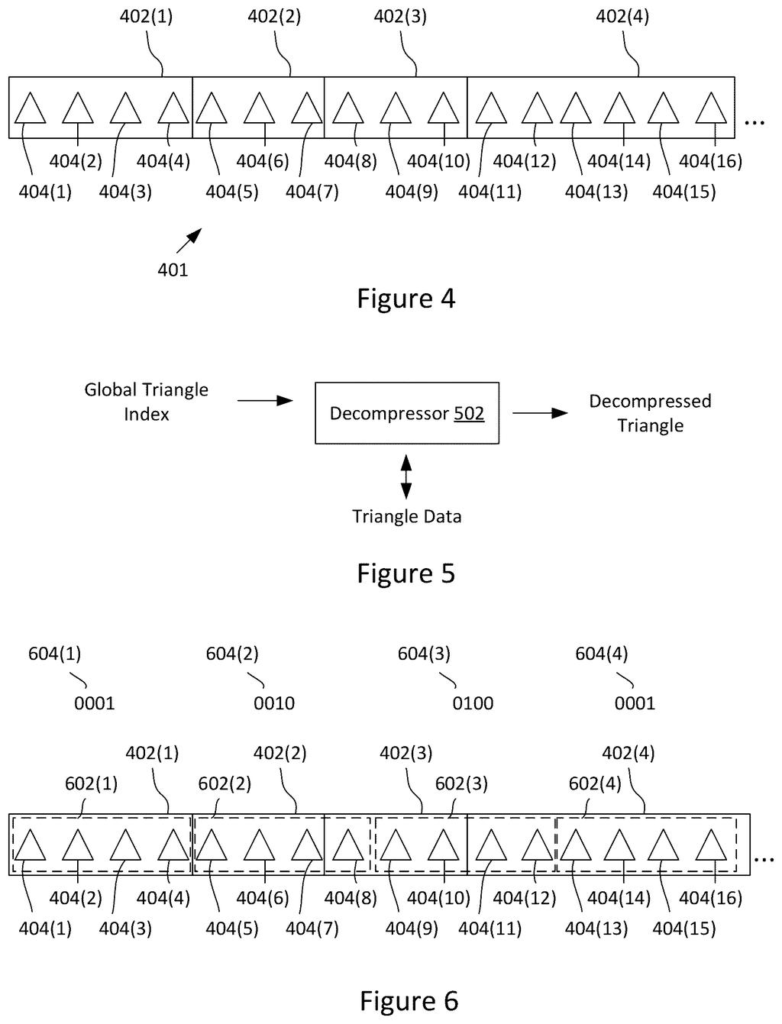
AMD's patent describes a smarter index system. Instead of scanning through variable-size compressed blocks one by one, it divides triangles into fixed-size groups and stores a small cheat sheet for each group. That cheat sheet records where the group starts in memory and which triangles sit at the end of a compression block. With that information, the GPU can calculate exactly where any triangle lives without reading data it doesn't need.
The result is a more direct path from "I need triangle number 4,827" to actually retrieving it, which matters most in real-time rendering where every wasted step shows up as a dropped frame or a longer load.
… retrieving metadata for the triangle based on a group index and a group triangle index for the global triangle index; and accessing a compressed block using a compressed block index and a block local index that are based on the group index, the group triangle index, and the metadata.
Translation: It finds the right compressed data by looking up index information step by step.
How AMD's metadata groups replace brute-force index scanning
The patent addresses a specific problem with compressed triangle mesh formats, where a 3D model is broken into compression blocks that each contain a different number of triangles. Because the blocks vary in size, you can't compute where a given triangle is stored using simple arithmetic. You have to track it.
AMD's solution introduces a two-level lookup structure. Triangles are organized into fixed-size groups (say, every 32 triangles forms a group). For each group, a small metadata record stores two things:
- The byte offset of the first triangle in that group inside its compressed block (so you know where to start reading)
- A bitmask (a row of 0s and 1s) that flags which triangles in the group are the last triangle in their compression block
When the decompressor (the hardware or software that unpacks the data) needs a specific triangle, it uses the group index to grab that metadata, then counts set bits in the mask (a popcount operation, which modern processors do in a single instruction) to figure out which compressed block the triangle is in and where inside that block to read from.
The key insight is trading a tiny, predictable metadata cost for the ability to skip directly to any triangle instead of scanning forward from the beginning of a mesh.
The metadata includes location information for the first triangle of the group and a mask that indicates, for each triangle, whether that triangle is at the end of a compression block.
Translation: Special tracking data marks where each triangle sits inside the compressed storage blocks.
What this means for GPU memory and real-time 3D rendering
For anyone using a GPU to render detailed 3D scenes, whether in a game, a design tool, or a real-time simulation, the speed of geometry unpacking feeds directly into frame rates and load times. A lookup that requires scanning variable-length blocks wastes memory bandwidth; AMD's fixed-group approach turns that scan into a small calculation instead.
The practical payoff is that this kind of technique can allow denser geometry compression without paying a performance penalty for random access. That matters as game assets and professional 3D models keep growing in triangle count. AMD keeps filing around GPU geometry and memory-efficiency suggests this is part of a broader push to improve how graphics hardware handles increasingly detailed scenes.
AMD's 18th filing we've tracked since June in our GPU rendering race follows one fixing mid-scene stalls and one on memory wait times.
This patent describes a bookkeeping method, not a new chip design, which means it could ship inside a software update without waiting for new hardware. AMD already distributes tools that help game studios prepare and compress their art assets, and a lookup improvement like this one would fit naturally into that existing pipeline.
Players would never see a toggle for it in a settings menu. The benefit shows up as smoother frame delivery or slightly faster level loads, which engineers care about deeply even when marketing has no easy way to announce it.
That invisibility does not make it unimportant. Software fixes that reduce wasted work tend to reach a lot of games quickly once they land in a shared tool, and this one appears ready to travel that route.
There are more where this came from
We read every patent application Big Tech publishes and send you the ones worth knowing. Plain English, free, every week.
The drawings
5 drawing sheets from US 2026/0301229 A1 · click any drawing to enlarge


Want this weekly breakdown for a company we don't cover? Patentlyze Pro →
Be the first to weigh in