
AMD Patents a Fix That Stops Its Graphics Hardware from Stalling Mid-Scene
When a GPU's ray tracing unit runs out of room to track rays in flight, it goes idle, wasting time and power. AMD has patented a way to borrow space from an existing memory buffer so the hardware never has to stop working.
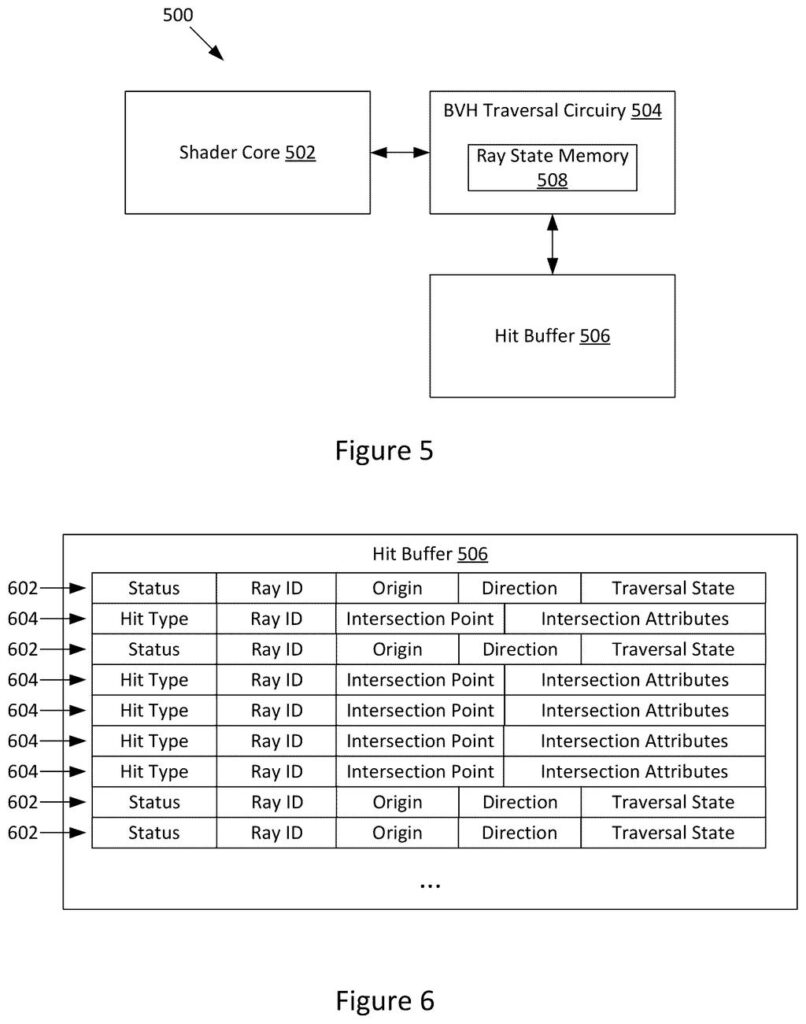
What AMD's ray tracing buffer trick actually does
Imagine your computer is rendering a scene in a game where light bounces realistically off every surface. To do that, the GPU fires thousands of rays and tracks where each one travels. But the dedicated chip that handles this tracking has a small, fixed amount of memory, and when that fills up, the hardware sits around doing nothing, waiting for space to open.
AMD's patent describes a way to use memory that's already there for a different job. A region normally used to record where rays hit objects can temporarily hold the overflow rays instead. When a slot opens in the main tracking memory, the hardware pulls those waiting rays back in and picks up where it left off.
The result is that the ray tracing unit stays busy rather than stalling. You don't add more physical memory; you just use what's already present more flexibly, which is a cheaper and more practical fix than redesigning the chip.
… in response to a ray state memory being full, storing data for the ray into a hit buffer; in response to at least one entry in the ray state memory being free, retrieving the data for the ray from the hit buffer into the ray state memory; …
Translation: When temporary memory fills up, the system overflows excess ray data into a buffer until space opens back up.
How the hit buffer doubles as a ray state overflow tank
Ray tracing works by simulating light as individual rays that bounce around a 3D scene. To speed that up, GPUs use a data structure called a bounding volume hierarchy (BVH), which is essentially a nested set of boxes that lets the hardware quickly figure out what a ray might hit without testing every object in the scene. Dedicated circuits handle this BVH traversal, and they keep a small internal memory called the ray state memory to track each ray's progress.
The problem is that ray state memory is small by design, and under heavy rendering loads it fills up. When it does, the traversal hardware goes idle, which is called being "starved of work."
AMD's patent adds a spillover mechanism. The GPU already has a hit buffer, a region of memory used to record confirmed ray-surface intersections (hits). AMD's approach lets that same buffer serve two roles:
- Its primary job: storing detected hit information for later processing
- Its secondary job: temporarily holding state for rays that couldn't fit in the traversal hardware's internal memory
When the ray state memory is full, incoming rays get parked in the hit buffer instead of being dropped or stalled. When a slot opens up in the internal memory, the hardware fetches a waiting ray from the hit buffer and continues processing it. The hardware stays active throughout, and no extra chip area is required.
Slots in the hit buffer can be used for two different purposes—to store information about detected hits, as well as to store working state for rays outstanding in the dedicated intersection hardware.
Translation: The buffer pulls double duty by holding both final hit results and paused tasks waiting for hardware space.
What this means for GPU rendering under heavy workloads
For anyone who plays games or uses creative software that relies on real-time ray tracing, idle GPU hardware translates directly into lower frame rates and longer render times. This fix targets a specific choke point that becomes more frequent as scenes grow more complex, with more objects, more lights, and more simultaneous rays.
The approach matters because it solves the problem in software and circuit logic rather than by adding more on-chip memory, which is expensive and physically constrained. AMD keeps filing on ray tracing efficiency at the hardware level, and this patent fits that pattern: squeeze more work out of the silicon that's already there, rather than making the chip bigger.
AMD's 17th filing we've tracked since June in the GPU rendering race follows one on keeping GPUs from waiting on memory and one on training AI for sharper game images.
When a graphics chip's ray tracing hardware runs out of room to track the light paths it's calculating, it sits idle, burning power while delivering nothing. In demanding games or visual effects work, that stall isn't rare, it's a predictable consequence of heavier scenes, and idle hardware is wasted money.
AMD's approach matches the scale of the problem well. Rather than carving out new memory on the chip, which costs silicon area and power, the patent repurposes memory already there for a second job it can handle without conflict, acting as overflow storage when the primary workspace fills up.
A narrow, targeted fix for a narrow, targeted failure mode. That's exactly the right ambition here, and the problem it attacks is costing real performance in real products today.
There are more where this came from
We read every patent application Big Tech publishes and send you the ones worth knowing. Plain English, free, every week.
The drawings
7 drawing sheets from US 2026/0301305 A1 · click any drawing to enlarge


Want this weekly breakdown for a company we don't cover? Patentlyze Pro →
Be the first to weigh in