
Apple Patents a Way to Find 'Down' by Reading Lines in a Camera Image
Knowing which way is 'down' sounds trivially obvious to a human, but it's a surprisingly hard problem for a device trying to anchor digital objects in the real world. Apple's latest patent tries to solve it using nothing but the lines already visible in a camera image.
How Apple's camera figures out which way is down
Imagine you're using an AR app to place a virtual piece of furniture in your living room. For the furniture to look like it's actually sitting on the floor, your device needs to know exactly which direction 'down' is. That usually relies on motion sensors inside the device, but those sensors can drift or be imprecise.
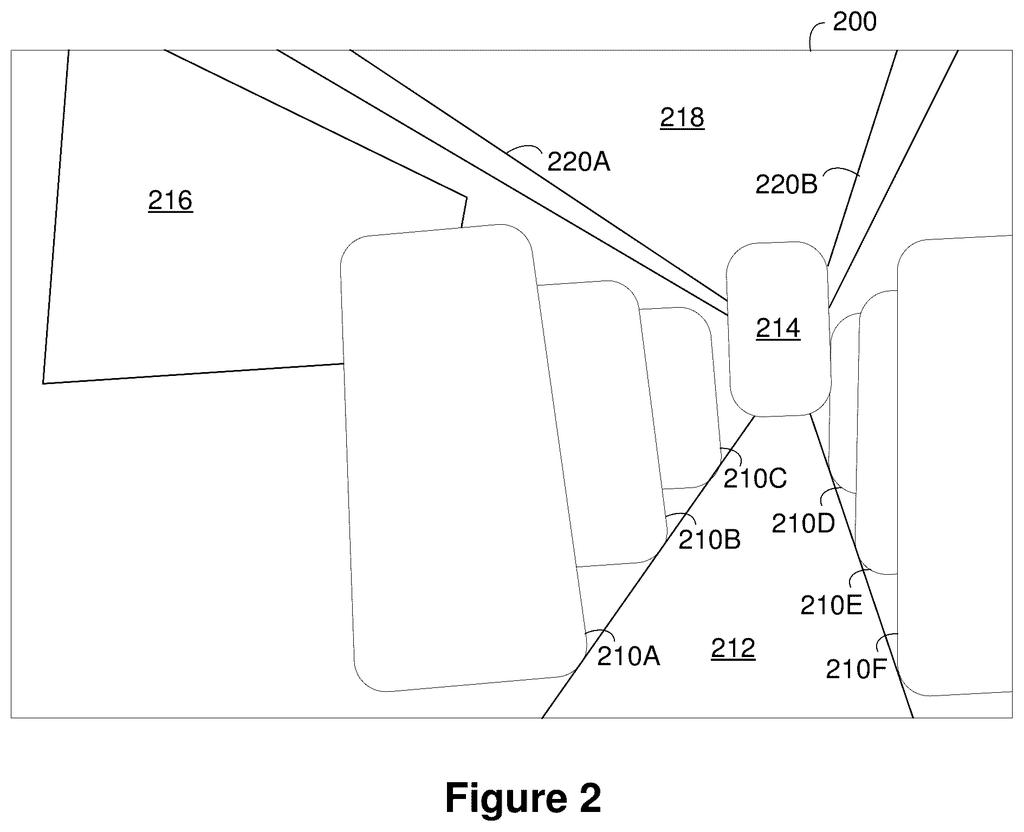
Apple's approach here is different: instead of relying on sensors alone, the device looks at the camera feed and finds the natural lines in the scene, things like the edges of walls, floors, door frames, and windows. Those parallel lines, when extended far enough, appear to converge at a point on the horizon. Apple's system reads those convergence points to mathematically figure out which way gravity is pulling.
This is essentially teaching a device to do what your eye does automatically when you walk into a room and instantly know what's level. By combining two of these convergence directions, the system can pin down a reliable 'downward' vector, even in tricky lighting or when the device is held at an odd angle.
How vanishing points define a gravity direction
The patent describes a pipeline that starts with a single image captured by the device's camera. From that image, the system detects multiple line segments in the scene, straight edges that appear naturally in built environments like walls, floor tiles, window frames, and shelves.
Those lines are then grouped and extended mathematically to find their vanishing points (the spot in the image where parallel lines in the real world appear to meet, like train tracks converging at the horizon). In a typical rectangular room, there are multiple such vanishing points, each corresponding to a different axis of the space.
The system identifies at least two of these vanishing directions and uses their geometric relationship to define a third vector: the downward direction. This is essentially a cross-product calculation in 3D space: if you know two axes, you can derive the third.
The result is a gravity-aligned orientation estimate derived purely from visual data, which can be fused with or used to correct data from the device's accelerometer or gyroscope. The patent notes the method runs on a device with an image sensor and onboard processors, pointing toward on-device computation rather than a cloud lookup.
What this means for AR and spatial computing
For augmented reality, placing a virtual object convincingly in the real world depends entirely on the device having an accurate sense of up and down. A small error in that estimate makes virtual furniture float, walls tilt, or shadows point the wrong way. Visual confirmation of the gravity direction, cross-checked against camera data, makes that placement more reliable.
Apple's Vision Pro and any future AR glasses would benefit directly from this kind of sensor fusion. It's also relevant for the camera system in iPhones, which already use scene understanding for features like portrait mode and object detection. A more reliable gravity estimate, derived from the scene itself improves everything that depends on knowing how a room is oriented.
This is a focused, narrow patent solving a real problem in spatial computing. It won't make headlines on its own, but reliable gravity estimation is foundational infrastructure for AR, and Apple filing specifically on the visual-line approach suggests they want to own this particular piece of the puzzle independently of IMU sensor patents.
There are more where this came from
We read every patent application Big Tech publishes and send you the ones worth knowing. Plain English, free, every week.
The drawings
7 drawing sheets from US 2026/0220812 A1 · click any drawing to enlarge


Want this weekly breakdown for a company we don't cover? Patentlyze Pro →
Be the first to weigh in