
Apple Files Patent for a See-Through Display That Zooms In Where You Look
Apple's filing describes a see-through display that zooms in on whatever you are staring at, then stops zooming the moment your eyes start darting around so you don't get sick.
What Apple's look-to-zoom display actually does
A woman with low vision stands at a crosswalk and cannot read the bus number across the street. Reading glasses won't fix that, and holding up a phone to zoom in means looking away from the road.
Apple's new patent application describes a see-through display with a camera built in. The camera watches the world ahead of you, and a second set of sensors tracks where your eyes are pointed. When you look at that bus sign for a moment, the device can show a zoomed-in copy of it right on top of what you are already seeing.
The filing also covers boosting contrast, sharpening edges, and adjusting the picture to match your particular vision. It even pauses the zoom while your eyes are darting around, since magnified images in motion can make you queasy.
… an optical combiner that presents the second image from the display as an overlay on the real world, wherein the real world is visible through the optical combiner.
Translation: A see through lens blends computer graphics directly into your normal view.
How the display decides when to zoom in
The core of the claims is a device with three parts: a camera that captures the real world, a display that shows a magnified piece of that picture, and an optical combiner (a see-through surface, like a lens or windshield, that merges the display's image with your direct view). Because the real world stays visible through it, the zoomed patch sits on top of your normal view.
Gaze tracking decides what to zoom. Small cameras aim at your eyes while light sources bounce a few beams off them, which lets the device work out where you are looking. If your gaze rests on an object past a set dwell time (the filing lists examples from 0.2 seconds up to 10 seconds), the zoomed view appears.
The description adds several other behaviors:
- Vision profile: your sharpness of sight, contrast sensitivity, field of view, and eyeglass prescription can shape the zoom or contrast boost.
- Motion sickness guard: zoomed content is hidden while your gaze is moving fast.
- Digital bifocals: looking downward can bring up a magnified strip.
- Modes: walking, driving, and meeting modes, plus road signs magnified only above a set speed.
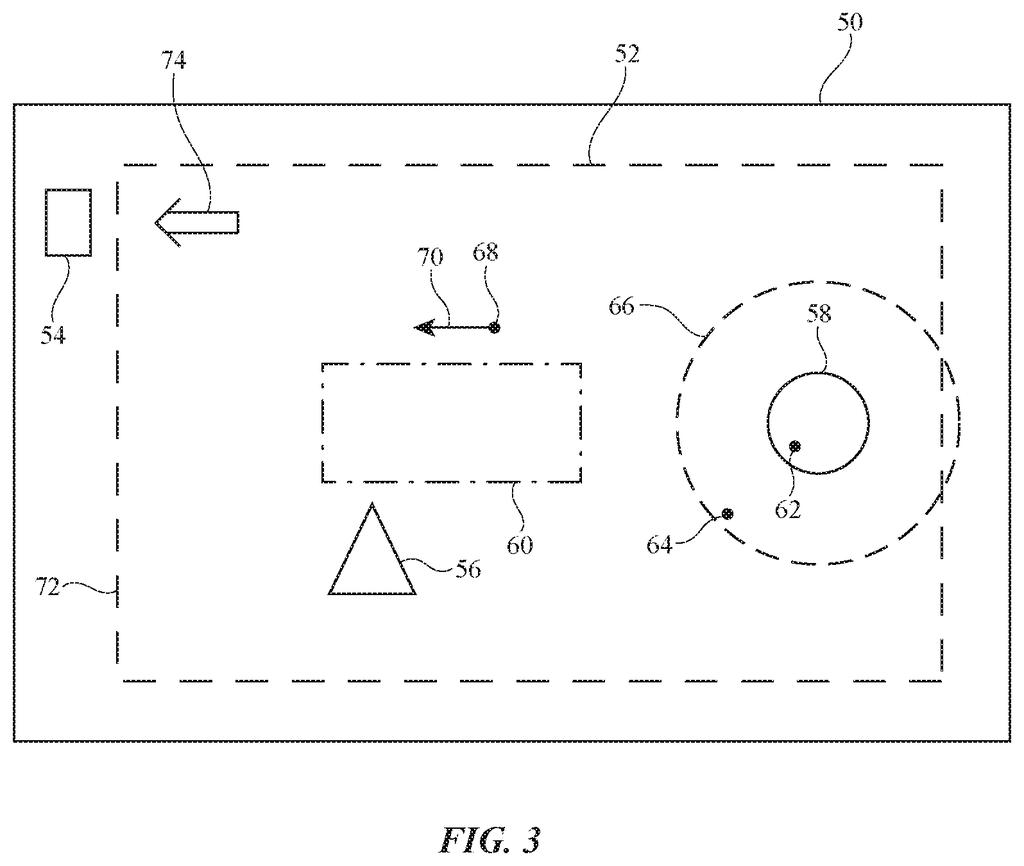
- Out-of-view alerts: an arrow can point toward something important just beyond your field of view.
Control circuitry in the device can gather information on a user's point of gaze using a gaze tracking system and other sensors, can gather information on the real-world image such as information on content, motion, and other image attributes by analyzing the real-world image …
Translation: Internal sensors track where you look and analyze what is happening around you in real time.
Why a zooming display matters for low vision
For people with low vision, a wearable that zooms where they look and adjusts to their own vision could replace handheld magnifiers. It would also leave both hands free. The driving mode and the speed-triggered sign magnification in the filing show the idea reaching beyond reading menus, into walking and driving.
The filing says the device could be a head-mounted display, a phone, a tablet, a car windshield display, or a watch. Headsets appear only in a later claim, so Apple is describing a broad idea for any see-through screen, not one gadget. Whether any of it ships is unknown, since a patent application is not a product.
Apple's 117th filing we've tracked since May in our AR glasses watch builds on earlier work like the smudge-detection sensor filing and the two-pattern lens brightness filing.
Claim 1 is short. It needs a camera, a display showing a magnified piece of the camera's picture, and a see-through surface that lays that piece over the real world. Eye tracking does not appear until claims 2 and 3, so the widest version covers any see-through zoom overlay, with or without watching your eyes.
Claim 18 goes further and drops the camera entirely. It covers showing magnified content on a see-through display once a motion sensor reports a speed above a set limit, which is a wide net for any driving or fast-walking zoom feature.
If granted, the dependent claims would add contrast boosts, edge sharpening, distortion correction, and zoom based on your vision. The goal of helping low vision users see better is sensible, and the claims are broad enough to matter. The description gives diagrams and examples but no test results, so how well it works for real people stays an open question.
Get our take in your Top Stories
Liked this breakdown? Add Patentlyze as a preferred source on Google, and our plain-English take shows up more often in your Top Stories the next time Apple patent news breaks.
There are more where this came from
We read every patent application Big Tech publishes and send you the ones worth knowing. Plain English, free, every week.
The drawings
5 drawing sheets from US 2026/0351148 A1 · click any drawing to enlarge


Want this weekly breakdown for a company we don't cover? Patentlyze Pro →
Be the first to weigh in