
Apple Patents a Way to Pay With a Friend's Card While Keeping Your Own Loyalty Perks
Apple is working on a way for one iPhone to borrow the payment card stored on a second iPhone, so the person paying can use their friend's card while still collecting their own store rewards. It's a surprisingly elegant answer to a very common social headache.
How Apple's shared-payment credential idea would work for you
Ever split a bill and wished you could use your friend's card to get their discount while still earning your own loyalty points? That's the exact situation this Apple patent is designed to fix.
Here's how it would work: say your partner has a credit card with great cashback, and you have the merchant account with the discount code. Today, you'd have to hand over a physical card, log into each other's apps, or just give up and pay separately. Under Apple's system, their iPhone would send a one-time payment permission to your iPhone. You'd pick their card from your checkout screen, they'd approve it on their end, and the payment would go through, with each person's benefits attached to their own account.
The second person's actual card details never fully transfer to your device. Instead, your phone receives a narrow, single-use authorization token, so the card stays secure on its home device the whole time. Think of it as your friend handing you a signed check for one specific purchase, rather than giving you their whole wallet.
… transmitting, by the first user device to the second user device, a request to authorize use of the payment credential to perform the transaction between the first user device and the merchant system, the request including the order information; …
Translation: Your phone asks your friend's phone to approve the purchase using their card details.
How the authorization token travels between two devices
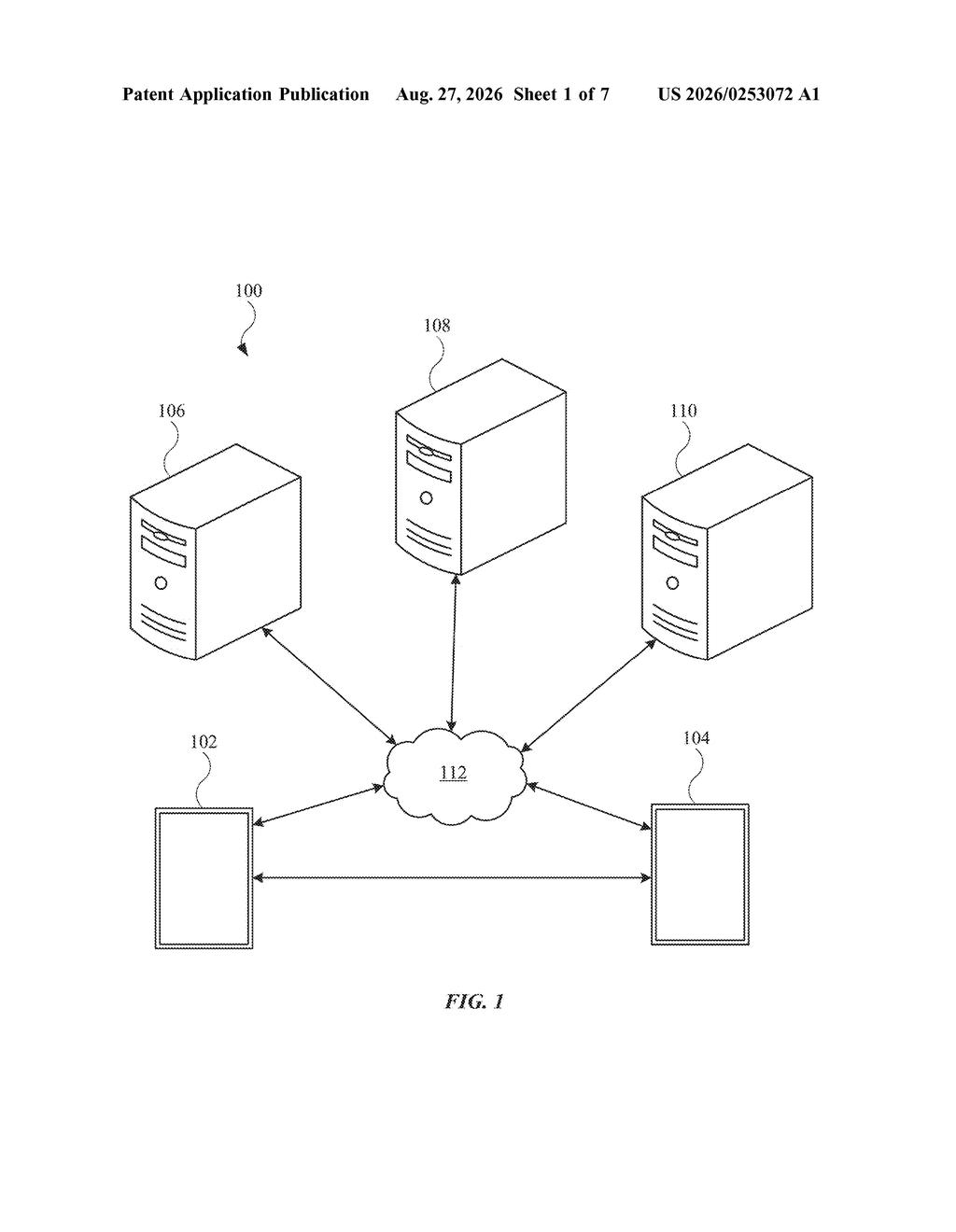
The patent describes a two-device handshake built into the payment flow. When you're checking out with a merchant, your device can display payment credentials from a second device alongside your own, as long as that second device has shared availability.
When you select the other person's card, your device sends the full order details to their device as a request. The second device then generates a transaction authorization token (a limited cryptographic proof derived from the stored card, not the card number itself) and sends it back to your device. Your device then passes that token to the payment server to complete the purchase.
- Merchant account benefits (discounts, promotions linked to your account) flow through your device because you're the one transacting with the merchant system.
- Card benefits (rewards points, cashback) flow to the second user because the authorization derives from their credential.
- The second user retains control: they can approve or deny each request in real time before any token is issued.
The patent situates this as a feature built on top of existing secure payment infrastructure (like Apple Pay's tokenization model) rather than a standalone system, which means the second device's card is never physically transferred or stored on the first device.
A user of the first electronic device may have a merchant account with the merchant system. A user of the second electronic device may utilize benefits (e.g., discounts, promotions) the user of the first electronic device is entitled to through the merchant account, while also gaining benefits (e.g., rewards points) of using the credential via the transaction authorization.
Translation: You can use your loyalty perks while your friend pays, letting them earn rewards points on the transaction.
What this means for shared accounts and loyalty programs
Loyalty programs and family finances are messier than payment apps currently admit. Couples, roommates, and parents with adult children constantly navigate situations where one person has the better card and another has the merchant account. Today's workarounds, sharing Apple Pay via Family Sharing or just handing over a physical card, are blunt instruments that don't preserve both parties' benefits simultaneously. A system that lets two people cooperate on a single transaction without compromising either account is genuinely useful.
The real signal here is that Apple is thinking about payments as a social layer, not just a wallet. If this ships, it would put pressure on banks and payment networks to support split-benefit transactions at the infrastructure level, not just the app level. Apple's payment filings are among this week's Big Tech patents worth watching for signals about where mobile commerce is heading.
That makes this Apple's 342nd filing in our Apple coverage since May, adding to work like room occupancy sensing and mid-chat photo sharing.
The problem this patent addresses is real and daily. Anyone who has ever stood at a register trying to figure out whose phone to tap knows the friction. The patent's answer, a real-time approval token that preserves each person's account benefits, matches the size of the problem without overengineering it.
What makes this filing interesting is the bilateral design: the second person actively approves each transaction. That's a privacy and security feature disguised as a UX detail. A system where you can delegate card use without losing visibility or control is a different thing from simply sharing card numbers, and that distinction matters for adoption.
The remaining question is whether merchants and payment networks will support split-benefit accounting at the transaction level, since that's outside Apple's direct control. The device-to-device mechanics described here are technically straightforward; the commercial agreements needed to make both users' rewards actually post correctly are the harder part.
Get our take in your Top Stories
Liked this breakdown? Add Patentlyze as a preferred source on Google, and our plain-English take shows up more often in your Top Stories the next time Apple patent news breaks.
There are more where this came from
We read every patent application Big Tech publishes and send you the ones worth knowing. Plain English, free, every week.
The drawings
7 drawing sheets from US 2026/0253072 A1 · click any drawing to enlarge


Want this weekly breakdown for a company we don't cover? Patentlyze Pro →
Be the first to weigh in