
Apple
Apple · Networking · Filed Jul 24, 2026 · USPTO published Nov 19, 2026 · This week's release
Apple Files Patent for a Crash Alert That Offers Satellite Help When Cell Service Fails
After a crash far from any cell tower, a normal emergency call has nowhere to go. Apple's patent application has your phone notice that and put a satellite message option on the crash screen, and only then.
- Publication number
- US 2026/0370754 A1(US20260370754A1)
- Applicant
- Apple Inc.
- Filed · Published
- Jul 24, 2026 · Nov 19, 2026
- Inventors
- Christopher D. LAURITZEN, Pablo F. CARO
- Status when we published
- Waiting for an examiner
- Document
- 10 claims
- US classification
- 455/414.1
- Parent application
- Continuation of 18/241,747 (filed Sep 1, 2023)(18241747)
What Apple's crash alert does without cell service
A car sits crumpled on a mountain road, miles from the nearest cell tower. The driver's phone has just felt the impact and knows something is wrong, but a normal emergency call has nowhere to go.
This Apple patent application describes how a phone or watch could handle that moment. After it detects a crash, it checks whether regular cell service is reachable. If it is, you get the usual crash screen and nothing extra. If it isn't, the screen adds an option to send a message over a satellite connection instead.
If you can't touch the screen, the device can wait a set amount of time and then send the crash details to a designated recipient over satellite on its own. Afterward you can read what it sent. The idea is a way to ask for help in places where the usual way fails.
in accordance with a determination that a terrestrial wireless communication network is not reachable by the computer system, displaying, via the display generation component, a non-terrestrial wireless communication option …
Translation: If regular cell service is unavailable after a crash, the device displays a satellite connection option.
How the phone decides when to show satellite help
The core claim is a simple decision rule. When the phone or watch gets data that a crash has happened (the filing says this can come from motion or sound), it checks whether a terrestrial network is reachable. That is the ordinary cellular network run from towers on the ground. If it isn't, the screen shows an option to start a message over a non-terrestrial network, and the filing's example of that is a satellite connection. If cell service is reachable, the option is left off.
Other claims add the follow-through:
- The device can first try a call to a designated recipient, before the satellite option appears.
- The screen can say plainly that cell service can't be reached.
- If you tap nothing for a set time and a satellite link is available, the device sends a message with crash information on its own, and a view-message option lets you read what went out.
- If you tap nothing and no satellite link is available, it offers a button to try a call instead.
- If you do tap the satellite option, you can pick from a list of message-content options, and the message carries those choices.
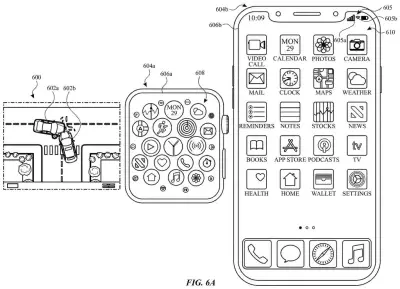
The description fills in the setting: a watch and phone that both show a crash screen, a countdown before an automatic emergency call, and a note that satellite use drains more battery than cellular, so the interface tries to keep taps to a minimum.
The present disclosure generally relates to techniques and user interfaces for initiating communication in the event of a crash.
Translation: This patent covers software and screen designs for sending emergency alerts after an accident.
Why a satellite button matters after a crash
If you're ever in a wreck outside cell coverage, the first problem is working out what to do next while stressed. The filing says as much: people in a crash may be rattled and prone to mistakes, so clear options and fewer taps can save time reaching help. Showing the satellite choice only when cell service is out keeps the screen simple the rest of the time.
It also touches battery life. The description notes that satellite messaging uses more energy than cellular, and that recharging after a crash may not be possible. That is why the phone would offer it only when it's needed. The patent builds on crash-detection screens the filing describes for both a watch and a phone.
This is the 685th Apple filing in our Apple coverage since May, adding to a phone-call thread that includes a hold-music detector and a silent reply tool.
Source: US 2026/0370754 A1 at the USPTO (PDF). Full patent text and figures are in the official publication.
Get our take in your Top Stories
Liked this breakdown? Add Patentlyze as a preferred source on Google, and our plain-English take shows up more often in your Top Stories the next time Apple patent news breaks.
Add Patentlyze on Google
One click.
There are more where this came from
We read every patent application Big Tech publishes and send you the ones worth knowing. Plain English, free, every week.
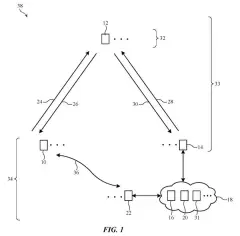
The drawings · 31 sheets
31 drawing sheets from US 2026/0370754 A1 · click any drawing to enlarge


Show the other 23 sheets


More from Apple
All 748 Apple patents →
More in Networking
All 516 Networking patents →
Qualcomm
Qualcomm Patents Technology That Tells Your Phone Which Service Will Fix Its Location Errors
Samsung
Samsung Files Patent for Phones That Learn When a Satellite Can Actually Hear Them
Qualcomm
Qualcomm Patents a Way for Phones to Switch Between Cell Towers and Satellites Automatically
Qualcomm
No comments yet