
Apple Files Patent for Borrowing Your Phone's Camera on a Shared TV
A TV's built-in webcam is usually the worst camera in the room, and your phone's is usually the best. Apple's patent application describes how the two could team up, and how the connection stays alive without draining batteries.
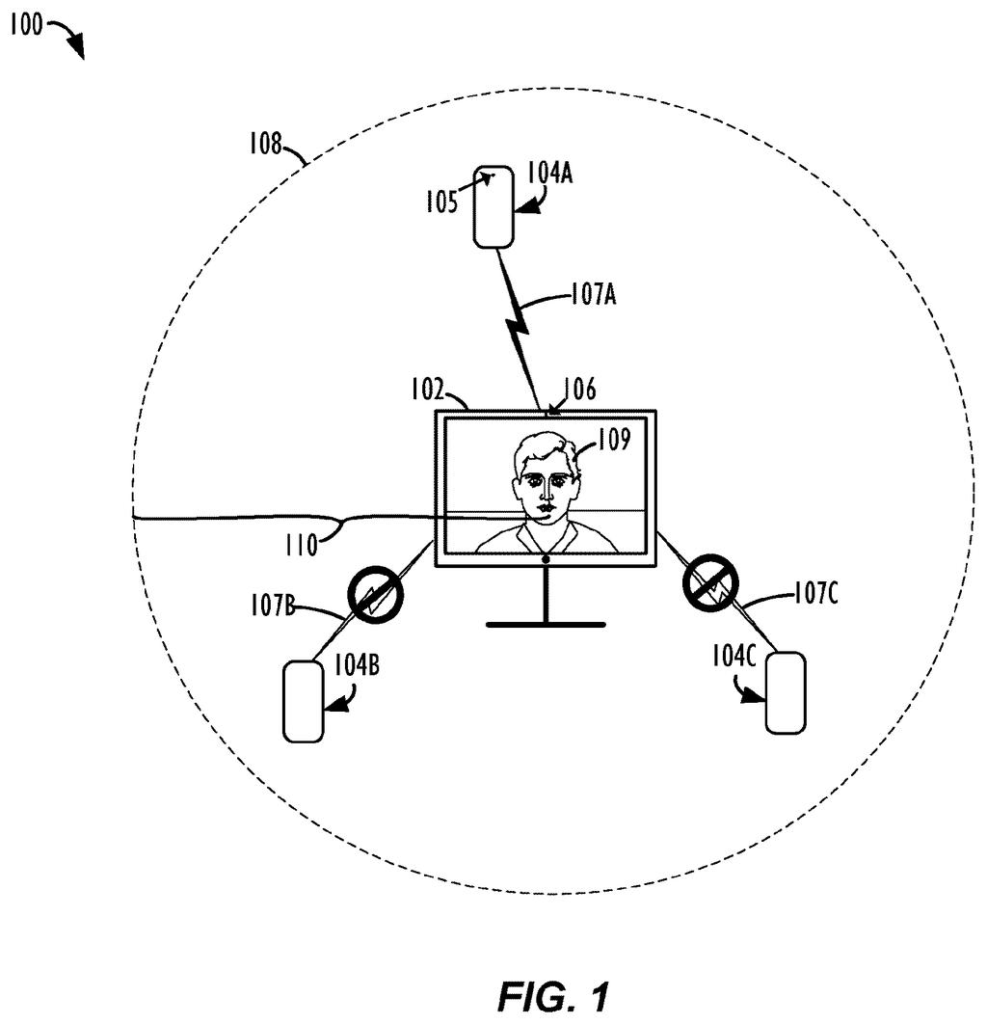
What Apple's phone-as-TV-camera patent does
Ever joined a video call on your living room TV and realized the little webcam on top makes you look like a grainy ghost? Or that the TV has no camera at all?
Apple's patent application describes a fix: let a nearby phone act as the TV's camera. The TV (which the filing calls a communal device, meaning it isn't tied to one person's account) notices your phone is close, and you approve the link with a QR code or a PIN. Then your phone's higher-quality camera feeds video to the TV.
The clever part is keeping that link from falling apart. Both devices keep sending tiny "still connected" signals over Bluetooth Low Energy, the low-power cousin of regular Bluetooth. If those signals stop, the session ends. If you only pause the video, say to check a text, the connection stays up so you can resume quickly.
Techniques for the establishment and maintenance of secure audio/video data streaming connections between electronic devices, e.g., a personal electronic device and a communal electronic device, which devices are not necessarily associated with the same user account.
Translation: How phones and shared TVs can securely connect even if they belong to different people.
How the two devices keep checking on each other
The patent covers a method where a first device, such as a smart TV, enters an "advertising" state. That means it broadcasts a short Bluetooth Low Energy (BLE) signal that tells nearby devices it's there. When it detects a second device, such as a phone, it starts a session over a secure peer-to-peer wireless link (the filing gives Wi-Fi as an example). The two devices don't need to share a user account, and approval can come through a QR code or PIN.
Once the session starts, the TV runs a background program (the filing calls it a daemon) that periodically broadcasts a session state indicator. This is a tiny 1-bit or 2-bit flag that says whether the session is active. The phone sends its own flag back. Both ride inside a standard BLE advertising packet, with an authentication tag that identifies the device.
The session stays open until a disconnection rule is met:
- One device stops hearing an "active" flag from the other for too long.
- A device stops broadcasting its own "active" flag for too long.
- Either device, or its user, ends the session on purpose.
Pausing or interrupting the video does not end the session. The filing also says the flags can keep broadcasting while a screen is off, that the devices must stay within a set distance, and that a phone could extend an ongoing video call to the TV while still running that call itself.
… initiating a first session between the first electronic device and the second electronic device via a secure wireless peer-to-peer connection protocol; establishing, at the first electronic device, a software process that periodically broadcasts a first session state indicator …
Translation: Opening a direct wireless link and constantly checking in to make sure the connection is still alive.
Why this matters for video calls on a shared TV
If you have ever squinted at a laggy, low-quality webcam on a TV or monitor, the appeal is obvious: you already carry a better camera in your pocket. The patent describes the behind-the-scenes plumbing that would let a phone lend its camera to a shared screen quickly, without the TV being tied to your account.
The filing puts a lot of weight on staying power. The flags ride on Bluetooth Low Energy advertising that is already running, so the filing says there is no extra power cost. The design also recovers cleanly when a device crashes, reboots or leaves range, and the connection survives you pausing to answer a call or text. For you, that would mean fewer dropped sessions and less re-pairing.
Apple's 31st filing we've tracked since May in our device-to-device handoff watchlist builds on routing audio to nearby speakers and waking devices via an old phone.
You would notice this feature the first time a video call on a shared TV just works: no cables, no account swapping, no restart after you check a text mid-call. The best version of it is the one you forget is there.
The plumbing in the filing targets the annoying failures: a call that dies because your phone went to sleep, or a TV that keeps thinking it's connected after you walk out of range. Because both sides keep sending tiny check-ins, each one can tell when the other is gone and clean up after itself.
The real benefit depends on how Apple would build it. A QR code or PIN adds a step, but it also keeps a stranger's phone from grabbing the TV's camera feed. For living rooms and shared spaces, that trade looks fair. A patent application gives no promise that any of this ships.
Get our take in your Top Stories
Liked this breakdown? Add Patentlyze as a preferred source on Google, and our plain-English take shows up more often in your Top Stories the next time Apple patent news breaks.
There are more where this came from
We read every patent application Big Tech publishes and send you the ones worth knowing. Plain English, free, every week.
The drawings
8 drawing sheets from US 2026/0352718 A1 · click any drawing to enlarge


Want this weekly breakdown for a company we don't cover? Patentlyze Pro →
Be the first to weigh in